
Teatro Romano de Merida and the layered stone stage of Augusta Emerita
Published on 09/19/2026 at 08:28 | Editorial responsibility: Rafael Müller, Editor-in-Chief AD HOC NEWS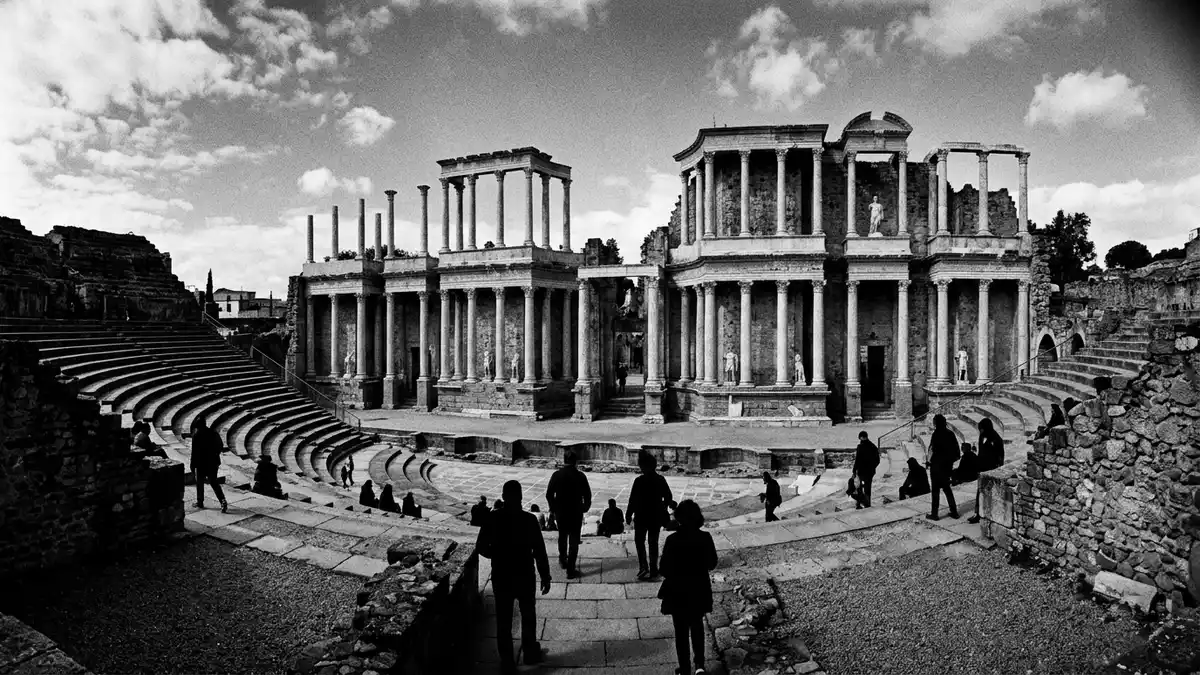
Teatro Romano de Merida in Merida in western Spain is a Roman theatre whose stone seating, orchestra and stage front still outline the performance space of the ancient colony of Augusta Emerita. Built in the late first century BC under the patronage of Marcus Vipsanius Agrippa, it forms part of the wider Archaeological Ensemble of Merida that preserves the former capital of the Roman province of Lusitania.
A Roman theatre built for Augusta Emerita
Teatro Romano de Merida stands within the former Roman colony of Augusta Emerita, founded in 25 BC under Emperor Augustus as the capital of Lusitania and a settlement for discharged soldiers.capital of Lusitania The theatre’s construction is attributed to the consul Marcus Vipsanius Agrippa, a close associate of Augustus known for large public building projects across the empire.Marcus Vipsanius Agrippa Inscriptions from the site date its inauguration to around 16–15 BCE, placing it among the early monumental structures of the new colony.around 16–15 BCE
The theatre was laid out with the usual Roman elements: a semi-circular cavea of stone seating rising from the orchestra, a raised stage and a tall architectural backdrop that framed performances. The complex was planned alongside the neighbouring amphitheatre, creating a twin entertainment precinct that anchored civic and cultural life in Augusta Emerita.twin entertainment precinct Over the first century AD the stage area was heightened and remodelled, giving the theatre the strong vertical emphasis visitors recognise in its present form.stage raised in the first century AD
Stone tiers, orchestra and stage front
Seen from the top of its cavea, Teatro Romano de Merida reads as a composition of stone curves and verticals. The seating forms a broad semi-circle of terraces divided into zones and stairways, arranged around the orchestra, the low paved area that separated audience from performers.semi-circular cavea and orchestra At full Roman capacity the theatre could accommodate thousands of spectators for dramatic performances that mixed spoken word with movement and music.accommodate thousands of spectators
The most striking feature is the reconstructed scaenae frons, the stage front composed of columns, entablatures and statuary niches in tiers of stone. This architectural wall rises behind the stage, turning the performance area into a framed room open to the sky and to the seating.stage front of columns and niches Marble and other stones distinguish columns and decorative elements from the body of the structure, and surviving statuary fragments hint at the sculptural programme that once accompanied plays and civic ceremonies.marble elements and statuary
Rediscovery, UNESCO status and living theatre
In late antiquity, as Christianity became the official religion of the empire, theatrical performances fell from favour and the theatre was progressively abandoned.abandoned in the 4th century CE Over centuries much of the structure collapsed or lay buried, leaving only the upper parts of the seating visible above ground. Systematic excavations began in the early twentieth century under archaeologist José Ramón Mélida, bringing the cavea, orchestra and stage front back into view and re-establishing the theatre as a central monument of Merida.excavations under José Ramón Mélida
Teatro Romano de Merida forms part of the Archaeological Ensemble of Merida, inscribed as a UNESCO World Heritage Site since 1993 for the breadth and preservation of its Roman remains.World Heritage Site since 1993 The theatre is closely associated with neighbouring monuments such as the Roman amphitheatre and the longer-distance circus, all linked within the city by streets and plazas that follow ancient lines.Roman amphitheatre in the same precinct The stone stage continues to host classical performances, particularly during the Festival Internacional de Teatro Clásico de Merida, reconnecting contemporary productions with the architecture that framed drama in the Augustan age.Festival Internacional de Teatro Clásico
Visiting Teatro Romano de Merida: what travellers from Western Europe should know
- Teatro Romano de Merida stands within the combined Roman theatre and amphitheatre precinct around Plaza Margarita Xirgu on the western side of Merida in Extremadura, Spain, and is reached on foot from the city’s streets.
- The stone seating of the cavea rises in terraces above the orchestra, and access within the theatre involves climbing and descending stairways and walking across uneven historic surfaces.
- Nearby Roman sites include the amphitheatre within the same enclosure, the circus further out along Avenida Juan Carlos I and the Roman bridge over the Guadiana, giving Merida a compact concentration of structures from Augusta Emerita.
- The official language is Spanish and the currency is the euro.
Searching for Teatro Romano de Merida on social platforms
These links open searches for Teatro Romano de Merida on each platform.Frequently asked questions about Teatro Romano de Merida
Where is Teatro Romano de Merida?
Teatro Romano de Merida is in the city of Merida in Extremadura in western Spain, within the Roman theatre and amphitheatre precinct around Plaza Margarita Xirgu.
What can visitors expect on a visit to the theatre?
Visitors encounter the stone tiers of the cavea, the orchestra and the reconstructed stage front with its columns and niches, all set within a broader Roman archaeological ensemble.
What makes Teatro Romano de Merida distinctive among Roman theatres?
Its combination of an early Augustan date, attribution to Marcus Vipsanius Agrippa, strong architectural stage backdrop and integration into a UNESCO-listed archaeological ensemble makes it a distinctive Roman theatre in the Iberian Peninsula.


