
Templo de A-Ma and the hilltop shrine by the sea
Published on 08/15/2026 at 14:16 | Editorial responsibility: Rafael Müller, Editor-in-Chief AD HOC NEWS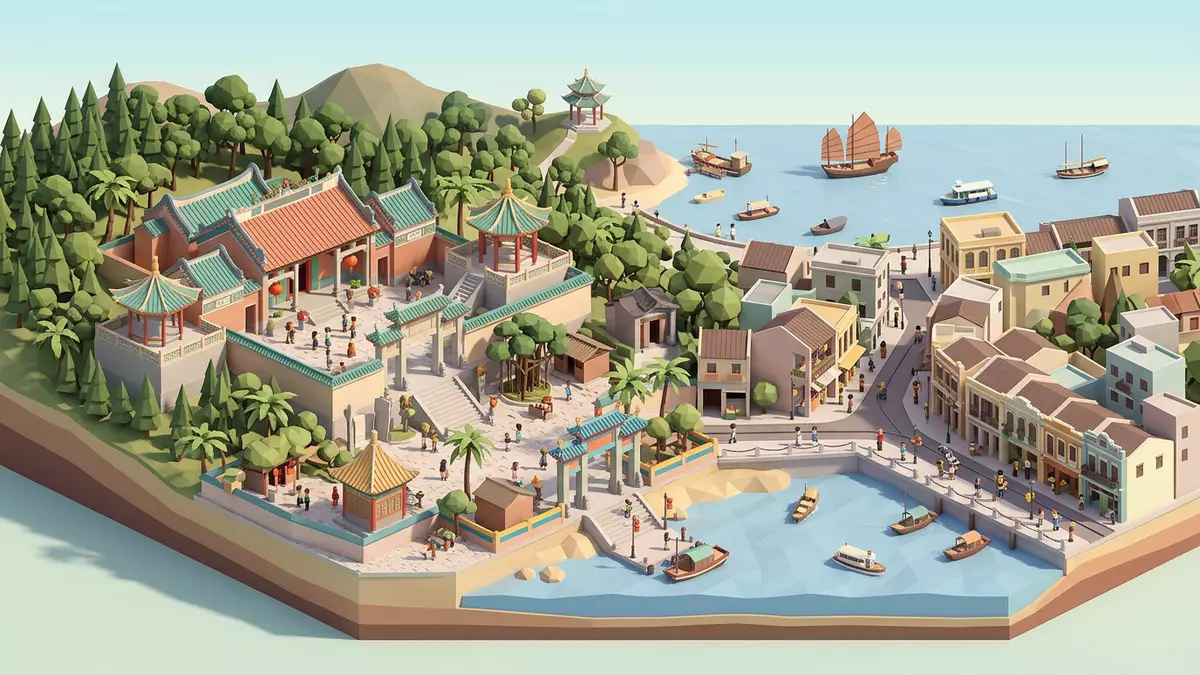
Templo de A-Ma stands on the southwestern tip of the Macau Peninsula, where granite pavilions climb Barra Hill above the sea. It belongs to the Historic Centre of Macao, inscribed on the UNESCO World Heritage List in 2005Historic Centre of Macao.
Granite pavilions on Barra Hill
The temple complex is a sequence of halls and pavilions rather than a single shrine. The Gate Pavilion, Memorial Arch, Prayer Hall, Hall of Benevolence, Hall of Guanyin and Zhengjiao Chanlin rise one after another up the slopepavilions and halls.
That layered arrangement gives the place its clearest visual character. Granite, brick, green glazed tiles and carved roof ridges sit together across different parts of the complex, while the hillside itself remains visible between themgranite and brick.
From Ming foundations to Qing restoration
The temple is associated with the Ming dynasty and with the year 1488, the date attached to the earliest structure, the Hall of Benevolence. The Prayer Hall was built in 1605 and rebuilt in 1629, and the complex reached its present scale in 1828Hall of Benevolence.
That sequence matters because it explains why the complex reads as a layered historical site. The later pavilions do not replace the earlier core; they accumulate around it, and the result is a compact record of religious architecture in Macau across several centuriesmid-Ming dynasty.
Mazu worship and the Macao name
Templo de A-Ma is dedicated to Mazu, also called A-Ma, the Chinese goddess of seafarers. The temple is tied to the old maritime world of Macao, and the city name is linked to A-Ma in local traditionMazu.
The setting reinforces that connection. The temple sits against Barra Hill and faces the water, with stone flagpoles in front and a sequence of carved and roofed structures stepping up the slopeBarra Hill.
Visiting Templo de A-Ma: what travellers from Western Europe should know
- The temple is in Macau, on the southern side of the peninsula, close to Barra Hill and the inner harbour.
- The route includes slope and steps through a compact hill complex, with the buildings set at different levels.
- The official language is Chinese and the currency is the Macanese pataca.
- Entry requirements depend on your nationality; UK travellers can check the FCDO travel advice at gov.uk/foreign-travel-advice, Irish travellers the Department of Foreign Affairs at ireland.ie.
Searching for Templo de A-Ma on social platforms
These links open searches for Templo de A-Ma on each platform.
Frequently asked questions about Templo de A-Ma
Where is Templo de A-Ma?
It stands on the southwestern tip of the Macau Peninsula, on Barra Hill. The temple forms part of the UNESCO-listed Historic Centre of Macao.
What should a visit feel like?
Expect a hillside complex of linked halls, stairways and courtyards rather than one enclosed building. Granite, brick and glazed tile create the strongest visual pattern.
What makes it distinctive?
The temple combines an early Ming-era foundation with later additions, and its name is tied to the story of Macau itself. Its setting on the slope above the sea gives the complex its clearest identity.


