
The Met in New York City: an encyclopaedic museum of art
Published on 09/17/2026 at 21:03 | Editorial responsibility: Rafael Müller, Editor-in-Chief AD HOC NEWS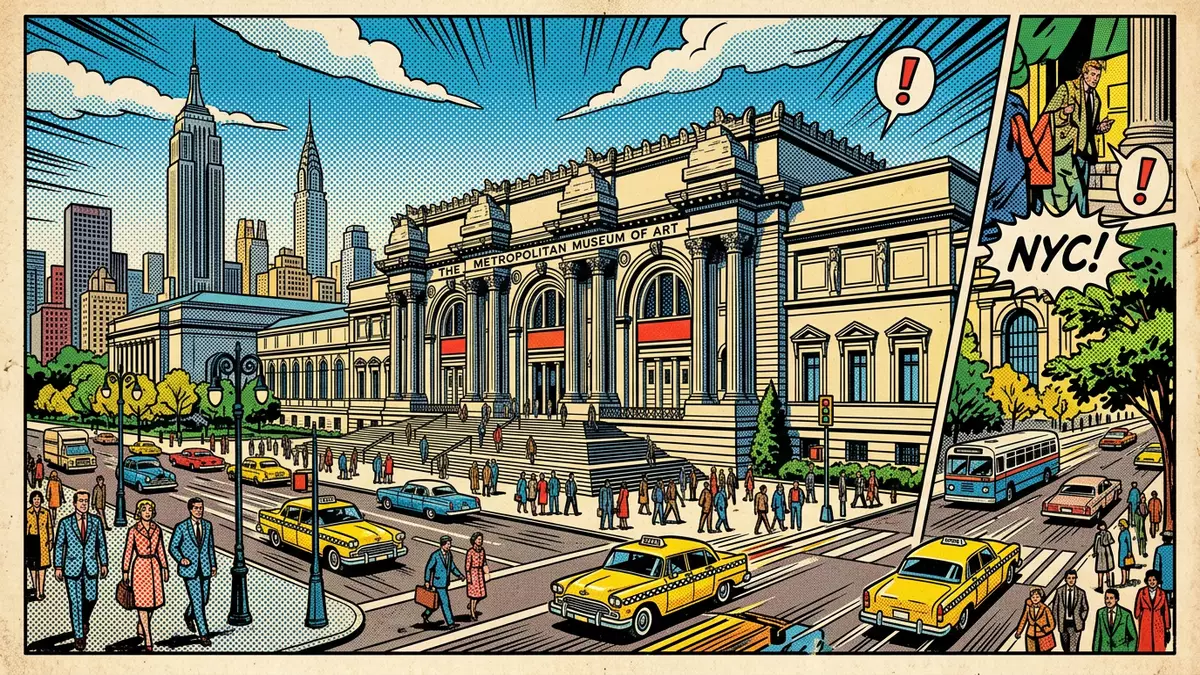
The Met in New York City is an encyclopaedic art museum on Fifth Avenue, presenting thousands of years of human creativity in a single vast building on the edge of Central Park. Founded in 1870 and opened to the public in 1872, it has grown into one of the largest art museums in the world, both in floor area and in the scope of its collection.
A palace of art along Fifth Avenue
The Met’s main site, known as The Met Fifth Avenue, stands at 1000 Fifth Avenue on Manhattan’s Upper East Side, facing the eastern edge of Central Park. The museum complex at this location opened in 1880 and has been expanded repeatedly, forming a building that stretches for nearly a quarter of a mile along the avenue and covers more than 2 million square feet (about 186,000 m²) of floor space.the complex of buildings at its present location in Central Park opened in 1880 Behind the formal façade, visitors move through a sequence of grand halls, broad staircases and galleries arranged over multiple levels.
The main entrance leads into the Great Hall, a monumental interior that sets the tone for the visit with stone columns, sweeping stairways and views towards galleries on several sides. From this central space, routes extend into wings devoted to different regions and periods, with galleries grouped into curatorial departments that together cover painting, sculpture, decorative arts, textiles, arms and armour and many other forms. The building’s size means that only a fraction of its holdings is on display at any time, and new routes through the museum can be traced on each visit.
From nineteenth-century idea to global collection
The Met was incorporated on 13 April 1870, following an initiative by American businessmen, financiers, artists and thinkers who wanted to establish a national institution and gallery of art in the United States.the museum was founded in 1870 by a group of American citizens It opened in 1872, initially in more modest quarters, before moving to its present site adjoining Central Park, where a purpose-built museum complex began to rise.a brief history of the museum summarises its founding in 1870 and opening in 1872
Over time the museum assembled a permanent collection that now contains well over a million objects, organised into 17 curatorial departments and stretching across more than 5,000 years of history.the museum’s collection contains more than 1.5 million objects spanning over 5,000 years The holdings grew through purchases, donations and bequests, forming a global survey that ranges from ancient Mesopotamian artefacts to contemporary art. The museum’s scale and breadth have made it a reference point for art history, museum practice and public access to culture in the United States.
Collections that span civilisations
Walking through The Met means crossing boundaries of time and geography in a few strides. One wing holds extensive collections of Egyptian art, with monumental sculptures and decorated sarcophagi, while another presents Greek and Roman works ranging from marble statuary to mosaics and finely worked metal objects.the museum holds numerous Egyptian, Greek and Roman works Elsewhere, galleries are devoted to European painting and sculpture, Islamic art, Asian art, African art and the arts of Oceania and the Americas.
The Met’s curatorial departments structure this variety into areas such as European Paintings, Asian Art, The American Wing, Arms and Armor, and Costume Institute, each with its own galleries and study collections.the collection is divided into 17 curatorial departments Works range from large-scale sculptures and architectural fragments to small domestic objects and textiles. This breadth lets visitors trace connections between cultures and periods, seeing, for example, how artistic techniques and motifs circulate between regions and reappear in new forms centuries later.
Visiting The Met: what travellers from Western Europe should know
- The Met Fifth Avenue stands at 1000 Fifth Avenue on the Upper East Side of Manhattan, on the eastern edge of Central Park, and is reached by New York City’s public transport system.
- Inside the museum, visitors encounter wide halls combined with staircases and corridors, and a visit can involve extensive walking between galleries spread over several floors.
- The Met also has a second site, The Met Cloisters, in Fort Tryon Park in northern Manhattan, specialising in medieval European art in buildings that incorporate elements of monastic architecture.
- The official language is English and the currency is the US dollar.
- Entry requirements depend on your nationality; UK travellers can check the FCDO travel advice at gov.uk/foreign-travel-advice, Irish travellers the Department of Foreign Affairs at ireland.ie.
Searching for The Met on social platforms
These links open searches for The Met on each platform.
Frequently asked questions about The Met
Where is The Met located in New York City?
The Met’s main building, The Met Fifth Avenue, is at 1000 Fifth Avenue on Manhattan’s Upper East Side, facing Central Park, with The Met Cloisters in Fort Tryon Park.
What can visitors expect on a visit to The Met?
Visitors move through large halls and galleries arranged by region and period, encountering art and artefacts from many civilisations across more than 5,000 years of history.
What makes The Met distinctive among art museums?
The Met combines vast floor area with a global collection, organised into numerous curatorial departments, making it an encyclopaedic museum that links artistic traditions across continents and centuries.


