
Tiantan and the architecture of heaven in Peking
Published on 09/24/2026 at 00:59 | Editorial responsibility: Rafael Müller, Editor-in-Chief AD HOC NEWS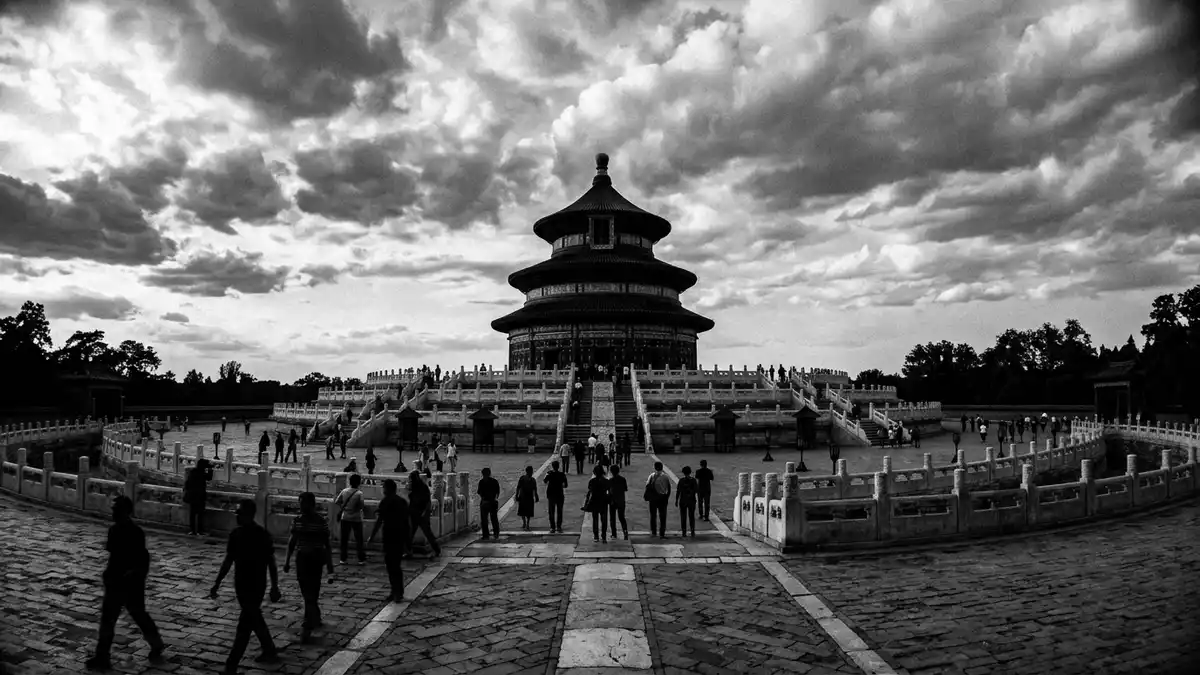
Tiantan, the Temple of Heaven in Peking, is arranged as a long ceremonial landscape of blue roofs, white stone terraces, pine trees and open courtyards. The complex was completed in 1420 under the Ming emperor Yongle, and its buildings remain linked by a clear north–south axis.
Tiantan’s blue roofs and white terraces
The Hall of Prayer for Good Harvests is the best-known building in Tiantan. Its circular wooden body rises above a three-tiered marble terrace, with triple blue-glazed roofs and a gilded finial. The hall measures 38.2 metres in height and 24.2 metres in diameter. Hall of Prayer dimensions appear among the complex’s architectural details.
The colours and materials form a precise visual vocabulary. Blue glazed tiles cover the principal roofs, while pale marble terraces and balustrades create the base. The northern part of the grounds is semicircular, and the southern part is square, reflecting the traditional Chinese association of Heaven with roundness and Earth with squareness.
From Ming imperial rites to a protected cultural landscape
Tiantan was used by emperors of the Ming and Qing dynasties for rites addressed to Heaven and prayers for harvests. The original Altar of Heaven and Earth was completed with the Forbidden City in 1420, during Yongle’s reign. In 1530, separate sacrifices for Heaven and Earth produced the Circular Mound Altar south of the principal hall.
The name Temple of Heaven dates from 1534, during the reign of the Ming emperor Jiajing. Qing rulers altered and expanded the arrangement, and the complex reached its present form after rebuilding associated with the eighteenth century. Tiantan’s imperial history is expressed through the relationship between its altars, halls, gardens and enclosing walls.
The ceremonial axis from altar to hall
The principal sequence runs from the Circular Mound Altar in the south to the Imperial Vault of Heaven and then northwards towards the Hall of Prayer for Good Harvests. A raised sacred way connects these major spaces. The arrangement makes the movement between altar, shrine and hall legible without relying on a single monumental entrance.
The Circular Mound Altar is an open stone platform for ceremonies connected with Heaven. North of it, the Imperial Vault of Heaven housed sacred tablets used during imperial rites. Its surrounding circular wall is known as the Echo Wall. The Hall of Abstinence and the Divine Music Administration occupy other parts of the enclosed grounds.
Tiantan covers 273 hectares and contains gardens, historic pine woods and a large group of ancient buildings. UNESCO added the Temple of Heaven to the World Heritage List in 1998, recognising its architectural and landscape design as an expression of traditional Chinese cosmology. Temple of Heaven architecture belongs to the mature tradition of imperial Chinese ceremonial construction.
Visiting Tiantan: what travellers from Western Europe should know
- Tiantan lies south of the Forbidden City in Dongcheng District, Peking. Line 5 serves Tiantandongmen Station, while Line 8 serves Tianqiao Station.
- The grounds cover 273 hectares, with long axial walks between the southern Circular Mound Altar, the Imperial Vault of Heaven and the northern prayer hall.
- The main ceremonial buildings stand inside a double-walled enclosure with gardens and historic pine trees. The official language is Mandarin Chinese and the currency is the renminbi.
- Tiantan’s principal spaces include open stone terraces, raised walkways, courtyards and circular buildings. The route combines broad outdoor areas with steps around the altars.
Searching for Tiantan on social platforms
These links open searches for Tiantan on each platform.
Frequently asked questions about Tiantan
Where is Tiantan?
Tiantan is in Dongcheng District, south of the Forbidden City in Peking. The complex occupies a broad landscaped area surrounded by historic urban neighbourhoods.
What can visitors expect at Tiantan?
The visit combines ceremonial halls, marble terraces, open altars, pine gardens and long axial paths. The principal buildings are separated across a large enclosure.
What makes Tiantan distinctive?
Its architecture connects circular blue-roofed halls, white stone platforms and a north–south ritual sequence. The complex also preserves the imperial sacrificial landscape of the Ming and Qing dynasties.


