
Tiantan and the ceremonial geometry of Peking
Published on 09/22/2026 at 12:01 | Editorial responsibility: Rafael Müller, Editor-in-Chief AD HOC NEWS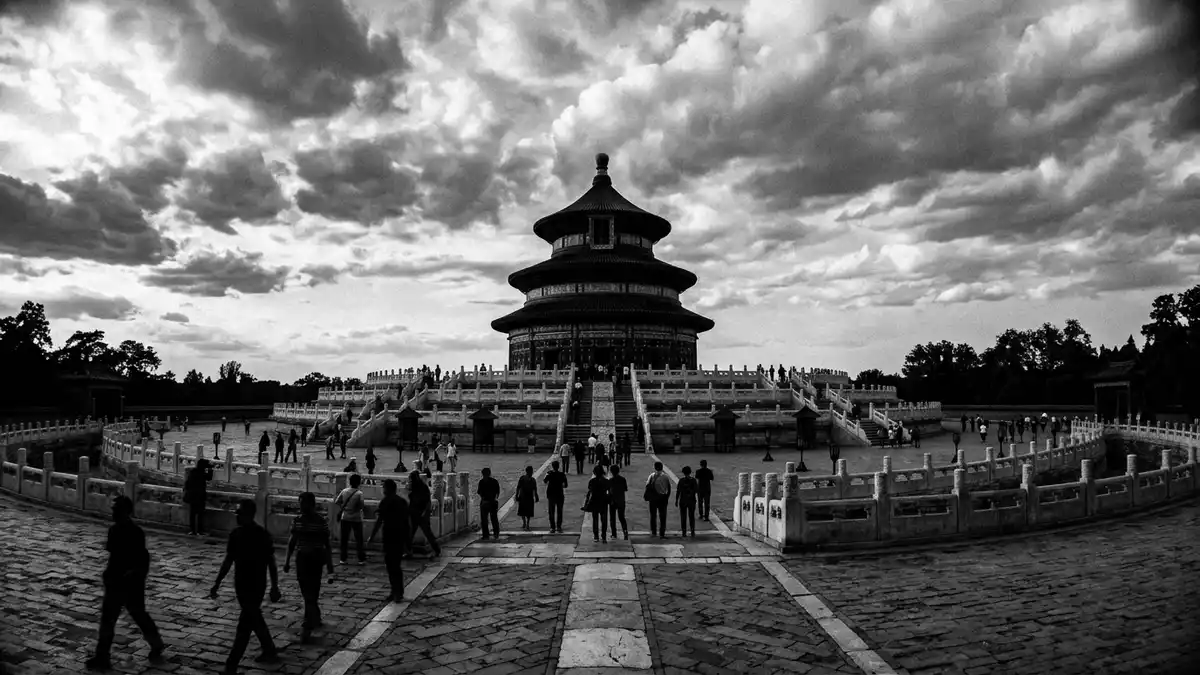
Tiantan, the Temple of Heaven in Peking, is a ceremonial landscape of blue roofs, circular altars and long avenues. Completed in 1420 under the Ming emperor Yongle, the complex joined architecture, open space and imperial worship in one carefully ordered setting.
Tiantan: circles, squares and blue glazed roofs
The complex occupies the southern part of Peking’s historic centre, in Dongcheng District. Its buildings stand among cypress groves, lawns and broad paved routes, with the principal structures arranged along a north-south axis.
Blue glazed roof tiles identify the principal halls and altars. Their colour belongs to the visual language of the complex, while the circular forms of the main buildings contrast with the square courts and enclosing walls. The result is a sequence of sharply defined shapes rather than a single monumental block. The World Heritage designation covers the imperial sacrificial altar and its surrounding landscape.
From Ming imperial rites to a civic park
Tiantan served the emperors of the Ming and Qing dynasties, whose ceremonies addressed Heaven, rain and agricultural harvests. The complex therefore belonged to state ritual as well as religious practice, with the emperor acting within a formal ceremonial order.
The first complex was completed during the Yongle reign in 1420. Under the Ming emperor Jiajing, the Hall of Prayer for Good Harvests was reconstructed in circular form in 1545. Qing rulers continued to maintain and alter the buildings, and the hall received its present name after a rebuilding programme under the Qianlong emperor.
The Temple of Heaven entered the UNESCO World Heritage List in 1998 as an imperial sacrificial altar in Beijing. Its significance lies in the relationship between halls, altars, walls, trees and routes, rather than in an isolated building. The traditional architectural complex remains legible across the park.
The principal buildings and their ceremonial order
The Hall of Prayer for Good Harvests is Tiantan’s most recognisable structure. It rises on a white stone terrace and carries a deep blue triple roof, with timber columns and richly coloured details beneath the eaves.
South of the hall stands the Circular Mound Altar, an open stone platform used for ceremonies addressed to Heaven. Its concentric terraces, carved balustrades and central position create a different architectural experience from the enclosed halls. The Imperial Vault of Heaven lies between the hall and the altar, surrounded by the Echo Wall.
The complex also contains the Hall of Abstinence, ceremonial gates, subsidiary buildings and extensive planted areas. The buildings are connected by the Danbi Bridge, a raised route that crosses the central grounds. Their arrangement gives Tiantan the character of a processional landscape, with enclosed, elevated and open spaces following one another.
The name Tiantan means Temple of Heaven. Its surviving architecture records the visual language of Ming and Qing court ritual without reducing the site to a museum display. The circular Hall of Prayer is one of the clearest examples of that relationship between ceremony and form.
Visiting Tiantan: what travellers from Western Europe should know
- Tiantan lies south of the Forbidden City in Dongcheng District, east of Yongnei Dajie. Beijing’s metro and bus network serve the surrounding entrances.
- The grounds combine long paved approaches, broad terraces, steps and open courtyards. The Circular Mound Altar and the Hall of Prayer for Good Harvests are reached along the central ceremonial routes.
- The official language is Mandarin Chinese and the currency is the renminbi.
- The park contains mature cypress groves, lawns and large stone platforms. The principal buildings are separated by substantial open spaces.
Searching for Tiantan on social platforms
These links open searches for Tiantan on each platform.
Frequently asked questions about Tiantan
Where is Tiantan?
Tiantan is in Dongcheng District, in the southern part of Peking’s historic centre. It lies south of the Forbidden City and east of Yongnei Dajie.
What can visitors see at Tiantan?
The principal sights include the Hall of Prayer for Good Harvests, the Imperial Vault of Heaven, the Echo Wall and the Circular Mound Altar. Cypress groves, terraces and ceremonial routes connect these buildings.
What makes Tiantan distinctive?
Tiantan combines circular halls, square courts, blue glazed roofs and open stone altars within one imperial ritual landscape. Its buildings and parkland were inscribed as a UNESCO World Heritage site in 1998.


