
Timbuktu and its earthen mosques on the edge of the Sahara
Published on 08/14/2026 at 14:23 | Editorial responsibility: Rafael Müller, Editor-in-Chief AD HOC NEWS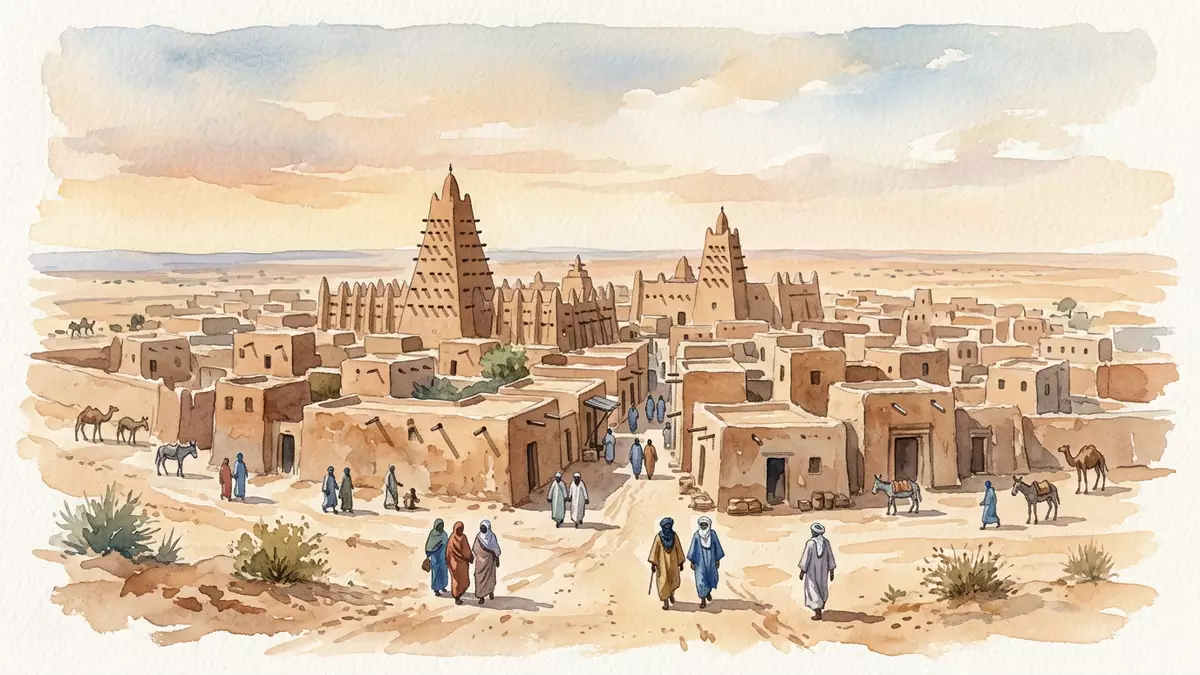
Timbuktu in Mali is a city of earthen mosques, manuscript traditions and Saharan edge. Its historic centre is a UNESCO World Heritage site, recognised for the mosques and cemeteries that define it.
Earthen monuments in a Saharan city
The city’s best-known buildings are Djingareyber, Sankore and Sidi Yahia, three great mosques that recall its medieval prominence. Their walls and towers belong to the Sudano-Sahelian tradition, with earth as the dominant material.
The 1988 inscription places these monuments within a formally protected historic ensemble. The designation also covers mausoleums and other sacred places linked to the city’s scholarly and religious life.
Learning, manuscripts and the city’s long memory
Timbuktu’s name is tied to Sankore University, the madrasas and the wider world of Islamic scholarship. In the fifteenth and sixteenth centuries, it served as an intellectual and spiritual capital in West Africa.
The city’s reputation also rests on manuscripts preserved in private and institutional collections. These texts reflect law, theology, astronomy and poetry, and they anchor Timbuktu in a written culture that reached far beyond the desert.
Desert setting and historic fabric
Timbuktu stands near the southern edge of the Sahara, in a dry landscape close to the Niger River corridor. That setting explains the city’s compact, earth-built character and the prominence of thick, simple forms.
The historic centre brings together mosques, shrines and cemeteries within one urban landscape. The city is also known by the French form Tombouctou, which appears alongside the English name in many contexts.
Visiting Timbuktu: what travellers from Western Europe should know
- Timbuktu lies in northern Mali, on the desert side of the Niger River basin. Travel is shaped by the city’s regional position and by the wider transport network across the country.
- The historic monuments are built in earth and mud brick, so their surfaces have a soft, textured finish. The mosques and mausoleums form low, clustered shapes rather than a stone skyline.
- The city’s heritage zone includes mosques, cemeteries and shrines. Its fabric is compact, with sacred places set close to one another.
- The official language is French and the currency is the West African CFA franc.
- Entry requirements depend on your nationality; UK travellers can check the FCDO travel advice at gov.uk/foreign-travel-advice, Irish travellers the Department of Foreign Affairs at ireland.ie.
Searching for Timbuktu on social platforms
These links open searches for Timbuktu on each platform.
Frequently asked questions about Timbuktu
Where is Timbuktu?
Timbuktu is in Mali, in the northern part of the country near the Sahara margin. It stands within a historic river-and-desert zone that shaped its long importance.
What does a visit involve?
The city is associated with earthen mosques, shrines and manuscript culture. Its built heritage is compact and largely low-rise, with earth-toned surfaces throughout.
What makes Timbuktu distinctive?
Timbuktu combines a UNESCO-listed historic centre, three famous mosques and a deep scholarly legacy. Its identity rests on architecture, learning and a Saharan location.


