
Timbuktu’s earthen mosques and manuscripts
Published on 08/29/2026 at 13:14 | Editorial responsibility: Rafael Müller, Editor-in-Chief AD HOC NEWS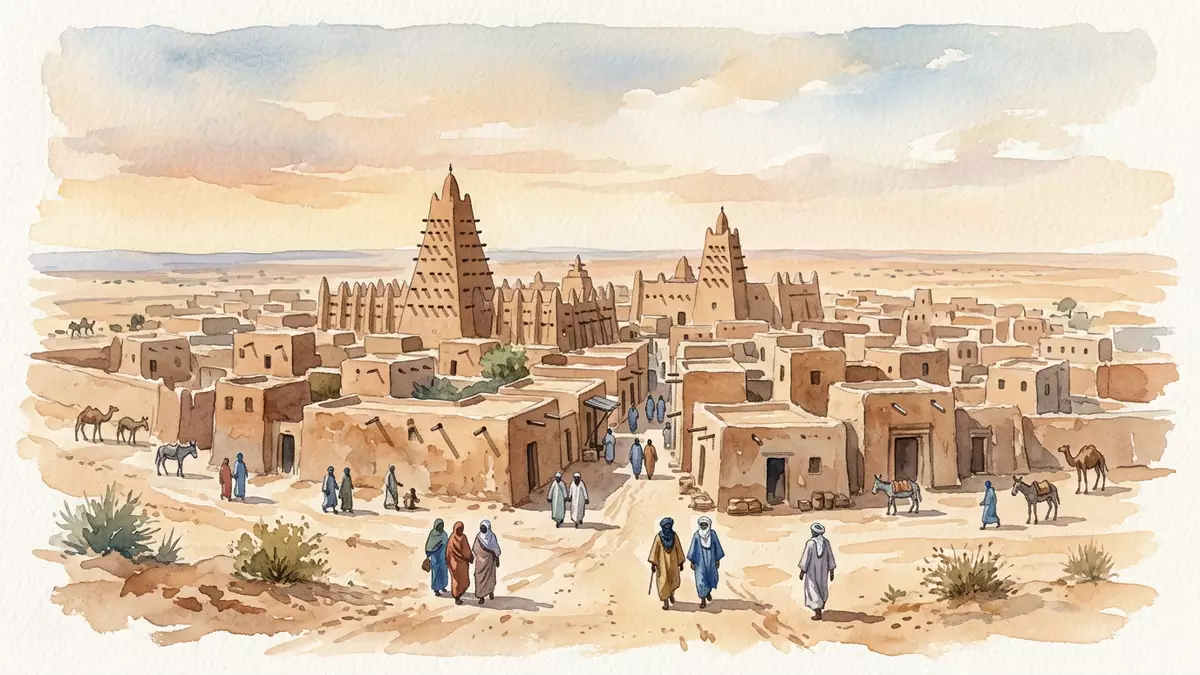
Timbuktu in Mali is marked by earthen mosques, manuscript collections and a place in West African intellectual history. Its built fabric centres on Djingareyber, Sankore and Sidi Yahia, three mosques that anchor the city’s UNESCO World Heritage status.
Timbuktu’s earthen mosque landscape
The city’s most recognisable buildings are made from earth, timber and plaster, with thick walls and projecting wooden beams. That material palette belongs to the Sahel and gives Timbuktu a distinct architectural unity.World Heritage status
The mosque of Djingareyber is linked with the Mansa Musa period and the fourteenth century. Sankore and Sidi Yahia complete the historic trio that defines the old city’s ceremonial core.Sankore and Sidi Yahia
Learning, trade and scholarly memory
Timbuktu’s reputation rests on scholarship as much as on buildings. The city was a centre of Islamic learning, and Sankore University became a name associated with books, teachers and manuscripts across the region.Islamic learning
That history belongs to the fifteenth and sixteenth centuries, when Timbuktu was a major intellectual and spiritual centre. The city also sat within Saharan caravan networks, which linked it to broader commercial and cultural worlds.fifteenth and sixteenth centuries
Timbuktu as a heritage city
The old monuments were inscribed on the UNESCO World Heritage List in 1988. That formal designation recognises both the architecture and the cultural importance of the city as a whole.inscribed in 1988
For travellers, the interest lies in the relationship between the mosques, the earthen city and the manuscript tradition. Timbuktu is a place where architecture and scholarship remain inseparable parts of the same historical landscape.manuscript tradition
Visiting Timbuktu: what travellers from Western Europe should know
- Timbuktu lies in northern Mali, inland from the Niger River, and is reached through the city’s airport and overland routes from the regional network.
- The built heritage is earthen, with mud-plastered surfaces and timber supports. Streets and courtyards are part of the historic urban grain.
- The city sits in the Sahara fringe. Heat, dust and dry air shape the landscape around the monuments.
- The official language is French and the currency is the West African CFA franc.
- Entry requirements depend on your nationality; UK travellers can check the FCDO travel advice at gov.uk/foreign-travel-advice, Irish travellers the Department of Foreign Affairs at ireland.ie.
Searching for Timbuktu on social platforms
These links open searches for Timbuktu on each platform.
Frequently asked questions about Timbuktu
Where is Timbuktu?
Timbuktu is a city in northern Mali, close to the Sahara and inland from the Niger River. It belongs to the Timbuktu region.
What does a visit involve?
The city is defined by its earthen architecture, historic mosques and manuscript heritage. The landscape is dry, open and tied to Saharan surroundings.
What makes Timbuktu distinctive?
Its distinctiveness lies in the combination of mud-built monuments, Islamic scholarship and its role in trans-Saharan exchange. The three great mosques remain the clearest physical expression of that legacy.


