
Titanic Belfast and the shipyard-shaped museum of memory
Published on 08/25/2026 at 16:53 | Editorial responsibility: Rafael Müller, Editor-in-Chief AD HOC NEWS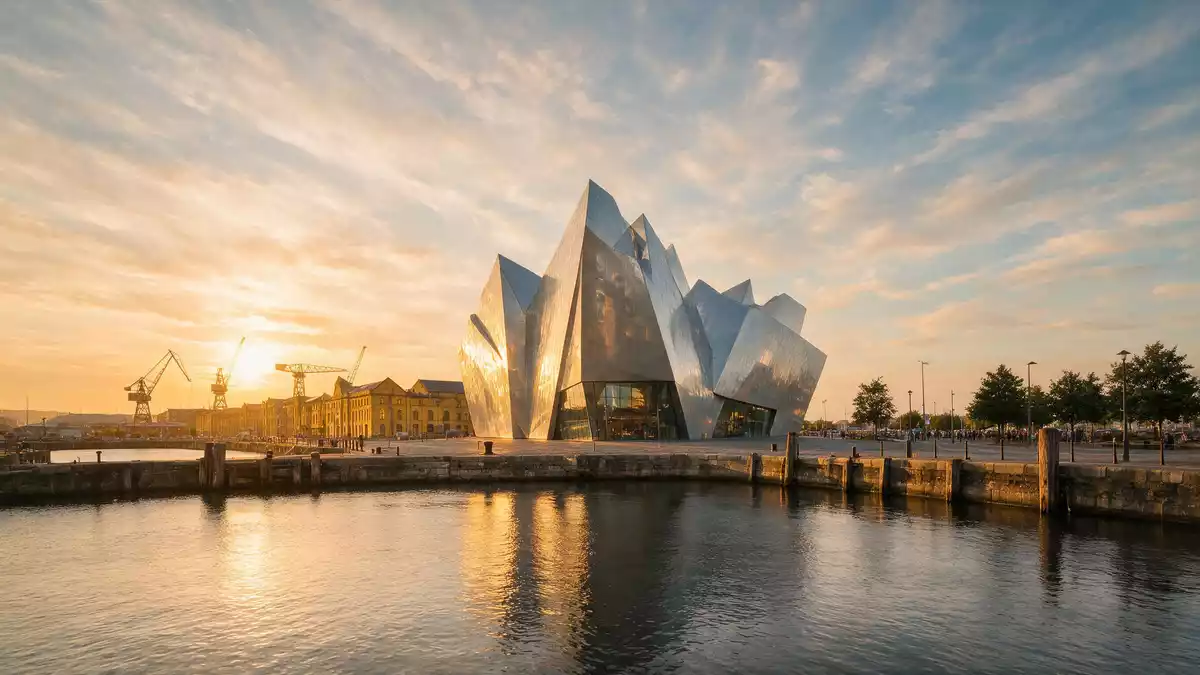
Titanic Belfast stands in Belfast’s Titanic Quarter as a striking museum whose faceted aluminium-clad walls rise beside the former Harland & Wolff shipyard where RMS Titanic was built in the early twentieth century. Opened in 2012, it brings the story of the liner and the wider shipbuilding industry back onto the slipways that once launched some of the largest vessels in the world.
A sculpted building on the old slipways
The first encounter with Titanic Belfast is architectural. The museum occupies a prominent site beside the former slipways and graving dock where shipyard workers assembled RMS Titanic and her sister ships in Belfast. Four main blocks lean around a central atrium, their steel structure wrapped in thousands of folded metal plates that give the facades a jagged, crystalline profile recalling the intersecting forms of ship prows and ice forms.Titanic Belfast is described as a six-storey building measuring around 14,000 square metres, with exhibition areas, banqueting space and service areas arranged within the angular shell.
The exterior composition was developed by Civic Arts, led by Eric Kuhne, with Belfast-based Todd Architects as executive architects. The cladding consists of textured aluminium panels set at varying angles, creating shifting patterns of light and shadow under the changeable skies of Northern Ireland. The overall height of the spikes reaches the scale of the shipyard gantries that once stood nearby, so the building reads from a distance as a cluster of metallic prows rising beside the River Lagan.The museum’s facades are reported as being formed from thousands of aluminium shards, a detail that adds to the sense of a sculpted industrial object rather than a conventional box-like gallery.
From Belfast’s shipyards to the Titanic Experience
Titanic Belfast is more than a single exhibition hall; it contains a sequence of themed galleries that trace Belfast’s maritime and industrial history and the construction of Titanic. The main attraction, known as the Titanic Experience, is laid out across several levels and uses interpretive galleries, large-scale reconstructions and audiovisual media to follow the ship from drawing office to ocean liner.The complex includes galleries, an underwater exploration theatre, recreations of cabins and a large rotating model of the ship, giving visitors a sense of both the vessel’s interior and its technical design.
One gallery concentrates on the Harland & Wolff drawing offices and the shipyard workforce who built the ship in the years leading up to 1912, while another follows the launch and the short voyage that ended with the collision with an iceberg in the North Atlantic. Later sections present film and documentary material about the inquiries that followed and the subsea expeditions that located the wreck on the ocean floor.The museum’s storyline covers Titanic’s construction in Belfast, her 1912 sinking and the subsequent exploration of the wreck, placing the building within a broader narrative of engineering ambition and maritime disaster.
Event halls, shipyard views and the wider Titanic Quarter
Beyond the core exhibition, Titanic Belfast functions as an events and conference venue and as a viewpoint across the redeveloped docks. Inside, a large banqueting hall evokes the scale of an Edwardian liner dining room, with high ceilings and a capacity that allows for sizeable gatherings.The building incorporates conference and banqueting suites capable of hosting hundreds of guests, alongside education spaces and hospitality areas.
The windows and walkways frame views towards the preserved slipways, the Hamilton Graving Dock and the wider Titanic Quarter redevelopment on the eastern side of the River Lagan. From the upper levels, the relationship between the museum and the former industrial landscape becomes clear. The building stands a short distance from the preserved SS Nomadic, a tender built in 1911 that once ferried passengers to larger liners and now serves as a companion attraction berthed in the adjacent dock.Titanic Belfast forms part of a wider cluster of maritime heritage sites in Belfast’s Titanic Quarter, anchoring a district that links riverfront promenades, former industrial structures and new commercial buildings.
Visiting Titanic Belfast: what travellers from Western Europe should know
- Titanic Belfast stands in the Titanic Quarter on the eastern side of the River Lagan, north-east of central Belfast, with signed road access via Queen’s Road.
- The building rises over several levels, connected by lifts and escalators, and includes internal staircases between some gallery areas that involve a modest amount of walking.
- The former slipways and dockside around the museum are paved open spaces exposed to weather, so moving between the main building and the preserved SS Nomadic involves an outdoor walk.
- The official language is English and the currency is the pound sterling.
- Entry requirements depend on your nationality; UK travellers can check the FCDO travel advice at gov.uk/foreign-travel-advice, Irish travellers the Department of Foreign Affairs at ireland.ie.
Searching for Titanic Belfast on social platforms
These links open searches for Titanic Belfast on each platform.
Frequently asked questions about Titanic Belfast
Where is Titanic Belfast located?
Titanic Belfast stands in the Titanic Quarter district of Belfast, on the eastern side of the River Lagan, close to the former Harland & Wolff shipyard.
What can visitors expect inside Titanic Belfast?
Visitors move through a series of galleries combining interpretive displays, reconstructed spaces and multimedia installations that follow the story of RMS Titanic and Belfast’s maritime industry.
What makes Titanic Belfast distinctive among maritime museums?
The museum combines a sculptural aluminium-clad building with exhibits set on the former slipways where RMS Titanic was built, linking architecture, location and storyline in a single complex.


