
Tokyo Tower, the red?white lattice landmark above Tokio
Published on 08/25/2026 at 16:15 | Editorial responsibility: Rafael Müller, Editor-in-Chief AD HOC NEWS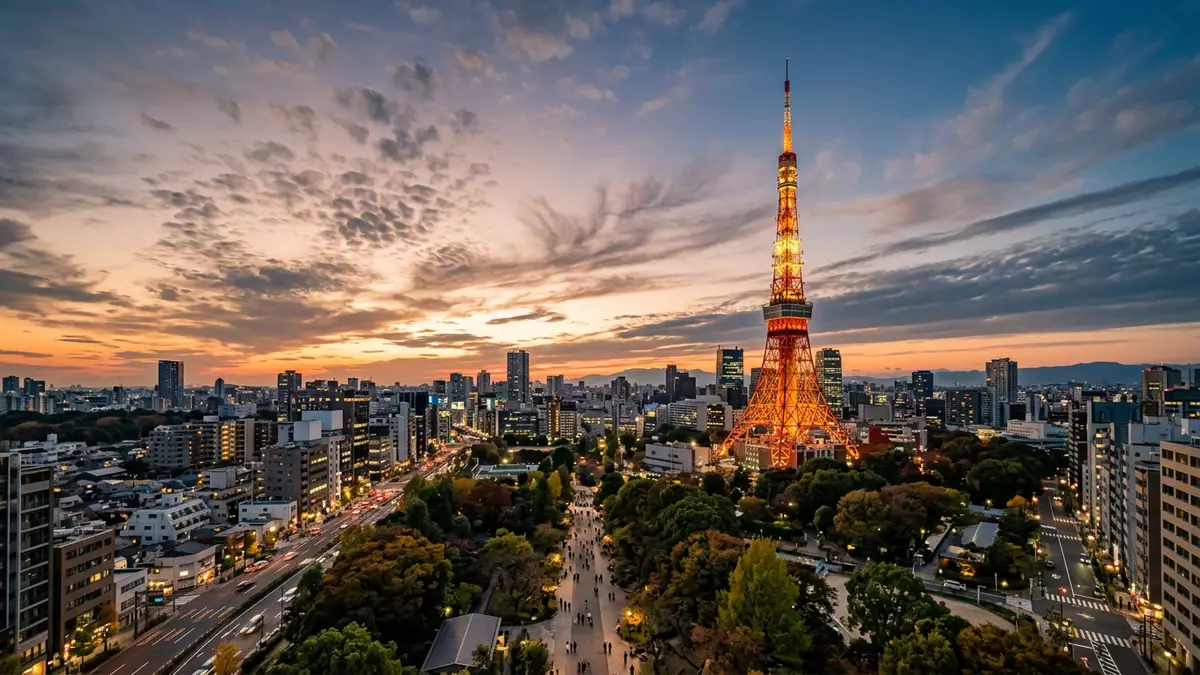
Tokyo Tower is a red and white steel lattice tower rising above the Shiba district of Minato in southern Tokio, a landmark that combines post?war engineering with wide urban views of Japan’s capital. Completed in 1958 and designed by structural engineer Tach? Nait?, it brought broadcast infrastructure and a new vertical silhouette to the city’s skyline.
A post?war steel giant in Minato
Tokyo Tower stands in Shibakoen, a district of Minato in central Tokyo, surrounded by arterial roads, office blocks and temple precincts that reveal the layered fabric of the capital. The tower reaches an architectural height of 333 m (1,093 ft), its antenna and steel framework forming a single vertical figure above the relatively low mid?century buildings around it.architectural height of 333 m Designed by structural engineer Tach? Nait? in collaboration with engineering practice Nikken Sekkei, it uses a lattice structure assembled from steel elements that taper towards the top.designed by structural engineer Tach? Nait?
The tower was completed in 1958 as part of Japan’s expansion of television and radio broadcasting across the capital and surrounding regions, giving transmitters a high perch above the streets.completed in 1958 Its steel members are painted in alternating bands of white and orange?red, a colour scheme that makes the geometric structure distinct against the sky. From a distance the tower’s proportions and trussed legs recall early twentieth?century European lattice towers, yet the details of the framing and the integration of broadcast equipment belong firmly to mid?century Japanese engineering.
Observation decks and interior spaces
Visitors encounter Tokyo Tower as a sequence of levels rising within and around the steel frame, beginning with a podium at the base and climbing through enclosed deck structures that sit partway up the tower. The main observation deck is housed in a rectilinear volume suspended within the lattice at about 150 m (492 ft), with glazing on all sides that opens views across Minato and towards other districts of Tokyo.main deck at 150 metres Elevators run from the ground level up to this deck, and there is also a staircase route that climbs through the supporting legs and interior landings, emphasising the tower’s structural geometry.
Above the main deck, a more compact top deck sits higher within the frame at around 250 m (820 ft), providing a different vantage over the city and, in clear conditions, distant outlines of other landmarks and mountain ranges.top deck at around 250 metres At lower levels the tower incorporates interior floors containing exhibition spaces, shops and other visitor facilities within a block?like base building that anchors the legs. These enclosed volumes contrast with the exposed steel frame above, where diagonal bracing and vertical members are clearly visible from the decks and from the ground.
Symbolism, skyline and neighbouring sights
When Tokyo Tower opened to the public in December 1958 it was the tallest freestanding steel tower in the world, standing several metres above the Eiffel Tower in Paris and dominating the capital’s skyline.tallest freestanding steel tower The tower served as Japan’s tallest structure until 2012, when it was overtaken by Tokyo Skytree, a newer broadcast tower further north in the city.tallest structure until 2012 Its presence above Minato marks Japan’s post?war economic expansion and the spread of television across households, while its colours and proportions have become a visual shorthand for Tokio in film, photography and graphic design.
The tower stands near temple grounds such as Zojoji, whose wooden halls and stone paths sit under the shadow of the steel frame, offering a direct contrast between Edo?period religious architecture and twentieth?century engineering. From the observation decks, visitors see the city’s grid of streets, rivers and towers laid out below, including views towards Tokyo Skytree and, when visibility is good, Mount Fuji on the horizon.views towards Tokyo Skytree and Mount Fuji At night the tower is illuminated by lighting schemes that trace the lattice and highlight its vertical lines against the dark sky, reinforcing its role as a beacon for the surrounding districts.
Visiting Tokyo Tower: what travellers from Western Europe should know
- Tokyo Tower stands in Shibakoen in Minato, south of the Imperial Palace area. It is reached by urban rail and subway lines serving nearby stations such as Akabanebashi and Onarimon, followed by a short walk through city streets.
- The approach from street level involves paved surfaces and some outdoor steps, and access to the observation decks includes indoor staircases and lifts inside the tower’s legs and core.
- Tokio lies on the Pacific coast of Honshu in Japan. The official language is Japanese and the currency is the yen.
- Entry requirements depend on your nationality; UK travellers can check the FCDO travel advice at gov.uk/foreign-travel-advice, Irish travellers the Department of Foreign Affairs at ireland.ie.
Searching for Tokyo Tower on social platforms
These links open searches for Tokyo Tower on each platform.
Frequently asked questions about Tokyo Tower
Where is Tokyo Tower located within Tokio?
Tokyo Tower stands in the Shibakoen area of Minato ward in central Tokyo, south of the Imperial Palace district and close to temple grounds such as Zojoji.
What can visitors expect during a visit to Tokyo Tower?
Visitors move from a base building into enclosed observation decks inside the steel lattice, using lifts or staircases, and see wide views over Tokio and distant landmarks on clear days.
What makes Tokyo Tower distinctive among towers in Japan?
Its red?white lattice frame, completion in 1958 under Tach? Nait? and role as a former tallest structure in Japan combine broadcast infrastructure with a symbolic skyline presence.


