
Torre di Pisa and its graceful lean over Piazza del Duomo
Published on 08/17/2026 at 14:05 | Editorial responsibility: Rafael Müller, Editor-in-Chief AD HOC NEWS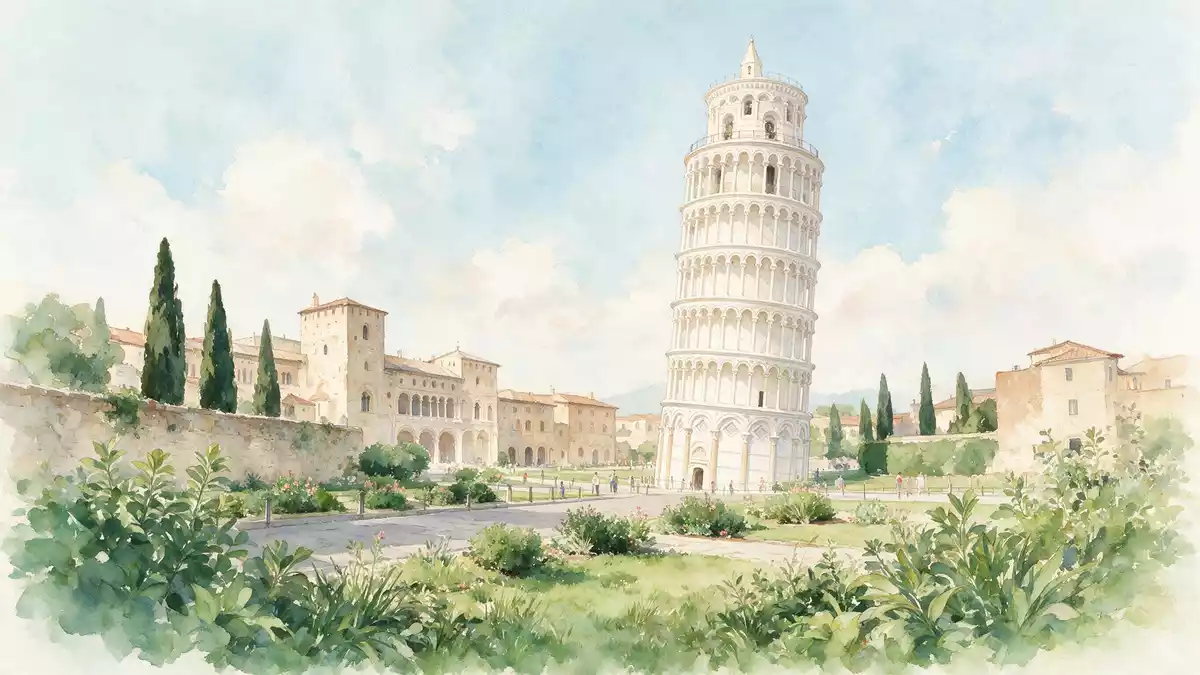
Torre di Pisa, known in English as the Leaning Tower of Pisa, is the freestanding bell tower of the cathedral of Santa Maria Assunta in the historic Piazza del Duomo in Pisa, Italy. Rising as a tall shaft of pale stone with a pronounced tilt, it brings together medieval engineering, decorative marble arcades and a stacked circular form that has become one of the most recognisable silhouettes in European architecture.
A medieval bell tower with a visible lean
Torre di Pisa stands beside the cathedral in the north-western part of Pisa, forming part of the ensemble of buildings that make up the Piazza del Duomo, also known as Piazza dei Miracoli.freestanding bell tower The tower is constructed from light-coloured stone and marble, organised into repeating arcades that wrap around its exterior on each level.beauty of its architecture From the base upwards, it leans away from the vertical, a consequence of soft ground beneath one side of its foundations, and that lean is clearly visible from every point in the square.
The tower reached its present form during the thirteenth and fourteenth centuries, after work began in the twelfth century and was interrupted and resumed several times.construction began on 9 August 1173 Its height is given by the Opera della Primaziale Pisana as 58.36 m (191.6 ft), with an external diameter of about 15 m (49.2 ft), and a present inclination of a little over 5 degrees from the vertical.height 58,36 metres and inclination Seen from the lawn of the square, the arcaded levels stack above each other in a near-cylinder, and the tilt gives the whole structure a sense of motion while remaining structurally stable.
Part of the Piazza del Duomo World Heritage ensemble
Torre di Pisa forms one of four major medieval monuments in the Piazza del Duomo: the cathedral, the baptistery, the bell tower and the walled cemetery known as the Campo Santo.group of monuments in Piazza del Duomo This square was recognised as a UNESCO World Heritage Site in 1987, underlining its importance for medieval architecture in Italy between the eleventh and fourteenth centuries.World Heritage Site in 1987 Within this ensemble, the tower’s lean and its ring of arcades distinguish it against the longitudinal mass of the cathedral and the domed volume of the baptistery.
The tower is the campanile of the cathedral and houses seven bells, corresponding to the notes of the musical scale, with the largest bell dating from the mid-seventeenth century and weighing several tonnes.seven bells and largest cast in 1655 From the outside, the uppermost level carries the openings from which the bells sound over the square. The white and grey stone of the tower harmonises with the cathedral’s marble cladding, and the slight lean creates a visual dialogue between the verticals of the facades and the inclined axis of the bell tower.
Structure, materials and ascent
The tower’s construction uses finely cut stone blocks arranged in concentric rings and arcaded galleries on successive levels, creating a rhythm of columns and arches that continues from the base to the bell chamber.stone blocks and arcades Inside, a staircase climbs in a spiral along the inner wall, giving access to the higher levels and eventually to the top, where the view opens over Pisa and the surrounding Tuscan landscape. The tower’s weight is reported as over 14,000 tonnes, a figure that conveys the mass resting on the relatively compact footprint of its foundations.weight 14.453 tonnes
The lean developed early during construction, when the ground beneath part of the base compressed unevenly, and successive builders adjusted the upper levels in an effort to compensate, producing a subtle curve in the tower’s profile.inclination due to subsoil The result is that the axis of the tower bends gently rather than forming a straight line, while the arcades retain their regular spacing. Within the wider history of medieval Italian architecture, this combination of decorative richness, structural challenge and visual drama has helped make Torre di Pisa an enduring symbol of Pisa and of Italy as a whole.symbol of the city and Italy
Visiting Torre di Pisa: what travellers from Western Europe should know
- Torre di Pisa stands in the Piazza del Duomo on the north-western edge of Pisa; the square lies north of the River Arno and is reached on foot from the historic centre.
- The approach to the tower across the square is level and paved, but the interior ascent uses a narrow spiral staircase with hundreds of stone steps.
- The official language is Italian and the currency is the euro.
Searching for Torre di Pisa on social platforms
These links open searches for Torre di Pisa on each platform.
Frequently asked questions about Torre di Pisa
Where is Torre di Pisa located?
Torre di Pisa stands in the Piazza del Duomo in Pisa, in the Tuscan region of Italy, on the north-western side of the historic centre.
What should visitors expect on a visit to Torre di Pisa?
Visitors encounter a tall, leaning marble bell tower beside the cathedral, with a level approach across the square and a steep internal staircase for those who ascend.
What makes Torre di Pisa distinctive among European landmarks?
The combination of its visible lean, its medieval arcaded structure and its role as part of a UNESCO-listed cathedral square makes Torre di Pisa distinctive.


