
Torre di Pisa and the marble cathedral square
Published on 08/29/2026 at 22:57 | Editorial responsibility: Rafael Müller, Editor-in-Chief AD HOC NEWS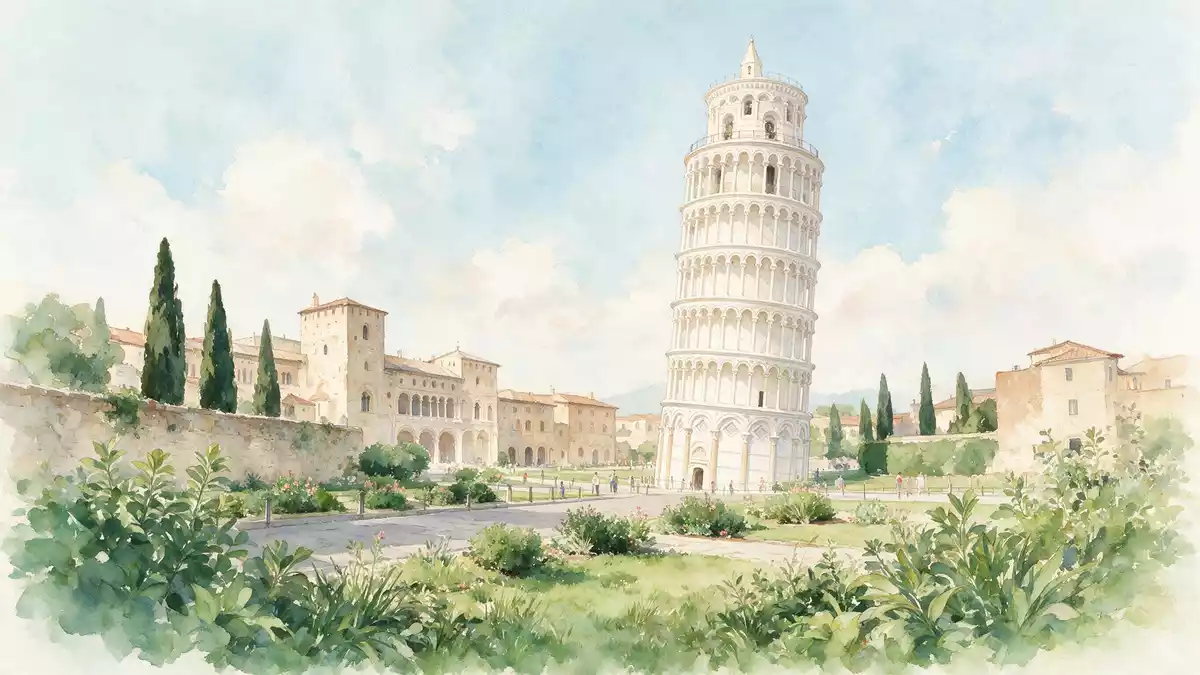
Torre di Pisa stands in Pisa’s cathedral square as a freestanding marble bell tower with a lean that defines its profile. Begun in 1173, it belongs to the Romanesque cathedral complex and is linked to the name of Pisa itself.
Marble, height and a bell tower in the square
The tower was planned as part of the cathedral complex and rose in white marble above the piazza. A bell tower is its present function, and that role remains legible in the structure’s open arcades and stacked stages. began in 1173
The tower’s height is commonly given as about 56 m, with the building reading differently from each side because of its inclination. That slant, together with the white stone surfaces and the arcaded rings, gives the tower its unusual silhouette. white marble
Piazza dei Miracoli and the cathedral complex
Torre di Pisa forms part of the Piazza dei Miracoli, the monumental group that also includes the cathedral, baptistery and Camposanto. The square was inscribed on the UNESCO World Heritage List in 1987, and the tower belongs to that wider religious setting. Piazza dei Miracoli
The tower is commonly associated with the cathedral of Santa Maria Assunta, and its separate shaft stands clear of the church front. The result is a composition of marble volumes rather than a single church facade, with the tower reading as one element among several. cathedral of Santa Maria Assunta
A Romanesque structure built over two centuries
The tower’s long construction history belongs to the medieval city of Pisa and the Romanesque period. Work began in the twelfth century, paused, and continued in stages across the thirteenth and fourteenth centuries. twelfth century
That extended building sequence is visible in the tower’s stacked loggias and the slightly irregular line of the shaft. The structure remains one of Pisa’s clearest medieval monuments, where the form of a bell tower and the effect of settlement are both immediately visible. stacked loggias
Visiting Torre di Pisa: what travellers from Western Europe should know
- The tower stands in central Pisa, in the Piazza dei Miracoli. It is reached on foot through the cathedral area and the surrounding monumental grounds.
- The structure is vertical for much of its height, then visibly slants. Its exterior is marked by marble arcades and a narrow shaft above the square.
- The tower sits beside the cathedral, baptistery and Camposanto. Those monuments make the square a concentrated medieval ensemble rather than an isolated landmark.
- The official language is Italian and the currency is the euro.
Searching for Torre di Pisa on social platforms
These links open searches for Torre di Pisa on each platform.
Frequently asked questions about Torre di Pisa
Where is Torre di Pisa?
It stands in Pisa, in the Piazza dei Miracoli beside the cathedral complex. The tower belongs to the monumental religious centre of the city.
What does a visit involve?
The tower is seen as part of the wider square, with the cathedral, baptistery and Camposanto close by. Its marble stages and pronounced lean are visible from the piazza.
What makes Torre di Pisa distinctive?
The tower’s distinctive feature is its inclination, which is part of its long medieval history. It is also a separate bell tower in white marble, standing apart from the cathedral front.


