
Tottori Sakyu and the long coast of shifting sand
Published on 08/25/2026 at 13:28 | Editorial responsibility: Rafael Müller, Editor-in-Chief AD HOC NEWS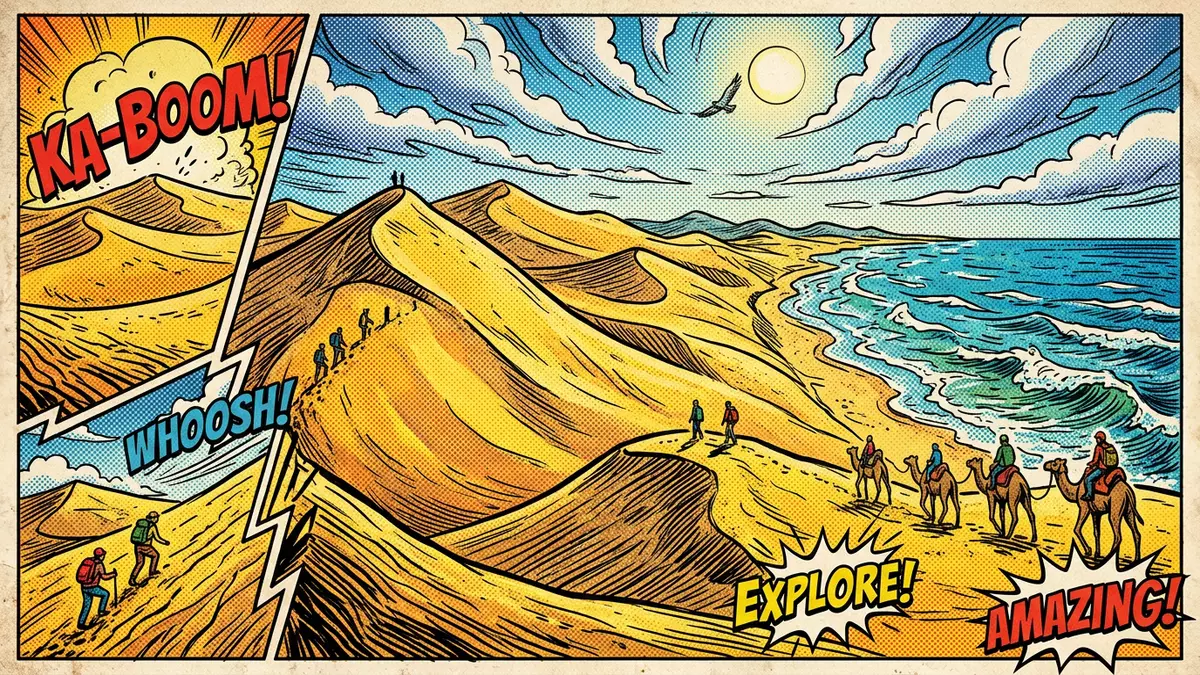
Tottori Sakyu is the sand-dune landscape beside Tottori on the Sea of Japan coast. Its broad ridges, open sand and long profile make the place legible at a glance, and the scale is immediate from ground level.
Tottori Sakyu across the coast and river
The dunes stretch across the shoreline outside the city centre and sit within the San’in Kaigan Geopark and national park setting. The named landscape is tied to the Sendai River, which appears in the story of how the sand reached the coast, and it is linked with Tottori Prefecture as a place name and administrative frame. Tottori Sand Dunes and Sea of Japan coast are the most useful anchors for the place’s setting.
The dune field extends for many kilometres along the shore and reaches a height that is large enough to define its skyline. The landform is not a flat beach; it is a wide sweep of sand with ridges, hollows and exposed surfaces that change from step to step as the ground rises and falls.
The sand, wind and geology of Tottori Sakyu
The material underfoot is not ordinary beach sand alone. Reports on the dunes describe granite gravel and sand arriving from the mountains by way of the Sendai River, with coastal currents and wind sorting the material into the form seen at ground level. granite gravel and sand and crushed granite sand give the dunes a geological character that is easy to miss if they are treated only as a scenic stop.
The dunes are part of a longer coastal system rather than an isolated patch of sand. Their surface includes ripples, slopes and depressions, and the visible texture shifts with the light and the angle of view. The result is a landscape that reads as a working coast as much as a landmark, with the sea on one side and inland terrain on the other.
Tottori Sakyu in Japanese landscape history
Tottori Sakyu is commonly linked with a long period of coastal formation rather than a single building phase. One published account places that development over tens of thousands of years, and another gives an even longer span of around 100,000 years; both point to an ancient landscape shaped by sediment, wind and water. 100,000 years is the clearest single period attached to the dunes, while national natural monument marks their formal standing.
The dunes are also identified with the San’in Kaigan Geopark, which places them within a broader coastal geology of rocks, cliffs and sand bodies. That frame matters because Tottori Sakyu is not only a view of sand: it is a named landform with recorded geological importance and a place in Japan’s protected landscape vocabulary.
Visiting Tottori Sakyu: what travellers from Western Europe should know
- The dunes lie outside central Tottori, and the usual approach is by bus from Tottori Station or by road from the city.
- The terrain is open sand with ridges and slopes, so walking there means crossing loose ground rather than paved paths.
- Tottori City and Tottori Prefecture are the key place names for orientation, and the Sea of Japan coast gives the site its setting.
- The official language is Japanese and the currency is the yen.
Searching for Tottori Sakyu on social platforms
These links open searches for Tottori Sakyu on each platform.
Frequently asked questions about Tottori Sakyu
Where is Tottori Sakyu?
Tottori Sakyu lies on the coast outside Tottori city in Tottori Prefecture, Japan. It faces the Sea of Japan.
What should a visit feel like?
The place is an open sand landscape with ridges, slopes and exposed surfaces. It is a terrain you cross, not a built monument you pass through.
What makes Tottori Sakyu distinctive?
Its scale, coastal setting and geological composition define it. The dunes are closely tied to the Sendai River, the San’in Kaigan Geopark and a long history of coastal formation.


