
Tour Hassan and the unfinished Almohad mosque of Rabat
Published on 09/19/2026 at 08:29 | Editorial responsibility: Rafael Müller, Editor-in-Chief AD HOC NEWS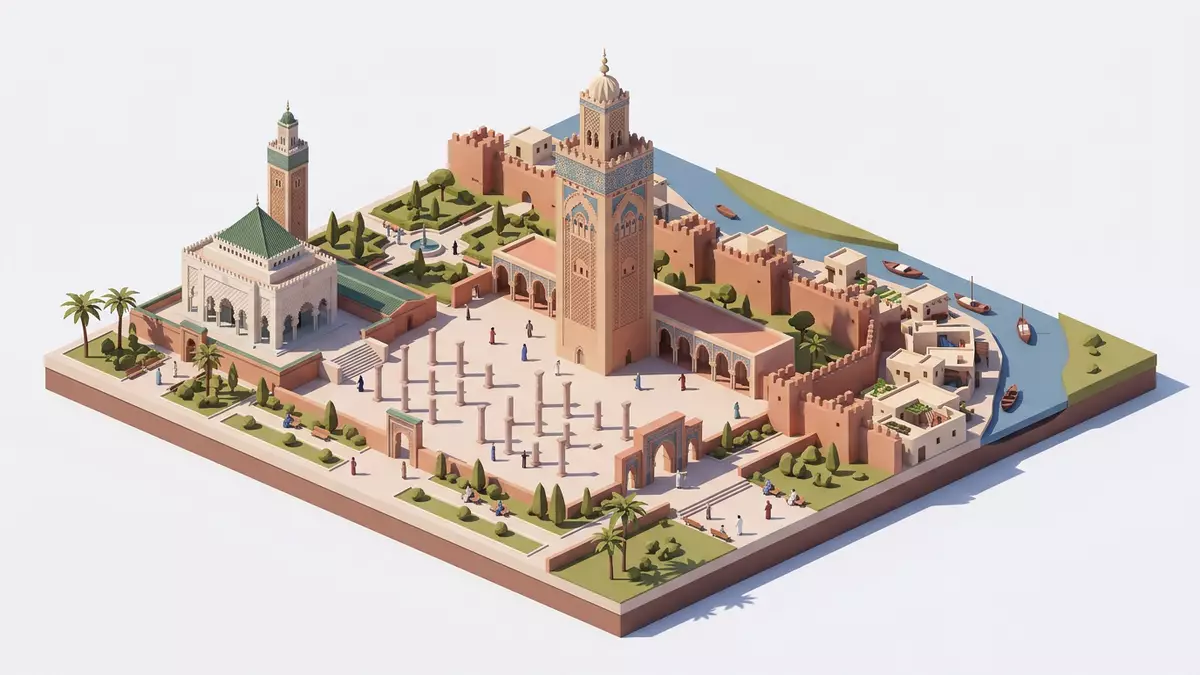
Tour Hassan in Rabat is the red-sandstone minaret of an unfinished twelfth-century mosque, rising above a broad esplanade of stone columns that mark the footprint of the vast prayer hall that was planned but never completed. Begun under Almohad ruler Abu Yusuf Yaqub al-Mansur in the 1190s, the tower and its surrounding ruins form one of the clearest surviving monuments of Almohad power on Morocco’s Atlantic coast, facing the Bouregreg estuary and the neighbouring district of Salé.
An Almohad project on a grand scale
Tour Hassan was conceived during the reign of Abu Yusuf Yaqub al-Mansur, the third caliph of the Almohad Caliphate, who ruled from 1184 to 1199 and governed a realm stretching across much of the Maghreb and al-Andalus.Abu Yusuf Yaqub al-Mansur The mosque complex on the Rabat plateau was laid out in the late twelfth century, with work starting around 1195, at a time when Almohad builders were also active in Seville and Marrakesh.Building efforts started around 1195 The plan called for an enormous rectangular mosque, with colonnades forming aisles parallel to the qibla wall and a single monumental minaret positioned on its western side.
The tower was intended to reach a height of around 86 m (282 ft), surpassing other minarets of its day, but construction stopped after al-Mansur’s death in 1199 and the shaft was left at about 44 m (144 ft).left at about 44 metres The mosque itself never progressed beyond its lower walls and forest of columns, and later seismic damage in 1755 brought down much of what had been raised, leaving today’s open field of stumps on the site where a roofed hall once stood.damage from the 1755 Lisbon earthquake
The red-sandstone minaret above the esplanade
Tour Hassan itself is a square minaret built in red sandstone, its surfaces divided into panels of carved decoration and blind arches typical of Almohad architecture.red stone minaret The tower rises in tiers, with each elevation marked by a band of ornament that catches the shifting light, and the truncated top makes its unfinished state legible from a distance, as if the building were paused mid-construction. Inside, ramps run around the core of the shaft instead of a narrow staircase, a layout that allowed a muezzin to reach the upper gallery on horseback when the call to prayer was delivered from the summit.
At the foot of the minaret, the mosque’s vast esplanade stretches away in orderly rows of square-section columns and fragments of wall that define the scale of the prayer hall that was envisaged.the unfinished mosque’s 348 columns The regular grid of supports creates long visual corridors along which the eye follows the alignment toward the tower, and the open sky above the site emphasises how different the space would have felt under a roof resting on the same supports. From the esplanade, the view takes in the Bouregreg river and the Atlantic light, situating the complex firmly within Rabat’s wider landscape.
Monumental complex and modern symbolism
Tour Hassan stands on Boulevard Mohamed Lyazidi in the Hassan quarter of Rabat, on a rise above the river that makes the tower visible from many parts of the city.Boulevard Mohamed Lyazidi Directly across the esplanade, a modern royal mausoleum houses the tomb of Mohammed V and members of the Alaouite dynasty, creating a dialogue between Almohad stonework and twentieth-century architecture across the shared forecourt.across from the Mausoleum of Mohammed V The pairing of the unfinished medieval mosque and the completed mausoleum ties the site to both imperial Rabat and the modern Moroccan state.
In 2012, the area around Tour Hassan was inscribed on the UNESCO World Heritage list as part of the “Rabat, modern capital and historic city” entry, recognising the ensemble of Almohad remains and more recent monuments as a cultural landscape of outstanding value.UNESCO World Heritage status in 2012 The tower and its esplanade have become a ceremonial space within Rabat, used as a setting for official receptions and public gatherings, while still preserving the clear outlines of the mosque project that never reached completion.
Visiting Tour Hassan: what travellers from Western Europe should know
- Tour Hassan stands in the Hassan district of Rabat on Boulevard Mohamed Lyazidi; trams and taxis link the area with Rabat’s central railway station and the medina.
- The site consists of an open esplanade with many low stone columns and steps leading up from surrounding streets, so walking across it involves uneven surfaces and short climbs.
- The Bouregreg river lies nearby beyond the esplanade, and the modern Mausoleum of Mohammed V faces the minaret across the same forecourt, making it straightforward to combine both in one visit.
- The official language is Arabic and the currency is the Moroccan dirham.
- Entry requirements depend on your nationality; UK travellers can check the FCDO travel advice at gov.uk/foreign-travel-advice, Irish travellers the Department of Foreign Affairs at ireland.ie.
Searching for Tour Hassan on social platforms
These links open searches for Tour Hassan on each platform.
Frequently asked questions about Tour Hassan
Where is Tour Hassan and what kind of monument is it?
Tour Hassan is a red-sandstone minaret on the site of an unfinished twelfth-century Almohad mosque in the Hassan district of Rabat on Morocco’s Atlantic coast.
What can visitors expect when they reach the site?
Visitors find a tall square minaret and a wide esplanade where stone columns trace the outline of the planned mosque, with the Mausoleum of Mohammed V facing the tower across the same forecourt.
What makes Tour Hassan distinctive among Moroccan landmarks?
The combination of an unfinished Almohad minaret, the vast grid of mosque columns and its role in the UNESCO-listed landscape of “Rabat, modern capital and historic city” gives Tour Hassan a character that is closely tied to both medieval and modern Morocco.


