
Tower Bridge and the moving roadway above the Thames
Published on 09/24/2026 at 08:09 | Editorial responsibility: Rafael Müller, Editor-in-Chief AD HOC NEWS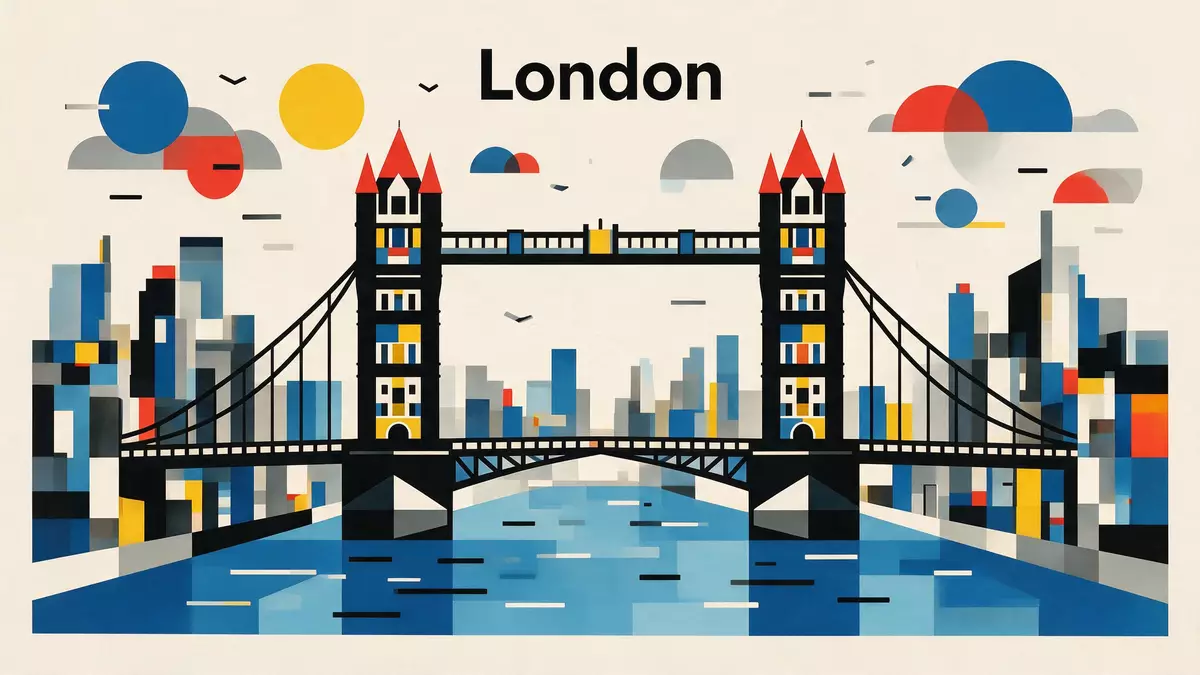
Tower Bridge is a working crossing over the River Thames, with two masonry-clad towers and a roadway that rises between them. Sir Horace Jones and Sir John Wolfe Barry created the bridge between 1886 and 1894, combining Victorian engineering with a Gothic Revival exterior.
Tower Bridge: two towers above a lifting roadway
The bridge’s defining feature is its pair of bascules. These leaves form the central roadway and pivot upwards when river traffic requires passage. When closed, they create the road crossing between Tower Hamlets on the north bank and Southwark on the south bank.
Tower Bridge is a combined bascule and suspension bridge. Steel forms the structural frame, while Cornish granite and Portland stone clad the towers and upper walkways. The stone surface gives the bridge a fortress-like appearance, while the moving centre exposes its mechanical character.
From Victorian construction to a Grade I listed bridge
Construction began in 1886 and ended with the bridge’s opening on 30 June 1894. The Prince and Princess of Wales opened the crossing, during the reign of Queen Victoria. Horace Jones died during construction, and John Wolfe Barry completed the engineering project.
The bridge carries a Grade I listed building status. Its history belongs to London’s nineteenth-century expansion, when the Thames remained both a transport route and a boundary between districts. The towers and high-level walkways preserve the visual language of that period, while the bridge continues to carry road traffic.
Tower Bridge construction timeline
Walkways, glass floors and Victorian machinery
The high-level walkways connect the towers above the roadway. They stand about 42 metres above the River Thames and contain sections of glass flooring. From these elevated passages, the bridge’s roadway, bascules and river corridor appear as parts of one visible structure.
The visitor route also includes the Victorian Engine Rooms beneath the southern approach. Original machinery records the hydraulic system that powered the bridge lifts for decades. The engines, boilers, accumulators and tools present the bridge as an engineering complex, not simply as a decorated river crossing.
The moving bascules remain central to Tower Bridge’s identity. Their operation links the road deck with the river beneath it, while the towers and walkways preserve the bridge’s architectural silhouette. Together, these elements explain the unusual experience of standing inside a bridge that is both landmark and infrastructure.
Victorian bridge engineering and Grade I listed status describe the structure’s engineering and heritage significance.
Visiting Tower Bridge: what travellers from Western Europe should know
- Tower Bridge crosses the Thames beside the Tower of London. London Bridge station and Tower Hill Underground station are named transport reference points nearby.
- The high-level walkways are reached inside the towers, with lift access available. The Engine Rooms lie at river level beneath the southern approach.
- The glass-floor sections are positioned above the central roadway and bascules. Handrails and side paths accompany the glass sections.
- The bridge links the City of London area with Southwark and stands beside the Tower of London, the Thames Path and Potters Fields Park.
Searching for Tower Bridge on social platforms
These links open searches for Tower Bridge on each platform.
Frequently asked questions about Tower Bridge
Where is Tower Bridge?
Tower Bridge crosses the River Thames in London, beside the Tower of London. Its north and south approaches connect the areas of Tower Hamlets and Southwark.
What can visitors see inside Tower Bridge?
The interior route includes the high-level walkways, glass-floor sections, tower spaces and Victorian Engine Rooms. The walkways stand about 42 metres above the Thames.
What makes Tower Bridge distinctive?
Its central roadway is formed by two bascules that rise for river traffic. Gothic Revival towers, steel framing, granite, Portland stone and preserved hydraulic machinery combine in one bridge.


