
Tower of London as a fortress of power and memory
Published on 09/18/2026 at 15:34 | Editorial responsibility: Rafael Müller, Editor-in-Chief AD HOC NEWS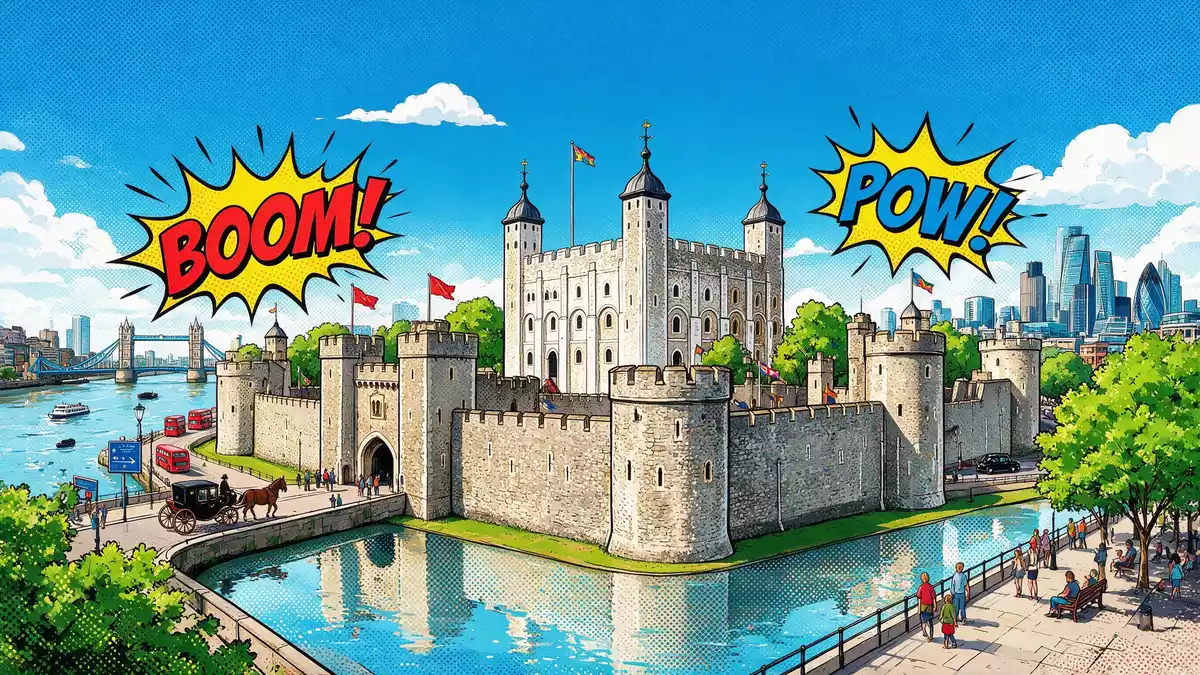
The Tower of London on the north bank of the Thames is first and foremost a fortress: a stone keep surrounded by curtain walls and a moat, built to secure the English capital after the Norman Conquest of the eleventh century. Founded under William the Conqueror and developed over the following centuries into a royal complex with palace buildings, chapels and layered defences, it condenses nearly a millennium of English history into a single walled enclosure.
A Norman stone keep at the core
At the centre of the site stands the White Tower, the massive Norman keep that gave the whole fortress its name and still dominates the inner ward. Work on this stone tower began in the 1070s, when William the Conqueror ordered a mighty keep raised inside the old Roman city wall of London to consolidate his hold on the city and the kingdom.William the Conqueror in the 1070s The keep was built of imported limestone from Caen in Normandy, a material that marked the tower out from the local fabric and tied it visually to its Norman builders.limestone from Caen in Normandy
The original Norman work did not remain isolated for long. From the late twelfth century onwards, successive kings expanded the complex, turning the single keep into a castle of concentric defences. Richard I initiated substantial building campaigns, while Henry III and his son Edward I strengthened and extended the fortifications with curtain walls, towers and a moat fed from the Thames.Henry III and Edward I expanded the fortress The result is an ensemble where the Norman core sits within an inner ward, which in turn is surrounded by a later outer ward, giving visitors a clear sense of how royal power was expressed in stone.
From royal residence to prison and treasury
Although the White Tower began life as a military stronghold, the wider complex functioned for centuries as a royal residence as well as a fortress. Medieval kings installed palace apartments within the inner ward, and for long periods the Tower served as an official home for the monarch and court, especially in troubled times.fortress palace with royal buildings Within these walls grew institutions central to the English state: the Royal Mint, responsible for producing coinage, worked at the site from the thirteenth century into the nineteenth century, while armouries and treasuries stored weapons and valuables for the crown.Royal Mint at the Tower from the thirteenth century
Alongside this official machinery of monarchy, the Tower took on a darker role as a place of confinement and execution. From the Middle Ages it became associated with political prisoners, and figures such as Anne Boleyn and Guy Fawkes were held within the fortress before their deaths.fortress, palace and prison Executions connected with the Tower took place both on Tower Green inside the walls and on nearby Tower Hill, giving the site a reputation for scenes of high drama and brutal justice. Walking through the complex, from the royal apartments to the more austere towers, makes the coexistence of ceremonial power and harsh punishment very tangible.
A World Heritage fortress on the Thames
The location of the Tower beside the Thames in the eastern part of historic London was chosen to control river traffic and the approach to the city. The fortress occupies the south-eastern corner of the former Roman wall line, where it overlooks the river and faces towards the route from the sea.on the south-eastern corner of the Roman wall From this position it guarded royal possessions and the royal family in times of war and rebellion, and for centuries it acted as a gateway to the capital as well as a stronghold.
The international significance of the Tower’s architecture and history was recognised in 1988, when it was inscribed as a cultural World Heritage Site by UNESCO.inscribed as a World Heritage Site in 1988 The designation highlights the White Tower as one of the most complete remaining examples of an eleventh-century fortress palace in Europe and emphasises the continuity of royal and state functions that have taken place here, from Norman times through the Tudor period and beyond. It also reflects the way the Tower’s skyline, with its stone walls, turrets and ravens, has become a recognised symbol of royal authority and of London itself.
Visiting Tower of London: what travellers from Western Europe should know
- The fortress stands on the north bank of the Thames in central London, close to Tower Bridge, and is reached easily by Underground and mainline rail services serving the surrounding area.
- Within the walls, movement between the different wards and towers involves climbs on stone staircases and walks across uneven historic surfaces, and some interior passages are narrow.
- The Tower lies in London in the United Kingdom, where the official language is English and the currency is the pound sterling.
Searching for Tower of London on social platforms
These links open searches for Tower of London on each platform.
Frequently asked questions about Tower of London
Where is the Tower of London?
The Tower of London stands beside the Thames in the eastern part of central London, at the historic edge of the old City and close to Tower Bridge.
What can visitors expect inside the Tower of London?
Visitors encounter a layered fortress with the Norman White Tower at its core, inner and outer wards, palace buildings and towers associated with imprisonment and executions.
What makes the Tower of London distinctive among European castles?
The Tower combines an eleventh-century stone keep, later concentric defences, royal residences, prison towers and state institutions within a single compact riverside site recognised as a World Heritage fortress.


