
Tower of London as fortress, palace and prison on the Thames
Published on 08/25/2026 at 22:16 | Editorial responsibility: Rafael Müller, Editor-in-Chief AD HOC NEWS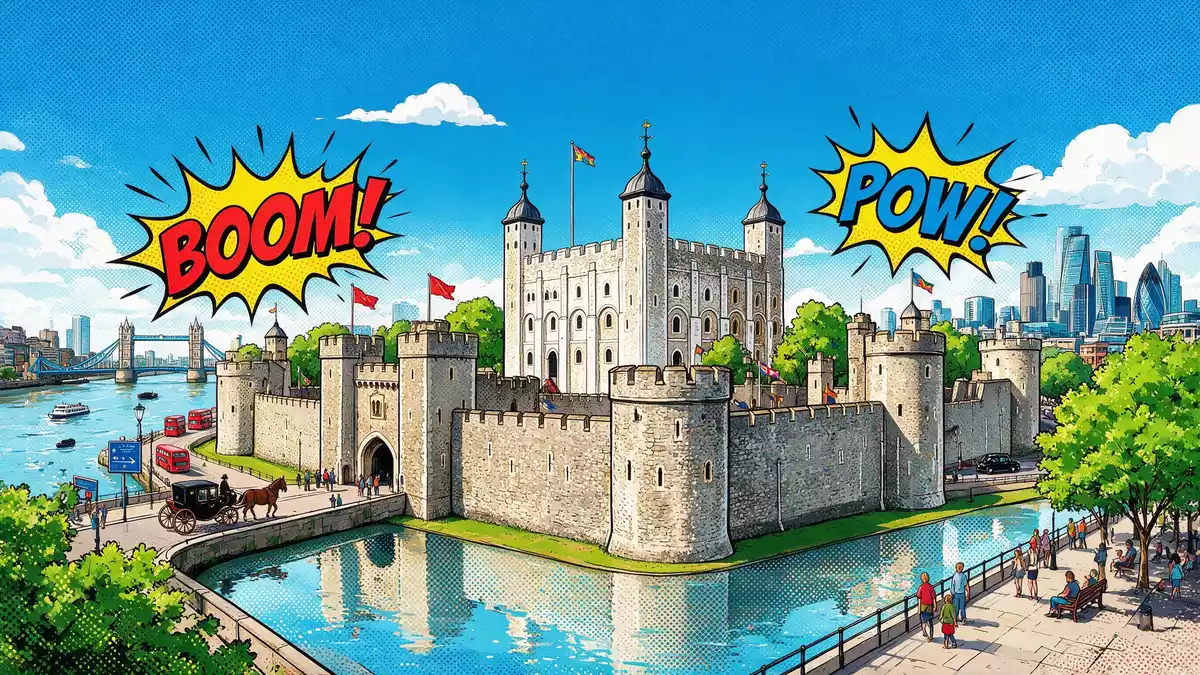
On the north bank of the River Thames, the Tower of London compresses nearly a millennium of English history into one walled riverside fortress. Founded in the late eleventh century under William the Conqueror, its compact site weaves together a massive stone keep, concentric defences and later barracks into a single complex where royal ceremony and confinement once shared the same courtyard.
From Norman keep to concentric fortress
The heart of the Tower is the White Tower, the great stone keep begun under William the Conqueror in the 1070s, close to the line of the old Roman city wall.the White Tower Built of pale limestone imported from Caen in Normandy, it rose as one of the earliest large stone keeps in England, its bulk defining the name by which the entire fortress is now known.massive stone fortress
During the thirteenth century, kings Henry III and Edward I wrapped this Norman core in successive rings of defences, adding curtain walls, smaller mural towers and a moat that turned the site into a full concentric castle.second curtain wall These additions created the pattern still visible: an inner ward around the keep, an outer ward with further towers and a riverside wharf marking the fortress’s direct relationship with the Thames.
Royal residence, mint and Crown Jewels
For several centuries after its foundation, the Tower functioned not just as a stronghold but as a royal residence, with palace apartments and chapels arranged around the inner ward.royal complex Monarchs could live, hold court and, in times of tension, shelter behind the fortress defences while remaining within the capital.
Beyond its residential role, the Tower housed key institutions of the English state. For centuries it held the Royal Mint, where coins of the realm were struck, and armouries where weapons were stored, maintaining the fortress’s role in defence and supply.royal buildings ensemble It also became the secure home of the Crown Jewels, a collection of regalia used in coronations and other state ceremonies, which remain associated with the site as a symbol of monarchy.guarding the Crown Jewels
Prison, execution ground and World Heritage site
Over the medieval and early modern periods, the Tower gained a reputation as a prison for political and high?status captives, held within its towers and, in some cases, executed on nearby Tower Green or Tower Hill.place of execution Its walls confined figures such as Anne Boleyn and Guy Fawkes, embedding stories of treason, accusation and royal justice into the physical fabric.
The continuity of royal and state use, from fortress and palace to prison and repository of records and coinage, has made the Tower a rare surviving ensemble of buildings reflecting English governance from the eleventh to the sixteenth centuries.layers of history In 1988 the site was inscribed on the UNESCO World Heritage list as a cultural property, recognising its role in major events of European history and its status as a symbol of royal power.Year of Inscription 1988
Visiting Tower of London: what travellers from Western Europe should know
- The fortress stands on the north bank of the River Thames at the eastern edge of central London, close to Tower Bridge and Tower Hill Underground station.
- Inside the outer walls, the ground rises and falls between wards, with cobbled paths, staircases in towers and stone steps connecting the keep, barracks and riverside defences.
- The official language is English and the currency is the pound sterling.
Searching for Tower of London on social platforms
These links open searches for Tower of London on each platform.
Frequently asked questions about Tower of London
Where is the Tower of London located?
The fortress stands in London, England, on the north bank of the River Thames beside the historic City of London.
What should visitors expect inside the Tower of London?
Visitors encounter a stone keep, layered defensive walls, barracks, towers and courtyards that reflect its long use as fortress, palace and prison.
What makes the Tower of London distinctive among European castles?
Its combination of Norman keep, concentric defences, royal palace buildings, state institutions and World Heritage status gives it an unusually dense concentration of historical functions.


