
Tower of London: fortress, palace and prison on the Thames
Published on 09/05/2026 at 17:30 | Editorial responsibility: Rafael Müller, Editor-in-Chief AD HOC NEWS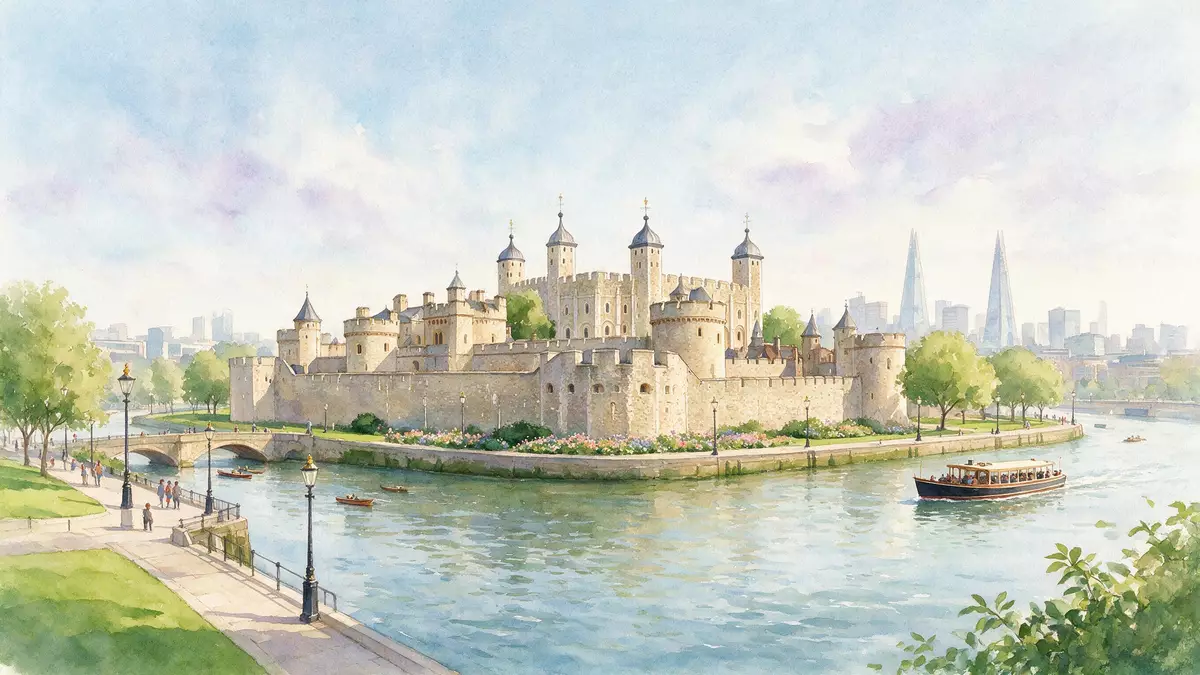
For nearly a millennium, the Tower of London has concentrated fortress walls, royal apartments and prison cells into a compact riverside complex on the north bank of the Thames in London. First raised under William the Conqueror in the late eleventh century, its core keep and successive rings of defences chart the evolution of English royal power in stone.
The White Tower and Norman beginnings
The heart of the site is the White Tower, the great stone keep begun under William I after the Norman Conquest of England in 1066. Construction of this massive square tower is dated to the 1070s and 1078 in different accounts, placing it firmly in the late eleventh century when Norman rule was being consolidated in London.White Tower keep The building rises above a deep foundation line close to the line of the former Roman city wall, using pale limestone imported from Caen in Normandy for its walls.Caen stone masonry
Originally the keep stood inside a simple enclosure, a powerful symbol of Norman authority dominating the eastern approach to the City along the river. At that stage it combined military strength and residential accommodation for the king, with thick walls, internal chapels and high-level chambers. Over time, further towers, mural galleries and service buildings were attached around it, but the White Tower’s stark mass still reads as the organising core of the whole site.
Concentric castle and royal residence
From the thirteenth century, the Tower of London developed into a full concentric castle, with an inner ward surrounding the White Tower and an outer ward enclosed by further walls and a moat. Major works under Henry III, whose reign ran from 1216 to 1272, and his son Edward I, king from 1272 to 1307, encircled the Norman keep with curtain walls and a second defensive circuit, turning the complex into England’s largest and strongest multi-ring fortress of its time.curtain walls and moat Gatehouses, wharf structures and water gateways linked the castle directly with the Thames, underlining its role as both fortress and river entrance to the capital.
Within these defences, palatial lodgings grew up around the Norman core, forming a royal residence that was used for centuries. Apartments, great halls and chapels lined the inner ward, and coronation processions traditionally began with the monarch staying at the Tower and then travelling to Westminster Abbey from there.coronation tradition Even when the main royal court shifted to other palaces, the buildings inside the walls continued to house royal officials, armouries and treasuries, keeping the site embedded in the machinery of the English state.
Prison, executions and the Crown Jewels
The Tower of London has an enduring reputation as a prison and place of execution for high-status captives caught up in political and religious conflicts. From the later Middle Ages into the early modern period, nobles, clerics and even queens were confined in its towers, with some executed on Tower Green inside the walls and others on the nearby rise of Tower Hill. The stories of Anne Boleyn and other prisoners have helped to shape the site’s image as a stage for power struggles and punishments.prison and executions
Alongside this punitive role, the complex gathered several key institutions. It housed the Royal Mint for centuries, storing dies and precious metals behind its fortifications, and it contained armouries supplying weapons and equipment to royal forces.mint and armoury Exotic animals kept in a menagerie occupied dedicated towers, while record offices stored important documents. In the modern era the Tower is best known as the secure home of the Crown Jewels, a collection of ceremonial regalia used at state occasions and housed in purpose-built vaults inside the fortress.
Architecture, setting and World Heritage status
The architectural character of the Tower of London reflects centuries of adaptation. The White Tower remains a textbook example of Norman military architecture, with massive walls, small high openings in the stonework and corner turrets rising above a square plan.Norman architecture Around it stand later medieval towers of varied height and form, stone curtain walls with battlements and a moat, parts of which have been altered since their defensive heyday. Inside the wards, surviving seventeenth- and nineteenth-century buildings illustrate attempts to adapt the complex to changing military, administrative and ceremonial needs.
The whole ensemble occupies a strategic site beside the Thames at the eastern edge of the historic City of London, close to later river crossings and dock developments. In recognition of its outstanding collection of royal buildings spanning the period from the eleventh to the sixteenth century, the Tower of London is inscribed as a cultural World Heritage Site, with its year of inscription recorded as 1988.UNESCO World Heritage listing Its layered use as fortress, palace, prison and repository for national treasures gives the small riverside footprint a density of historical fabric that is rare in Europe.
Visiting Tower of London: what travellers from Western Europe should know
- The Tower of London stands on the north bank of the River Thames at the eastern edge of the City of London, close to Tower Bridge and accessible by Underground and mainline rail stations bearing its name.
- Within the walls, movement involves staircases in medieval towers, uneven stone surfaces and walkways along the battlements, including steps up and down between different levels.
- The riverside setting means exposed outer wards and wall walks, while interiors range from large halls to confined tower rooms that can feel enclosed.
- The official language is English and the currency is the pound sterling.
Searching for Tower of London on social platforms
These links open searches for Tower of London on each platform.
Frequently asked questions about Tower of London
Where is the Tower of London located?
The Tower of London stands on the north bank of the River Thames at the eastern edge of central London, beside major road and rail links.
What can a visitor expect inside the Tower of London?
A visit combines the White Tower keep, medieval curtain walls and towers, exhibitions about the Crown Jewels and armouries, and views across the river from the battlements.
What makes the Tower of London distinctive among European castles?
Its compact site combines an eleventh-century Norman keep, later concentric fortifications, royal apartments and long-term roles as prison, treasury and home of the Crown Jewels.


