
Trinidad’s cobbled heart in Cuba’s sugar country
Published on 08/14/2026 at 15:01 | Editorial responsibility: Rafael Müller, Editor-in-Chief AD HOC NEWS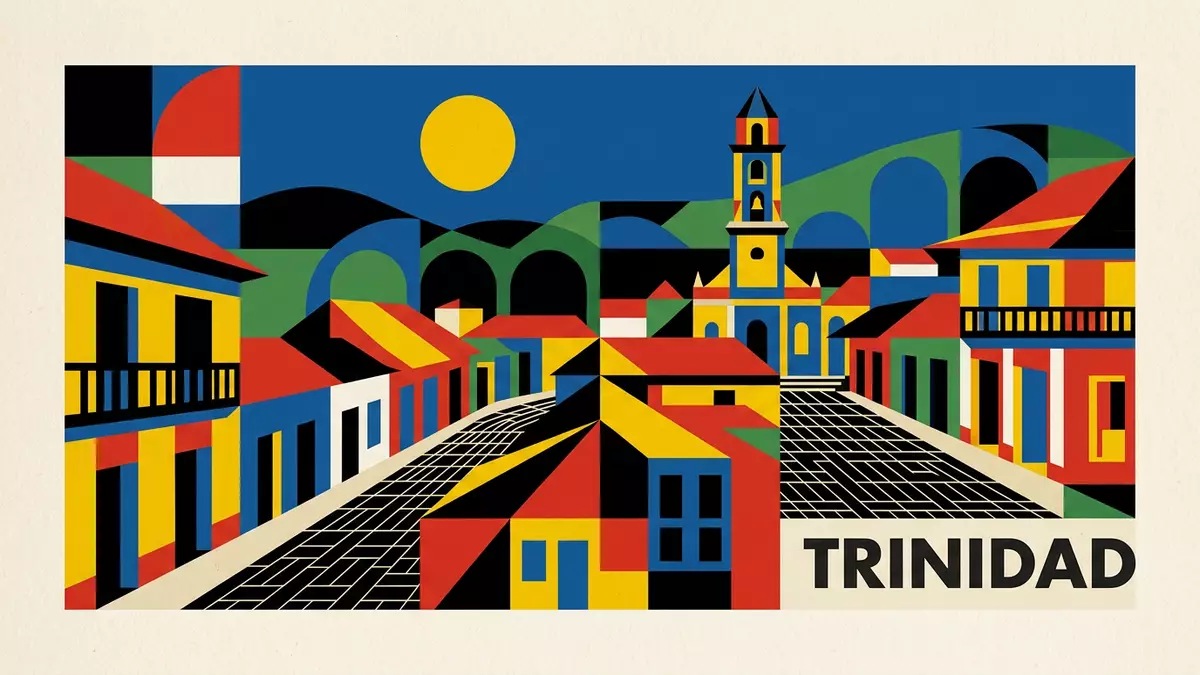
Trinidad in central Cuba is a colonial town whose historic centre forms a compact district of cobbled streets, pastel houses and sugar-era palaces linked to the nearby Valley de los Ingenios. Founded as Villa de la Santísima Trinidad in the early sixteenth century, it later prospered from the sugar industry and tobacco processing, a history that still reads clearly in its preserved streets and courtyards.
A Spanish colonial town shaped by sugar
Trinidad stands in the province of Sancti Spíritus on Cuba’s southern coast, and together with the Valley de los Ingenios it is recognised as a cultural World Heritage Site for its sugar-era landscape and colonial architecture.Trinidad and the Valley de los Ingenios The town was founded on 23 December 1514 by Diego Velázquez de Cuéllar under the name Villa de la Santísima Trinidad, making it one of the earliest Spanish settlements on the island.foundation in 1514
The surrounding valleys of San Luis, Santa Rosa and Meyer together form the Valley de los Ingenios, where a dense network of cane fields, mill sites, plantation houses and slave barracks once drove the region’s wealth.rural sugar landscape The valley contains vestiges of dozens of historic sugar mills and features such as la Torre Iznaga, a tall tower built in 1816 by Alejo Iznaga Borrell, which still rises above the former plantations.Valle de los Ingenios
Plaza Mayor and Trinidad’s colonial streets
At the heart of Trinidad’s historic centre lies Plaza Mayor, described as an open-air museum of Spanish colonial architecture framed by cobbled streets and houses with pastel-coloured facades and wrought-iron grilles.Plaza Mayor description The square is overlooked by the campanile of the former Convento de San Francisco, whose tower is one of the town’s most recognisable vertical landmarks above the low roofs.Convento de San Francisco tower
Among the notable residences around Plaza Mayor are Palacio Brunet and Palacio Cantero, grand houses dating from the eighteenth and nineteenth centuries that still carry the layout and finishes of Trinidad’s sugar-age elite.Palacio Brunet and Palacio Cantero Palacio Cantero now houses the municipal history museum, while other former mansions in the old town accommodate collections on local culture and archaeology in spaces of high ceilings, internal courtyards and tiled floors.Municipal History Museum
From valley landscape to Caribbean coast
Beyond the historic centre, Trinidad’s wider municipality reaches from inland hills down to bays and beaches on the Caribbean Sea, giving the town a varied setting between sugar valley and coast.municipality and coast Topes de Collantes in the nearby Escambray mountains forms an upland area of forest and waterfalls, while Casilda Bay and the Ancón Peninsula carry low-lying shores, reefs and long stretches of pale sand at Playa Ancón.
The formal protection of Trinidad and the Valley de los Ingenios as a World Heritage Site emphasises the continuity of building traditions in the town, including the use of lime mortar, terracotta roofing tiles and cobbled street surfaces.preserved materials and layout Single-family houses with internal patios line many of the streets, and the irregular pattern of plazas, lanes and small gardens preserves a sense of the original colonial layout amidst the surrounding landscape.
Visiting Trinidad: what travellers from Western Europe should know
- Trinidad lies in Sancti Spíritus Province on Cuba’s southern coast and is reached overland from other Cuban cities, with approaches that pass cane fields and low hills.
- The historic centre is built on uneven ground with cobblestone streets, and moving between its squares and churches involves short climbs and descents over stone paving.
- Plaza Mayor sits within a compact area of the old town, so visiting the main museums and colonial houses generally involves walking short urban stretches between them.
- Outside the historic centre, roads extend towards Casilda Bay and the Ancón Peninsula, where beaches and coastal viewpoints lie within the wider municipality.
- The official language is Spanish and the currency is the Cuban peso.
Searching for Trinidad on social platforms
These links open searches for Trinidad on each platform.
Frequently asked questions about Trinidad
Where is Trinidad in Cuba?
Trinidad is a town in Sancti Spíritus Province in central Cuba, located near the island’s southern coast and linked to the rural valleys of former sugar plantations.
What should a visitor expect in Trinidad’s historic centre?
Visitors encounter cobblestone streets, low pastel houses, colonial churches and former mansions around Plaza Mayor, many of which now hold museums and cultural spaces.
What makes Trinidad distinctive among Caribbean towns?
Trinidad is distinctive for its well-preserved colonial urban ensemble and its formal recognition, together with the Valley de los Ingenios, as a cultural World Heritage Site.


