
Twelve Apostles at Port Campbell: limestone towers in the Southern Ocean
Published on 09/18/2026 at 15:59 | Editorial responsibility: Rafael Müller, Editor-in-Chief AD HOC NEWS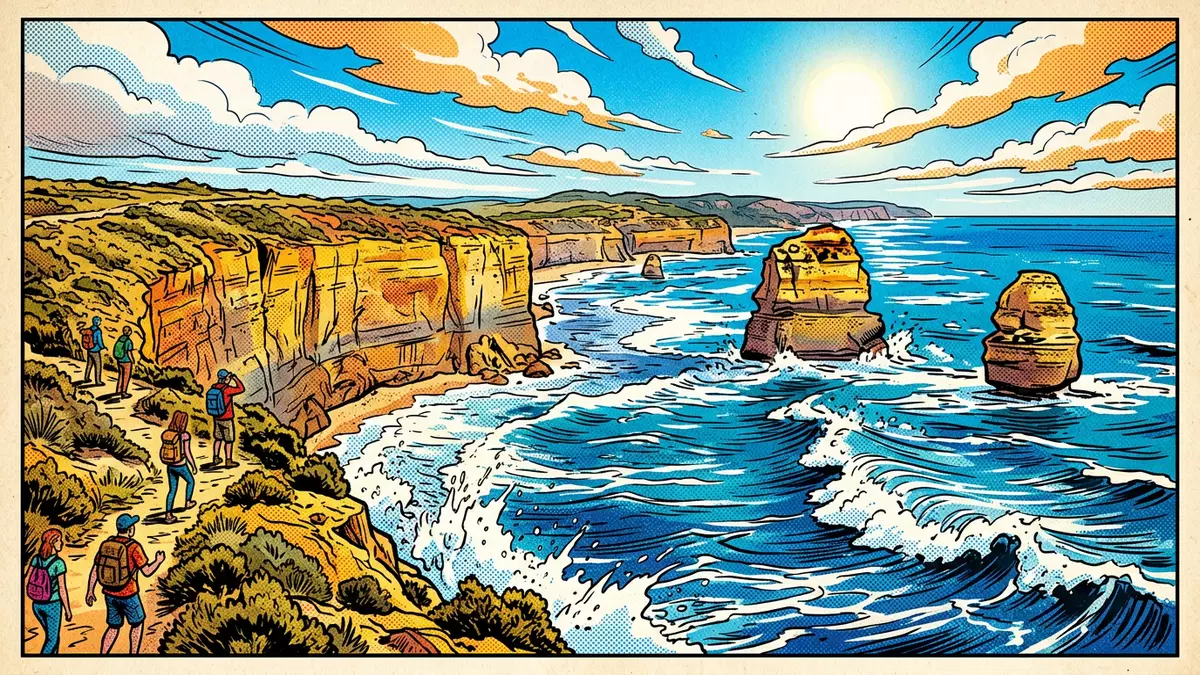
Along the coast near Port Campbell in Victoria, Twelve Apostles marks a dramatic meeting of land and sea, where tall limestone pillars stand in the Southern Ocean just offshore. The sea stacks belong to Port Campbell National Park and form one of the most recognisable stretches of Australia’s Great Ocean Road, framed by cliffs, surf and long views along the coast.
Limestone stacks carved from a retreating coastline
Twelve Apostles consists of a group of limestone stacks standing in the surf off the cliffs of Port Campbell National Park, along the southern coast of Victoria in south-eastern Australia.limestone stacks The formations rise beside near-continuous sea cliffs of similar rock, creating a narrow band of land between the Southern Ocean and the agricultural hinterland inland.near continuous sea cliffs The stacks reach heights of around 45 m (148 ft) above the water surface, their upper portions catching the light while their bases take the brunt of the surf.
The cliffs and Twelve Apostles stacks are composed mainly of Port Campbell Limestone, a marine sedimentary rock laid down when this part of Victoria formed the floor of a shallow sea during the mid-Miocene period.Port Campbell Limestone Beneath the limestone sits softer Gellibrand marl, clay and mudstone, which erode more rapidly, contributing to the layered appearance of the cliffs and stacks where bands of differing resistance to the sea are visible.layered appearance
Millions of years of formation and a changing set of stacks
The rock making up Twelve Apostles was formed over millions of years as tiny marine organisms settled on the seabed, their remains compressing into limestone layers under accumulating sediment.marine organisms settled Geological research using microscopic fossils has dated the limestone to roughly between 8.6 million and 14 million years old, placing it in the mid-Miocene, a period when global climates were warmer than at present.8.6 million and 14 million years Tectonic movements later lifted and tilted these layers, bringing them above sea level and exposing them to marine erosion.
The sea stacks themselves are relatively young landforms in geological terms. Following a marked rise in sea level around 20,000 to 23,000 years ago, waves began cutting into the newly formed cliffs, enlarging joints and weak zones into caves, arches and eventually isolated pillars of rock.rise in sea level The group known as Twelve Apostles has never consisted of twelve stacks; charts from the late eighteenth century used names such as “Sow and Pigs”, and the biblical name gained currency in the late nineteenth century as tourism to the coast developed.biblical name
Great Ocean Road setting and nearby formations
Twelve Apostles stands within Port Campbell National Park on the western part of the Great Ocean Road, a coastal route linking a series of cliffs, headlands and bays in south-western Victoria.western part of the Great Ocean Road The viewpoint area faces a line of stacks just offshore, with additional formations scattered along the coast, including arches and small islands that mark further stages in the erosion sequence.remaining rock stacks To the east, other sea stacks such as Gog and Magog near Gibson Steps and the formations at Loch Ard Gorge form part of the same limestone coast.
Twelve Apostles lies near the town of Port Campbell in south-western Victoria, on the shore of the Southern Ocean. From the viewing platforms, the coastline runs away in both directions, with high cliffs edging the sea and flat farmland inland. The wider region includes further protected coastal areas such as Bay of Islands Coastal Park, where additional stacks and cliffs extend the limestone scenery along tens of kilometres of shore.limestone coast
Visiting Twelve Apostles: what travellers from Western Europe should know
- Twelve Apostles is on the coast of Victoria in south-eastern Australia, near the town of Port Campbell and alongside the Great Ocean Road, reached by road from inland centres.
- The viewpoint sits on top of cliffs above the Southern Ocean, with boardwalks and paths and a series of steps connecting different levels and platforms.
- The surrounding terrain combines exposed coastal cliffs, strong ocean swell and open farmland inland, so conditions on the paths and viewing areas reflect a fully coastal environment.
- The official language is English and the currency is the Australian dollar.
- Entry requirements depend on your nationality; UK travellers can check the FCDO travel advice at gov.uk/foreign-travel-advice, Irish travellers the Department of Foreign Affairs at ireland.ie.
Searching for Twelve Apostles on social platforms
These links open searches for Twelve Apostles on each platform.Frequently asked questions about Twelve Apostles
Where is Twelve Apostles located?
Twelve Apostles is on the coast of Victoria in south-western Australia, near the town of Port Campbell, within Port Campbell National Park along the Great Ocean Road.
What can visitors expect at Twelve Apostles?
Visitors encounter limestone sea stacks rising from the Southern Ocean, high coastal cliffs, boardwalks and viewing platforms, with expansive views along a rugged stretch of shoreline.
What makes Twelve Apostles distinctive?
The site is distinctive for its combination of mid-Miocene limestone geology, tall sea stacks close to the cliffs, and its setting within a long protected coastal landscape.


