
U Bein Bridge and its long teak crossing over Taungthaman Lake
Published on 09/24/2026 at 05:51 | Editorial responsibility: Rafael Müller, Editor-in-Chief AD HOC NEWS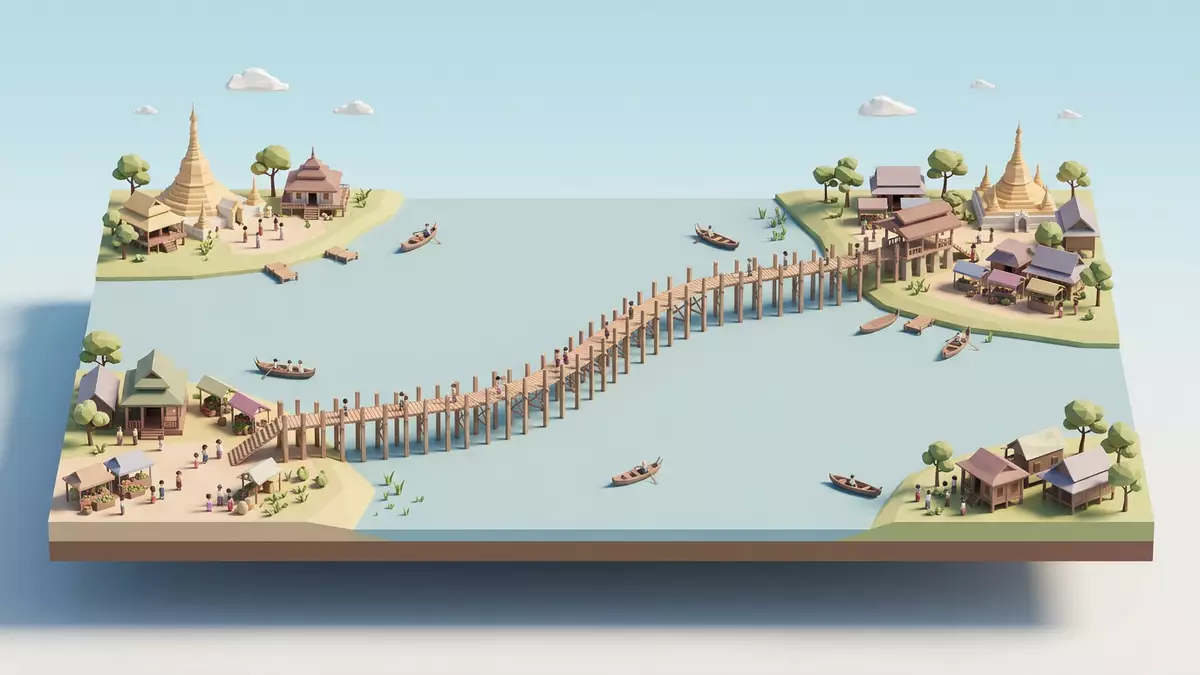
U Bein Bridge crosses Taungthaman Lake near Amarapura as a long timber walkway carried above shallow water. Built between 1849 and 1851, it extends for about 1.2 km (0.75 miles) through a landscape of lake, teak posts and distant shore.
U Bein Bridge: a teak walkway across Taungthaman Lake
The bridge is a wooden footbridge with a gently curving route across Taungthaman Lake. Its deck follows a narrow line above the water, with timber posts rising beneath it and open views stretching towards Amarapura and the surrounding countryside.
Its principal material is teak, a durable hardwood used throughout Myanmar’s traditional buildings. The bridge carries a single pedestrian lane, while raised sections and resting shelters interrupt the long crossing. The structure is supported by more than a thousand posts, giving the route a repeated rhythm of uprights, beams and planks.
From Inwa timber to an Amarapura crossing
U Bein Bridge belongs to the nineteenth-century history of the Konbaung dynasty. Construction began in 1849 and finished in 1851, during the period when Amarapura served as a royal capital in central Myanmar.
The bridge is named after U Bein, the local official associated with its construction. Much of the timber came from the former royal palace at Inwa, also known as Ava. That reused teak gives the crossing a direct connection with the royal architecture of an earlier Burmese capital. the bridge’s construction dates place it firmly in the middle of the nineteenth century.
The visible rhythm of posts, spans and water
U Bein Bridge is defined by repetition. Lines of teak supports rise from the lakebed, while the walkway passes across a sequence of spans and small shelters. Some supports have been replaced with concrete, but the bridge retains its wooden character.
The crossing has a length of about 1.2 km (0.75 miles), making its scale apparent from the shore and from the water. The bridge’s slight curve prevents the route from appearing as a single rigid line. its teak structure and palace timber connect the practical crossing with the architectural history of Inwa.
At different water levels, the relationship between deck and lake changes visibly. The posts may appear partly surrounded by open water, mudflats or wet ground. Boats and fishermen belong to the lake setting, while pedestrians, monks and local residents use the raised timber route.
Visiting U Bein Bridge: what travellers from Western Europe should know
- U Bein Bridge lies in Amarapura, south of Mandalay, and crosses Taungthaman Lake. Road transport from Mandalay reaches the bridge’s lakeside approaches.
- The crossing is a narrow wooden pedestrian route above shallow lake water. Its uneven timber surface and open edges require careful footing.
- Myanmar is the official country name used in English, and the national currency is the kyat.
- The bridge is part of the historic landscape around Amarapura, Inwa and Mandalay, former royal centres connected with the Konbaung dynasty.
Searching for U Bein Bridge on social platforms
These links open searches for U Bein Bridge on each platform.
Frequently asked questions about U Bein Bridge
Where is U Bein Bridge?
U Bein Bridge is in Amarapura, near Mandalay in central Myanmar. It crosses Taungthaman Lake between the lakeside approaches on either shore.
What can visitors expect at the bridge?
The visit centres on a long wooden footbridge above shallow water. The route has timber planks, open edges, support posts and small resting shelters.
What makes U Bein Bridge distinctive?
Its distinctive character comes from its length, teak construction and connection with Inwa’s former royal palace. The bridge combines an everyday pedestrian crossing with nineteenth-century royal history.


