
Uluru’s red monolith and sacred landscape
Published on 09/17/2026 at 08:46 | Editorial responsibility: Rafael Müller, Editor-in-Chief AD HOC NEWS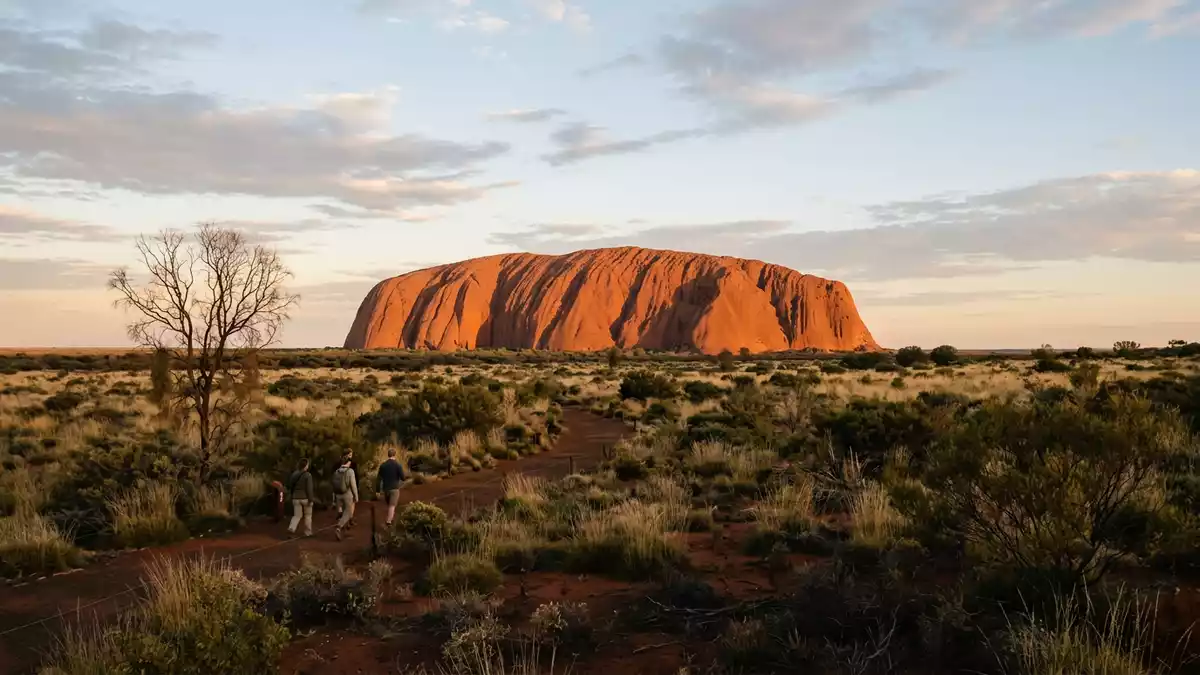
Uluru rises from the red plain near Yulara as a single sandstone monolith, with steep sides and a smooth, rounded profile. It sits within Uluru-Kata Tjuta National Park, a World Heritage landscape linked to A?angu culture and Australia’s deep geological historyWorld Heritage landscape.
Uluru and the central Australian plain
The rock stands in the Northern Territory, far from the coastal cities that shape most Australian itineraries. Around it lies a wide desert country of open horizons, low vegetation and strong colour contrasts between the rock and the plain.
Uluru is part of a broader country of inselbergs and ancient sedimentary rock, and its surface shows the layering and weathering that give it its distinctive form. The place is tied to the A?angu, the Traditional Owners of the area, and to a living cultural landscape rather than a monument frozen in one moment of historyA?angu cultural landscape.
Sandstone, colour and scale
The rock is composed of arkosic sandstone, and its steep slopes make the mass read as one object even when the surface breaks into ledges, fissures and shallow hollows. The scale is part of its appeal: it dominates the surrounding plain without losing the detail of the rock facearkosic sandstone.
Uluru-Kata Tjuta National Park was inscribed on the UNESCO World Heritage List for its natural values in 1987 and recognised again in 1994 for its cultural landscape. That dual status reflects both the geology and the enduring relationship between the place and the A?anguWorld Heritage List.
Uluru in the country around Yulara
Yulara is the nearest township and the usual base for visitors. The park lies in central Australia, in a dry interior setting that makes distances feel large and the land feel open.
Kata Tjuta lies west of Uluru within the same park and shares the same broad desert setting. Seen together, the two formations show different expressions of the same ancient landscapeKata Tjuta lies west.
Visiting Uluru: what travellers from Western Europe should know
- The park is reached from Yulara by road, with access continuing into Uluru-Kata Tjuta National Park. The nearest major regional reference point is Alice Springs in central Australia.
- The rock is exposed and broad, with no sheltered summit route. Visitors meet open ground, sandstone surfaces and long sightlines across the plain.
- The official language is English and the currency is the Australian dollar.
- Entry requirements depend on your nationality; UK travellers can check the FCDO travel advice at gov.uk/foreign-travel-advice, Irish travellers the Department of Foreign Affairs at ireland.ie.
Searching for Uluru on social platforms
These links open searches for Uluru on each platform.
Frequently asked questions about Uluru
Where is Uluru?
Uluru stands in the Northern Territory of central Australia, within Uluru-Kata Tjuta National Park near Yulara. Alice Springs lies to the south-east.
What should a visit feel like?
The place is defined by open desert, a large red rock face and wide views across flat country. The site is not a city attraction but a landscape with a strong cultural presence.
What makes Uluru distinctive?
Its single block form, red sandstone body and World Heritage status make it immediately recognisable. The cultural landscape around it is inseparable from the rock itself.