
Vang Vieng’s limestone karst valley along the Nam Song River
Published on 08/16/2026 at 13:30 | Editorial responsibility: Rafael Müller, Editor-in-Chief AD HOC NEWS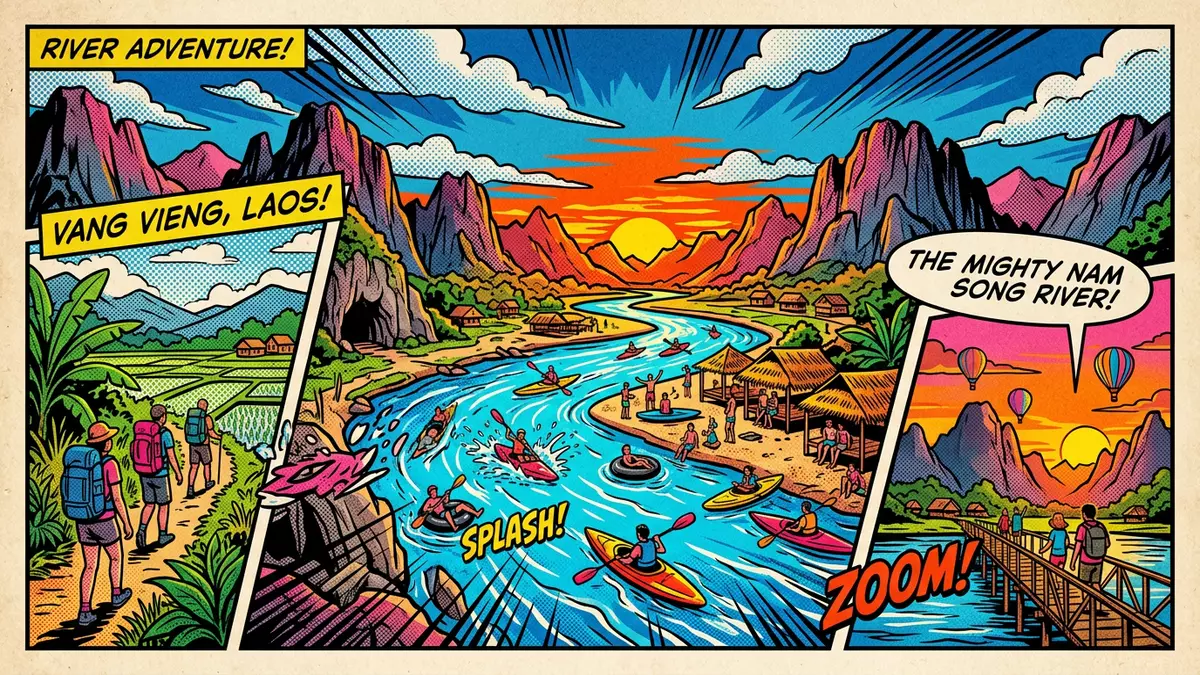
Vang Vieng in central Laos is a small riverside town set in a broad valley where the Nam Song River runs beneath steep limestone hills, caves and blue lagoons carved into a karst landscape. The town lies between the capital Vientiane and the historic city of Luang Prabang, and its surroundings of jagged grey-green peaks and rice fields have made Vang Vieng a recognised centre for adventure travel in Laos.
Limestone karst peaks around the Nam Song River
Vang Vieng sits on the banks of the Nam Song River, with the town’s streets and guesthouses clustered near the water and limestone hills rising directly from the valley floor beyond the river channels. The karst landscape around Vang Vieng is characterised by rugged limestone mountains that form pinnacles, domes and cliffs, some of them covered in dense vegetation and lianas above rice paddies and river braids in the plain.dreamlike limestone mountain peaks The wider karst field extends for several kilometres north–south and east–west along the right bank of the Nam Song, creating a continuous belt of limestone terrain around the town.karsts de Vang Vieng
The limestone rocks in this region reach elevations well above the valley floor, with named peaks such as Pha Nampin and Pha Deng rising to more than 1,500 m (4,921 ft) in the wider karst sector north and south of Vang Vieng.calcaires jusqu’à 1 600 mètres From vantage points on hills such as Nam Xay, the valley appears as a patchwork of rice paddies, river channels and scattered farm tracks ringed by cliffs and sharp ridges.Nam Xay viewpoint Hot-air balloons, when they fly over the river and hills, emphasise the relief of the karst terrain as they drift above the peaks and the town.
Caves, blue lagoons and the underground water world
The karst geology of Vang Vieng has produced a dense network of limestone caves that open at the base of hills and along valley margins, many of them reachable from tracks leading west of the Nam Song River.network of caves Over geological timescales, slightly acidic rainwater and river water have dissolved the limestone bedrock, forming underground channels, caverns and sinkholes that in places have collapsed, leaving freestanding towers and open depressions.karst landscapes formed through dissolution of limestone Many of the better-known caves near Vang Vieng can be entered along marked paths, with interior chambers where stalactites and stalagmites have developed from slow dripping water.
The same karst processes have created the blue lagoons around Vang Vieng, pools of clear, mineral-rich water at the foot of limestone hills, some fed by underground springs and surface streams emerging from caves.Blue Lagoons near Vang Vieng These lagoons, including well-known spots such as Lagoon 1 and Lagoon 3, are surrounded by forest and cliffs and have platforms or simple facilities around their banks for visitors to reach the water. In places, karst towers stand directly above lagoon pools, giving views of turquoise water framed by limestone walls and trees.
A riverside town between Vientiane and Luang Prabang
Vang Vieng is located in Vientiane Province in central Laos, set roughly midway between the national capital Vientiane and the heritage city Luang Prabang on the Mekong.small town of Vang Vieng The settlement itself is relatively small, with low-rise buildings, simple streets and bridges crossing the Nam Song to reach the main valley of caves, lagoons and cliffs to the west.city on the banks of the Nam Song River Around the town, Hmong villages and Buddhist monasteries from the sixteenth and seventeenth centuries form part of the cultural landscape alongside rice fields and farm plots.
Over the years Vang Vieng has become a recognised base for adventure and nature tourism in Laos, with activities such as kayaking along stretches of the Nam Song River, caving, rock climbing and hiking on tracks that wind between limestone hills and rural settlements.picturesque landscape with karst mountains The town’s position in a valley of karst limestone mountains, combined with water features such as caves and lagoons, has made the surrounding countryside a focal point for eco-adventure travel in Laos.central point for adventure tourism
Visiting Vang Vieng: what travellers from Western Europe should know
- Vang Vieng lies in Vientiane Province in central Laos on the Nam Song River, roughly between Vientiane and Luang Prabang, with road and rail routes linking these three destinations.
- Tracks west of the Nam Song cross bridges and unpaved roads into the karst valley, where approaches to caves, viewpoints and blue lagoons generally involve walking on uneven ground and climbing slopes or stairways on limestone terrain.
- The surrounding limestone hills and viewpoints reach elevations well above the valley floor, so ascents such as the climb to Nam Xay viewpoint involve sustained uphill walking on steep paths and basic steps.
- Vang Vieng has a hot dry season and a wet monsoon, and in the rainy months paths, tracks and river levels respond to seasonal rainfall in the karst valley.
- The official language is Lao and the currency is the Lao kip; entry requirements depend on your nationality, UK travellers can check the FCDO travel advice at gov.uk/foreign-travel-advice, Irish travellers the Department of Foreign Affairs at ireland.ie.
Searching for Vang Vieng on social platforms
These links open searches for Vang Vieng on each platform.
Frequently asked questions about Vang Vieng
Where is Vang Vieng in Laos?
Vang Vieng is a riverside town in Vientiane Province in central Laos, set on the Nam Song River between Vientiane and Luang Prabang in the country’s interior.
What can visitors expect in the landscape around Vang Vieng?
The area around Vang Vieng offers a valley of limestone karst peaks, caves, blue lagoons, rice fields and river channels, with tracks and paths leading into the hills and countryside.
What makes Vang Vieng distinctive compared with other towns in Laos?
Vang Vieng is distinctive for its combination of a small riverside town and a surrounding limestone karst landscape, where caves, lagoons and cliffs have formed an established base for adventure and nature tourism.


