
Vesuvio above the Gulf of Naples
Published on 09/21/2026 at 18:28 | Editorial responsibility: Rafael Müller, Editor-in-Chief AD HOC NEWS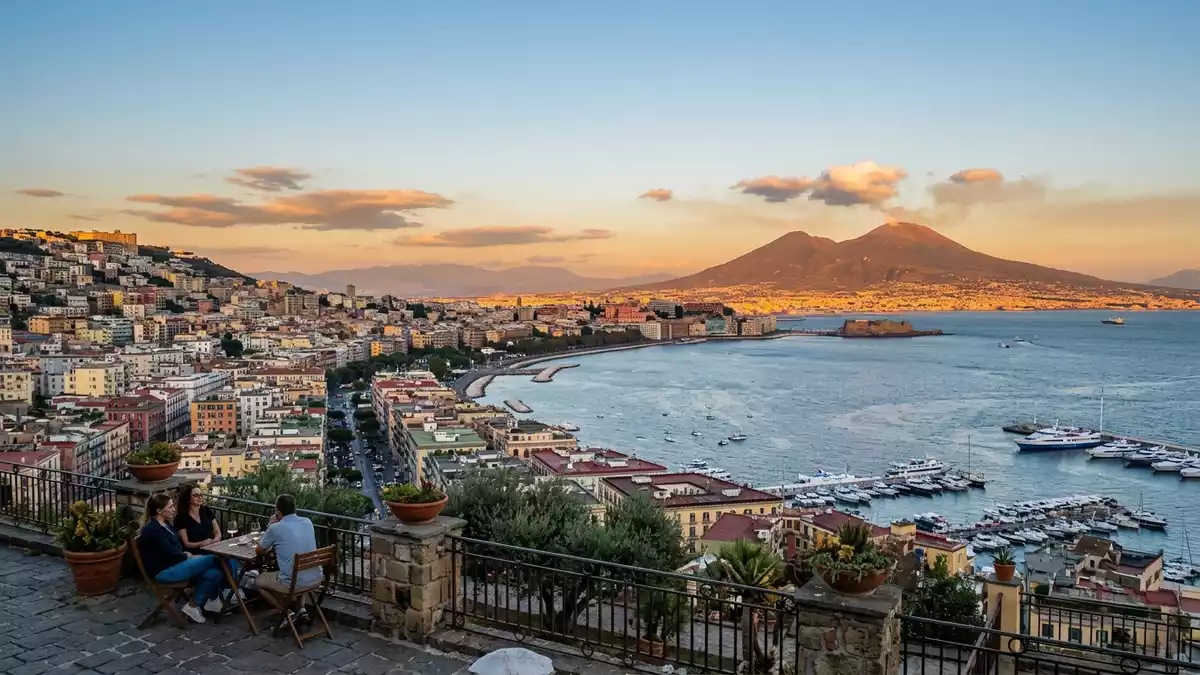
Vesuvio, better known in English as Mount Vesuvius, is the active stratovolcano that dominates the eastern skyline of Neapel and the curve of the Gulf of Naples in southern Italy. Rising to about 1,281 m (4,203 ft) above sea level in the region of Campania, it combines a broad volcanic cone with a deep summit crater that has shaped both the landscape and the history of the surrounding towns since antiquity.
A layered volcano above the bay
Vesuvio stands on the coastal plain of Campania, its western slopes falling towards the Bay of Naples and its higher flanks forming a broken ridge above cultivated land and suburban settlements.active volcano above the Bay of Naples The mountain is a stratovolcano built from successive layers of hardened lava, ash and fragmented rock, producing a steep-sided cone with a conspicuous summit depression. The present peak, often referred to locally as Gran Cono, sits within the larger, older volcanic structure of Monte Somma, so that the overall massif combines a younger central cone encircled by the remnants of a wider caldera ring.Gran Cono within Monte Somma
The volcano’s height and isolated position make its outline recognisable from Neapel and from much of the gulf, especially where the profile of the cone rises behind the coastal towns of Ercolano and Torre del Greco. The official elevation of roughly 1,281 m (4,203 ft) places Vesuvio among the higher peaks of the Bay of Naples area, and its slopes carry a mix of bare, stony ground and patches of vegetation characteristic of Mediterranean volcanic terrain.height of about 1,281 m
A volcano marked by ancient and modern eruptions
Vesuvio is inseparable from the catastrophic eruption of 79 AD, during the Roman Imperial period, which buried the towns of Pompeii and Herculaneum beneath volcanic material and fixed their streets and houses in the archaeological record.eruption of 79 AD Historical accounts and geological studies describe a sequence of later eruptions over the centuries, with activity recorded many times after antiquity. The current summit cone developed within the larger Somma caldera in the centuries following one of these major eruptive phases, giving the mountain its present two-part structure of inner cone and outer ring.present cone within an older caldera
The last confirmed eruption of Vesuvio occurred in 1944, during the Second World War, after which the volcano entered a quiescent phase that continues with fumaroles and minor seismic activity but without further explosive events.last eruption in 1944 The combination of an active classification and a decades-long period without major eruptions means that the summit crater can be approached on marked paths while the broader volcanic system remains under scientific observation. The surrounding slopes record past activity in layers of dark lava, lighter pumice and tuff, which appear in road cuttings, ravines and the rims of smaller subsidiary depressions.
Vesuvius National Park and the crater paths
The mountain and its immediate surroundings form the Vesuvius National Park, which frames Vesuvio within a protected area of volcanic landscapes, Mediterranean scrub and cultivated terraces.Vesuvius National Park The park administration describes a network of 11 numbered paths with a combined length of about 54 km (33.6 mi) of walkway, ranging from lower-level loops through woodland and old lava fields to the more exposed routes towards the upper slopes and crater rim.11 paths totalling around 54 km
On the higher ground near the summit, paths across compacted volcanic ash and rough stones lead towards the main crater edge, where the steep inner walls of Vesuvio are visible as a mix of loose debris and more solid lava layers. From the rim, the view extends over the Gulf of Naples, the line of the Sorrento Peninsula, and the densely settled plain stretching towards Neapel. Lower down, other trails cross older lava flows and areas of vegetation, allowing visitors to see how plant communities have recolonised surfaces laid down by past eruptions while still leaving wide swathes of bare rock and clinker.
Visiting Vesuvio: what travellers from Western Europe should know
- Vesuvio rises east of Neapel in Campania; approaches commonly start near the coastal towns of Ercolano and Torre del Greco, where roads lead towards the national park.
- The upper paths towards the crater follow compacted ash and stony ground at altitude, with sections on the rim involving a noticeable gradient and stretches on loose volcanic material.
- The wider Vesuvius National Park includes lower-level trails through woodland and old lava fields, so routes range from short walks on rough surfaces to longer excursions across varied volcanic terrain.
- The official language is Italian and the currency is the euro.
Searching for Vesuvio on social platforms
These links open searches for Vesuvio on each platform.
Frequently asked questions about Vesuvio
Where is Vesuvio located?
Vesuvio stands on the Gulf of Naples in Campania, southern Italy, rising east of Neapel above the coastal plain and the Bay of Naples.
What should visitors expect on a visit to Vesuvio?
Visitors encounter marked paths on volcanic ash and stones, views over the gulf from the crater rim, and access to a wider network of trails within Vesuvius National Park.
What makes Vesuvio distinctive among European volcanoes?
Vesuvio combines an active status with a stratovolcanic cone inside the older Monte Somma caldera and is closely associated with the Roman-period eruption that buried Pompeii and Herculaneum.


