
Victoria & Alfred Waterfront: Cape Town’s harbour quarter framed by Table Mountain
Published on 08/17/2026 at 13:20 | Editorial responsibility: Rafael Müller, Editor-in-Chief AD HOC NEWS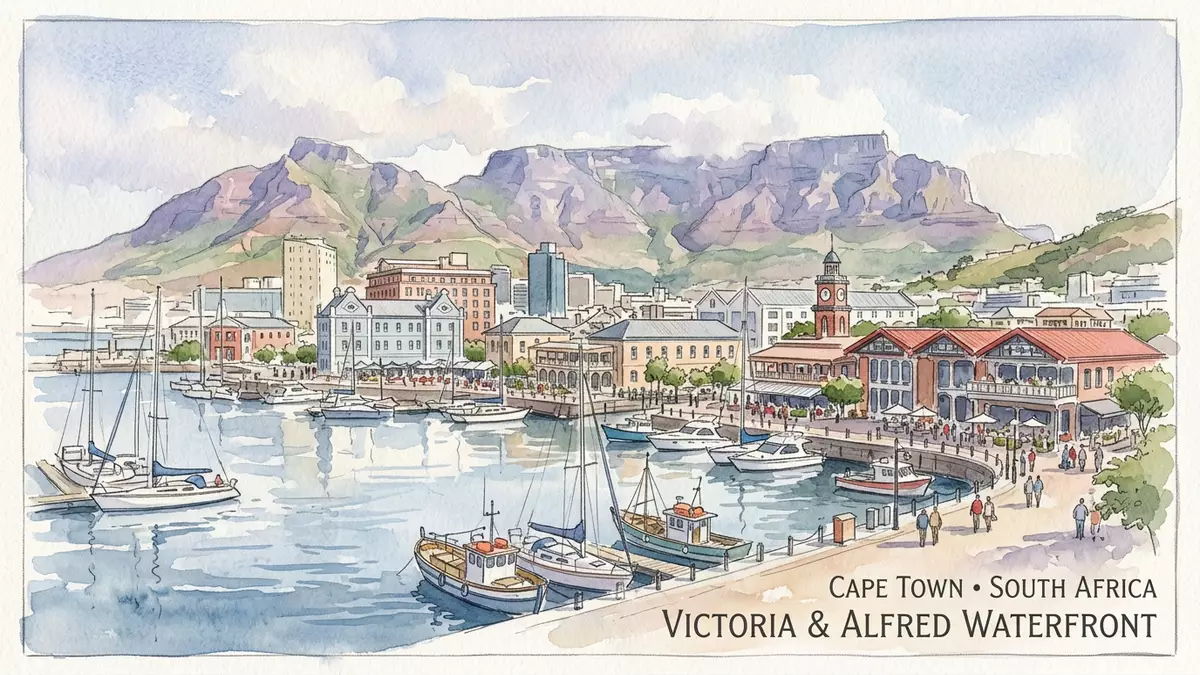
Victoria & Alfred Waterfront in Kapstadt is a harbour district where nineteenth-century dock basins, cranes and warehouses stand directly against the backdrop of Table Mountain. More than a single attraction, it is a piece of Cape Town’s working port that has been reshaped as a mixed-use waterfront while retaining its maritime geometry.
From royal names to working harbour
The name Victoria & Alfred Waterfront comes from two historic harbour basins on the edge of Table Bay, the Alfred Basin and the Victoria Basin. The first basin honours Prince Alfred, second son of Queen Victoria, and the second commemorates the queen herself, fixing the British royal family into Cape Town’s geography.The Waterfront was named after the Alfred Basin and the Victoria Basin
Prince Alfred visited the Cape as a young midshipman in the Royal Navy and in 1860 tipped the first load of stone for a substantial breakwater, marking the start of Cape Town’s modern harbour works.In June 1858 winter storms wrecked ships in Table Bay and in September 1860 Prince Alfred started construction of the breakwater The Alfred Basin followed, and harbour infrastructure developed through the late nineteenth century as maritime traffic grew along the sea route between Europe and Asia.
Redevelopment of an historic dockyard
By the later twentieth century, newer deep-water facilities further along the port had reduced the importance of the original basins and quays. The older dock area stood with its stone walls, warehouses and mechanical equipment still in place but increasingly under-used as shipping requirements changed.The breakwater created in 1860 and extended in 1905 anchored Cape Town’s shipping trade until mid-twentieth-century changes
A turning point came in November 1988, when Victoria & Alfred Waterfront (Pty) Ltd was established to redevelop the historic docklands around the two basins as a mixed-use urban quarter that would coexist with the functioning port.In November 1988 Victoria and Alfred Waterfront (Pty) Ltd was created to redevelop the docklands as a mixed-use area while the harbour continued operating Over the following decades, former industrial structures were converted into spaces for shops, restaurants, cultural venues and hotels, with port operations continuing in adjacent quays.
Table Mountain, harbour basins and city life
What distinguishes Victoria & Alfred Waterfront is the way the harbour basins open onto Table Bay while the cliffs of Table Mountain rise behind the city skyline. From quayside promenades and terraces, visitors see container ships and tugs in one direction and the flat-topped mountain and Signal Hill in the other, binding together port, city and landscape.The 123-hectare V&A Waterfront development combines retail, leisure, offices, residential buildings and hotels alongside the harbour
Many of the buildings around the basins retain their warehouse proportions, with brick or stone walls, high roofs and large openings now adapted to new uses.A former coal store and baggage warehouse from 1904 now houses the Victoria & Alfred Hotel and Alfred Mall Historic cranes, rail tracks set into the paving and moored boats underline that this is still a working harbour, even as terraces, hotels and public art draw visitors to the water’s edge.
Visiting Victoria & Alfred Waterfront: what travellers from Western Europe should know
- Victoria & Alfred Waterfront lies on Cape Town’s Atlantic seaboard, within the city’s port in Table Bay, north of the central business district.
- The district is largely level quayside terrain, with long promenades along the Alfred Basin and Victoria Basin and various internal staircases and escalators inside buildings.
- Table Mountain, Signal Hill and the city centre sit within clear sight of the waterfront, so the area often features as a starting point for exploring central Cape Town.
- The official language is Afrikaans, English and other South African languages and the currency is the South African rand.
- Entry requirements depend on your nationality; UK travellers can check the FCDO travel advice at gov.uk/foreign-travel-advice, Irish travellers the Department of Foreign Affairs at ireland.ie.
Searching for Victoria & Alfred Waterfront on social platforms
These links open searches for Victoria & Alfred Waterfront on each platform.
Frequently asked questions about Victoria & Alfred Waterfront
Where is Victoria & Alfred Waterfront located in Cape Town?
Victoria & Alfred Waterfront occupies historic harbour basins in Table Bay, immediately north of Cape Town’s central business district on the Atlantic seaboard.
What can visitors expect to find at Victoria & Alfred Waterfront?
Visitors encounter a mix of quayside promenades, converted warehouses, hotels, shops and cultural venues set around the Alfred Basin and Victoria Basin within a working harbour.
What makes Victoria & Alfred Waterfront distinctive among harbour districts?
The district combines nineteenth-century maritime infrastructure and active port operations with urban redevelopment, all framed by direct views of Table Mountain and the surrounding city skyline.


