
Victoria Falls and the basalt gorge below it
Published on 09/14/2026 at 06:28 | Editorial responsibility: Rafael Müller, Editor-in-Chief AD HOC NEWS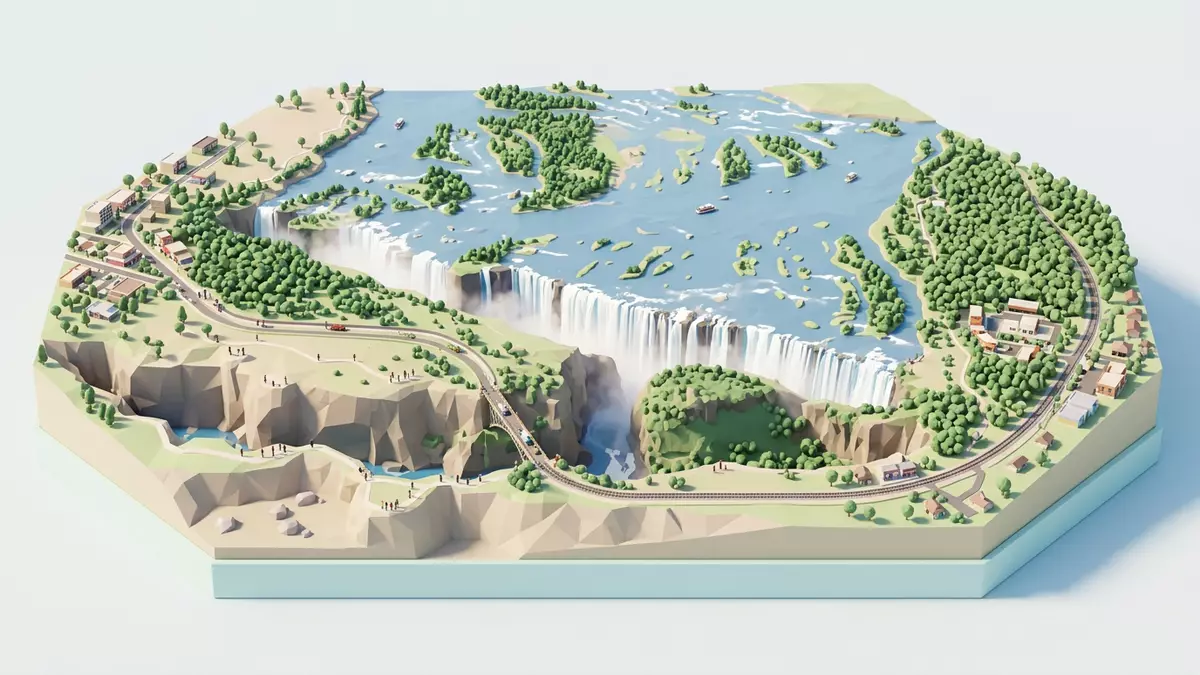
Victoria Falls is a broad curtain of water on the Zambezi River, at the border between Zambia and Zimbabwe. The falls and adjoining parklands were inscribed as a World Heritage site in 1989, and the name Mosi-oa-Tunya still sits beside the English one.
Water, rock and a border crossing
The falls span a deep break in a basalt plateau, where the river drops into a narrow gorge below. That combination of sheet-like water and dark rock gives Victoria Falls its most striking form.Zambezi River World Heritage site
The official names link the falls to two countries and to the local phrase Mosi-oa-Tunya, meaning the smoke that thunders. David Livingstone gave the English name in 1855, and that date remains tied to the European naming of the place.David Livingstone 1855
Names that travel with the water
Mosi-oa-Tunya captures the spray that rises above the gorge, while Victoria Falls remains the name used in English. Both names matter because they belong to the same place, not to separate sights.
The site sits on an international boundary, so the landscape and the politics of place meet in a single view. That makes the falls more than a waterfall: they are a shared river landscape with a formal conservation status and a long recorded history.border between Zambia and Zimbabwe
How the gorge frames the falls
Below the lip, the river enters a set of steep basalt gorges that continue downstream. The rock walls, the narrow channel and the falling water create the place’s clearest visual contrast.
The World Heritage inscription recognises both the beauty of the falls and the geological processes that shaped the setting. Here, the geology is not background; it is part of the view, with basalt, spray and cliff edges all reading at once.Mosi-oa-Tunya / Victoria Falls
Visiting Victoria Falls: what travellers from Western Europe should know
- Victoria Falls lies on the border between Zimbabwe and Zambia, with access from the towns of Victoria Falls and Livingstone on opposite sides of the river.
- The ground near the falls includes gorge edges, river viewpoints and parkland, so the landscape changes quickly from open river to steep rock.
- The official language is English in Zimbabwe and Zambia has English as an official language; the currency is the Zimbabwean dollar in Zimbabwe and the Zambian kwacha in Zambia.
- Conditions on the river edge and in the gorge vary with the terrain, so footwear and caution matter more than distance.
Searching for Victoria Falls on social platforms
These links open searches for Victoria Falls on each platform.
Frequently asked questions about Victoria Falls
Where is Victoria Falls?
Victoria Falls sits on the Zambezi River between Zimbabwe and Zambia. The falls are associated with the town of Victoria Falls in Zimbabwe and Livingstone in Zambia.
What does a visit involve?
A visit usually centres on viewpoints, river-edge paths and the wider gorge landscape. The terrain is defined by water, spray and steep basalt walls rather than by a single viewing point.
What makes Victoria Falls distinctive?
The place combines a large waterfall, a basalt gorge system and a transboundary setting. Its English name and Mosi-oa-Tunya show the layered cultural history of the falls.


