
Victoria Falls and the great curtain of the Zambezi
Published on 09/18/2026 at 09:56 | Editorial responsibility: Rafael Müller, Editor-in-Chief AD HOC NEWS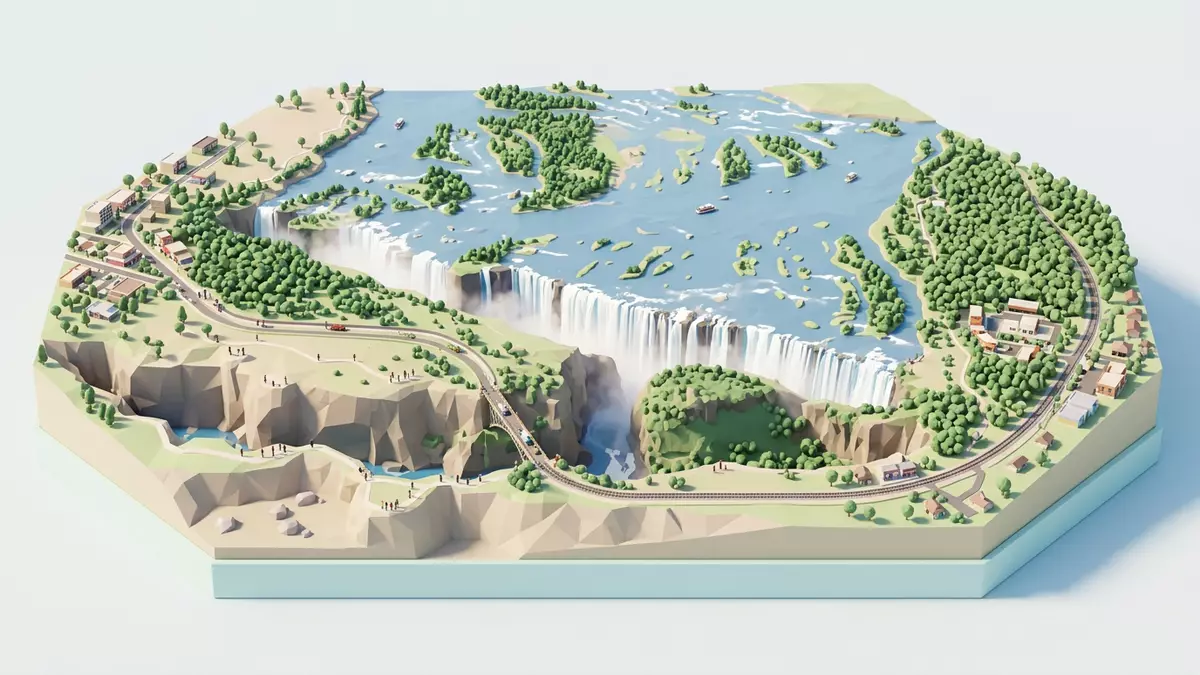
Victoria Falls is one of southern Africa’s defining landmarks, where the Zambezi River plunges off a basalt plateau in a continuous curtain of water along the border between Zambia and Zimbabwe. The falls are widely known by the local Lozi name Mosi-oa-Tunya, meaning “the smoke that thunders”, and were named Victoria Falls by the Scottish explorer David Livingstone in 1855 in honour of Queen Victoria.Scottish explorer David Livingstone
The Zambezi River and the basalt gorge
Victoria Falls lies roughly midway along the course of the Zambezi River, the fourth-longest river in Africa, where the river forms the international boundary between Zambia and Zimbabwe.midway along the course of the Zambezi River At this point the Zambezi reaches one of its greatest widths, more than 1,700 m (about 5,600 ft), before dropping abruptly into a narrow chasm cut into the Batoka Plateau. The falls stand at around 915 m (3,000 ft) above sea level, where the basalt bedrock is deeply fractured into a series of east–west fissures that have guided the river’s course into successive gorges.fractures running in a roughly east–west direction
The present line of the waterfall follows one of these major joints, creating a face that drops up to about 108 m (355 ft) from the lip to the river below.a maximum drop of 108 m After the plunge, the Zambezi flows away through a zig-zag sequence of basalt gorges, each marking an earlier position of the falls as erosion has cut back through the plateau. The rock at the lip includes a resistant dolerite sill overlying basalt, a combination that contributes to the clean cliff over which the river falls.dolerite sill and basalt lava flows
The largest curtain of falling water
What distinguishes Victoria Falls is not only its height but the way the Zambezi forms a continuous wall of water. The waterfall extends for about 1,708 m (5,604 ft) across the river, creating what UNESCO describes as the world’s largest curtain of falling water.largest curtain of falling water in the world At peak flood, hundreds of millions of litres of water pour over the edge each minute, throwing up spray that can be visible for many kilometres from roads in both Zambia and Zimbabwe.sprays from this giant waterfall
The falls are divided into several named sections that correspond to variations in depth along the lip and the shape of the underlying gorge. From west to east these include Devil’s Cataract, Main Falls, Rainbow Falls and Eastern Cataract, each with its own characteristic drop, with depths measured at around 61 m, 83 m, 99 m and 98 m respectively.Devil’s Cataract, Main Falls, Rainbow Falls, Eastern Cataract The overall effect is a single broken line of water, separated only by small islands along the cliff, turning the wide river into a wall of mist and noise in the narrow gorge.
National parks and viewpoints on both banks
Victoria Falls and the surrounding riverine landscapes form part of two protected areas: Mosi-oa-Tunya National Park in Zambia and Victoria Falls National Park in Zimbabwe, with riverine sections of Zambezi National Park also included.Mosi-oa-Tunya National Park and Victoria Falls National Park Together these protected areas cover several thousand hectares of river, woodland and gorge, forming a transboundary World Heritage Site inscribed by UNESCO in 1989 for both its geological significance and its natural beauty.inscribed on the World Heritage List in 1989
On the Zimbabwean side, paths and viewpoints in Victoria Falls National Park provide extensive views of the Main Falls and Rainbow Falls sections, where the water faces broadly south. On the Zambian side, trails in Mosi-oa-Tunya National Park run closer to the lip of Eastern Cataract and across a bridge to a small island in the river upstream, giving a sense of the width of the Zambezi before it drops into the gorge. Both banks share the experience of dense spray rising from the chasm and rainbows forming when the sun strikes the mist.
Visiting Victoria Falls: what travellers from Western Europe should know
- Victoria Falls lies on the Zambezi River where Zimbabwe meets Zambia, with viewpoints in Victoria Falls town on the Zimbabwean side and near Livingstone on the Zambian side. It is reached overland from regional centres by road and rail.
- The main viewpoints are linked by paths and walkways that include sections with many steps and uneven surfaces, and the spray can leave the ground wet and slippery.
- The surrounding protected area includes national park land on both banks of the river, with woodland, riverine vegetation and gorge viewpoints beyond the immediate waterfall.
- The official languages are English in Zimbabwe and English in Zambia, and the currencies are the Zimbabwean dollar and the Zambian kwacha.
- Entry requirements depend on your nationality; UK travellers can check the FCDO travel advice at gov.uk/foreign-travel-advice, Irish travellers the Department of Foreign Affairs at ireland.ie.
Searching for Victoria Falls on social platforms
These links open searches for Victoria Falls on each platform.
Frequently asked questions about Victoria Falls
Where is Victoria Falls?
Victoria Falls stands on the Zambezi River in southern Africa, forming part of the border between Zimbabwe to the south and Zambia to the north.
What can visitors expect on a visit?
Visitors encounter a broad wall of water dropping into a basalt gorge, with viewpoints on both banks, dense spray rising from the chasm and walking paths through national park landscapes.
What makes Victoria Falls distinctive?
Victoria Falls combines a drop of about 108 m with a width of around 1,708 m, creating the largest continuous curtain of falling water in the world and a landscape of deep gorges carved by the Zambezi.


