
Victoria Memorial in Kolkata and its white marble grandeur
Published on 08/20/2026 at 10:31 | Editorial responsibility: Rafael Müller, Editor-in-Chief AD HOC NEWS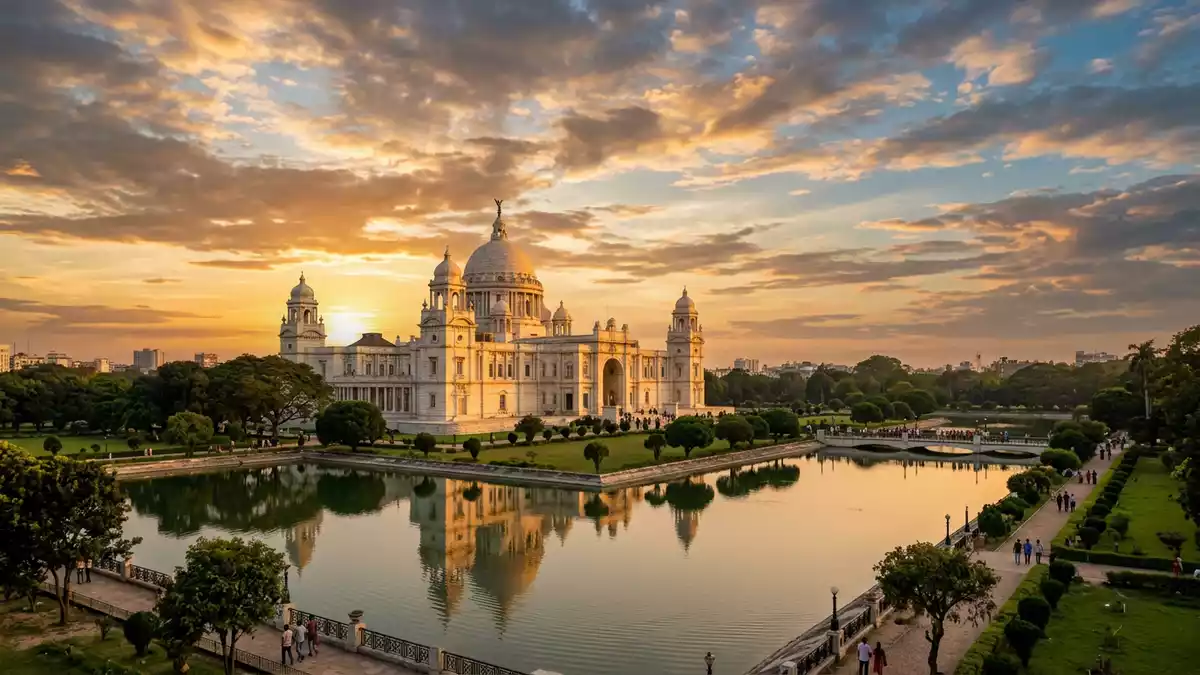
Victoria Memorial in Kolkata is a monumental white marble building set in broad gardens on the edge of the Maidan, bringing together imperial architecture and a museum of colonial history. Completed in 1921 after a construction phase that began in 1906, it was conceived after the death of Queen Victoria in 1901 and has become one of the defining structures of this part of India.
A white marble palace beside the Maidan
Victoria Memorial stands at the southern side of the Maidan, the large expanse of open ground in central Kolkata, with its formal entrance on Queen’s Way. The structure itself is built of white Makrana marble, giving the building a pale, almost luminous presence against the surrounding lawns and water features.white Makrana marble The complex is surrounded by extensive gardens that cover in the region of 64 acres (about 25 ha), laid out with straight paths, ornamental planting and stretches of open grass that frame the building from every side.64 acres of sprawling gardens
The building takes the form of a domed central block flanked by lower wings and corner towers, creating a symmetrical composition that recalls European classical architecture while standing in a distinctly Indian urban setting.modeled on classical European domed architecture Inside the garden boundary, paths lead around ornamental water bodies and past statues, giving a sequence of perspectives on the marble facades as visitors move around the site.
From imperial monument to museum of the Raj
The idea for Victoria Memorial emerged shortly after Queen Victoria’s death in January 1901, when Lord Curzon, then Viceroy of India, put forward a plan for a substantial memorial in Kolkata, at that time the capital of British India.Lord Curzon proposed the memorial after 1901 The foundation stone was laid by the Prince of Wales, later King George V, on 4 January 1906, and the building was formally opened to the public on 28 December 1921 by another Prince of Wales, later King Edward VIII.foundation in 1906 and inauguration in 1921
The architect was Sir William Emerson, then president of the Royal Institute of British Architects, who designed the memorial as a combined monument and museum. The layout integrates galleries that display paintings, sculptures, documents and artefacts relating to British rule in India, alongside commemorative spaces focused on Queen Victoria herself.museum housing artefacts of British rule Over time the emphasis of the displays has shifted towards presenting the broader history of the period, giving visitors a setting where architecture and collections together sketch a picture of the Raj era and its impact on Kolkata.
Indo?Saracenic architecture in marble
Architecturally, Victoria Memorial belongs to the Indo?Saracenic revival style, a hybrid mode that draws on classical European forms and motifs from Mughal and other Indian traditions.Indo-Saracenic revivalist style The exterior combines a large central dome with sculptural details, colonnades and smaller cupolas, while the marble surfaces are punctuated by niches and statuary. Elements such as arches and decorative reliefs introduce references to Mughal architecture, and there are influences from Venetian and other European styles in the articulation of the facades.
Within the halls and galleries, the architectural language continues in high ceilings, arcaded walkways and grand staircases, all carried by the same pale marble that defines the exterior. The building and gardens were designed together, with the landscape plan attributed to figures including Lord Redesdale and Sir David Prain, so that the Memorial sits as the focal point of a planned composition of lawns, trees and water.gardens designed by Lord Redesdale and Sir David Prain Seen from different directions across the Maidan, the Memorial appears as a bright, solid mass set against the open ground and the later city fabric beyond.
Visiting Victoria Memorial: what travellers from Western Europe should know
- Victoria Memorial stands at 1, Queens Way on the Maidan in central Kolkata, with the nearest metro station at Maidan on Line 1 of the Kolkata Metro.
The site is within the main urban area of Kolkata and reached by city transport, including metro and road connections. - The approach from the Maidan side involves walking across open ground and paved paths, with further paths and steps within the garden giving access around the building.
Inside, visitors encounter large interior spaces and staircases rather than steep external terrain. - The complex lies in eastern India’s humid subtropical climate, and the open gardens expose visitors to sun and seasonal rainfall.
The official language is Hindi and Bengali are widely spoken locally, and the currency is the Indian rupee. - Entry requirements depend on your nationality; UK travellers can check the FCDO travel advice at gov.uk/foreign-travel-advice, Irish travellers the Department of Foreign Affairs at ireland.ie.
Searching for Victoria Memorial on social platforms
These links open searches for Victoria Memorial on each platform.
Frequently asked questions about Victoria Memorial
Where is Victoria Memorial located in Kolkata?
Victoria Memorial is situated at 1, Queens Way on the Maidan in central Kolkata, within West Bengal in eastern India.
What can visitors expect when they enter Victoria Memorial?
Visitors encounter extensive gardens leading to a white marble building with large halls and galleries displaying artworks and historical objects from the colonial period.
What makes Victoria Memorial distinctive among Kolkata’s landmarks?
Its combination of Indo?Saracenic marble architecture, a central dome and corner towers, and a museum devoted to the history of the British Raj gives the Memorial a character unlike other civic buildings in the city.


