
Vieux-Port de Marseille, the harbour that made a city
Published on 08/16/2026 at 14:11 | Editorial responsibility: Rafael Müller, Editor-in-Chief AD HOC NEWS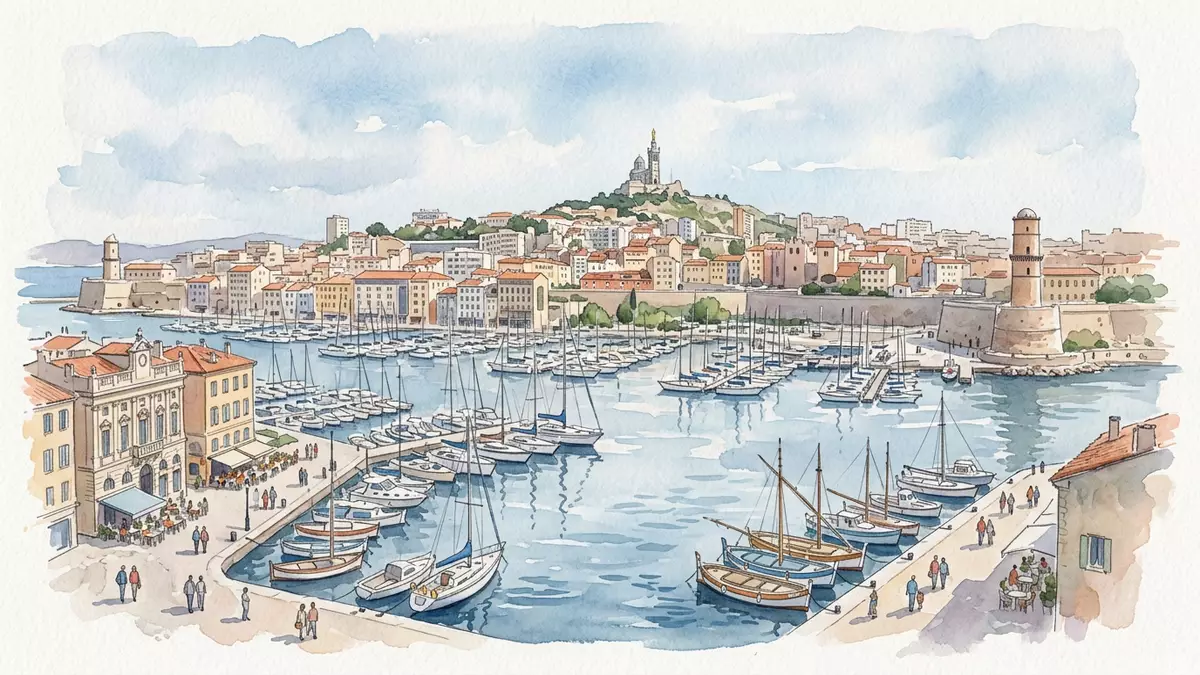
Vieux-Port de Marseille is the historic harbour basin that gave Marseille its shape, its first streets and its enduring waterfront life. Greek settlers from Phocaea founded the city of Massalia around 600 BC on this sheltered cove, making the port the cradle of Marseille and the starting point for its role as a Mediterranean trading city.Greek Massalia on this site
A harbour basin framed by quays and forts
The harbour of Vieux-Port de Marseille occupies a rectangular basin opening westwards to the Mediterranean, with quays lining its northern and southern shores and a narrow entrance framed by fortifications. The basin lies in a natural inlet once known as Lacydon, a rocky Mediterranean cove whose sheltered waters and surrounding limestone hills made it a natural harbour for ancient mariners.Lacydon, a rocky cove The city’s historic centre developed on the northern bank, where the early streets of Massalia, later Roman Massilia and medieval Marsiho, followed the slope above the water.Centre on the north bank
At the entrance to the basin stand Fort Saint-Jean on the north side and Fort Saint-Nicolas on the south, a pair of stone fortifications whose walls still watch over the mouth of the port. From the seventeenth century these forts guarded the approach to the harbour, marking the threshold between the open sea and the sheltered basin.Fort Saint-Jean and Fort Saint-Nicolas Walking along the quays today, the view north takes in these fortifications and the modern MuCEM complex across the water, while to the east the basin reaches towards the Quai des Belges and the older streets of Marseille.
From ancient Massalia to maritime powerhouse
When the Phocaean Greeks moored their ships in Lacydon around 600 BC, they established a trading post that grew into Massalia, a city engaged with routes across the Mediterranean.Founding of Massalia around 600 BC The harbour remained central through Roman times, when Massalia became Massilia, and into the Middle Ages, when Marsiho clustered around the northern quays. For centuries, the Old Port served as Marseille’s economic heart, with maritime activity concentrated in this basin until the nineteenth century.Economic centre until the nineteenth century
Between the fifteenth and seventeenth centuries, stone quays were constructed and shipyards for galleons occupied parts of the waterfront, giving the basin a more regular outline and consolidating its role in Mediterranean trade.Quays built between the fifteenth and seventeenth centuries Hemp fields at the far end of the port supplied rope for mariners, a specialised activity that gave Marseille’s main thoroughfare, the Canebière, its name.Hemp cultivation and the Canebière As sailing ships increased in size during the nineteenth century, heavy commercial traffic moved to new docks at La Joliette and later to the Grand Port Maritime de Marseille further north, leaving Vieux-Port de Marseille as a harbour for smaller vessels and civic life rather than large-scale freight.
Waterfront life around the basin
Vieux-Port de Marseille today is surrounded by promenades, slipways and moorings for fishing boats, pleasure craft and ferries, with the water surface broken by lines of masts and the reflections of neighbouring façades. The Quai des Belges at the eastern end of the basin forms a broad space that has long hosted the city’s fish market, with stalls set out close to the water.Fish market on the Quai des Belges Around the basin, cafés and restaurants occupy lower floors, with terraces overlooking the harbour and the constant movement of boats entering and leaving through the narrow mouth.
A striking contemporary feature is the mirrored canopy designed by Norman Foster, known locally as the Ombrière, which stands on one of the main quays and reflects both the harbour surface and the people passing underneath.Norman Foster's Ombrière canopy From the quays, short crossings by boat connect the northern and southern sides of the basin, while the surrounding streets lead uphill towards neighbourhoods such as Le Panier and away towards Marseille’s wider districts. The combination of historic stone quays, fortifications, and more recent structures like the Ombrière gives the harbour a layered appearance in which different periods of Marseille’s development remain visible along a single shoreline.
Visiting Vieux-Port de Marseille: what travellers from Western Europe should know
- Vieux-Port de Marseille lies at the western edge of central Marseille, opening towards the Mediterranean; the basin is bordered by quays that connect with tram and metro stops in the city centre.
- The waterfront is largely level, with long paved promenades along the quays; some side streets and approaches rise steeply towards older districts such as Le Panier.
- Fort Saint-Jean and Fort Saint-Nicolas stand at the harbour entrance and can be reached on foot from the quays, with paths that include stairways and stone surfaces.
- The official language is French and the currency is the euro.
- Entry requirements depend on your nationality; UK travellers can check the FCDO travel advice at gov.uk/foreign-travel-advice, Irish travellers the Department of Foreign Affairs at ireland.ie.
Searching for Vieux-Port de Marseille on social platforms
These links open searches for Vieux-Port de Marseille on each platform.
Frequently asked questions about Vieux-Port de Marseille
Where is Vieux-Port de Marseille located?
Vieux-Port de Marseille occupies the Old Port basin at the western edge of central Marseille in southern France, opening directly onto the Mediterranean Sea.
What can visitors expect when walking around the harbour?
Visitors encounter long waterfront promenades, lines of moored fishing boats and yachts, historic stone quays, and views towards Fort Saint-Jean, Fort Saint-Nicolas and the surrounding city.
What makes Vieux-Port de Marseille distinctive among European harbour fronts?
The combination of an ancient harbour founded around 600 BC, surviving fortifications at its entrance and contemporary additions such as Norman Foster’s mirrored canopy gives the basin a visibly layered character.


