
Vieux-Quebec: a fortified city above the St Lawrence
Published on 09/23/2026 at 20:39 | Editorial responsibility: Rafael Müller, Editor-in-Chief AD HOC NEWS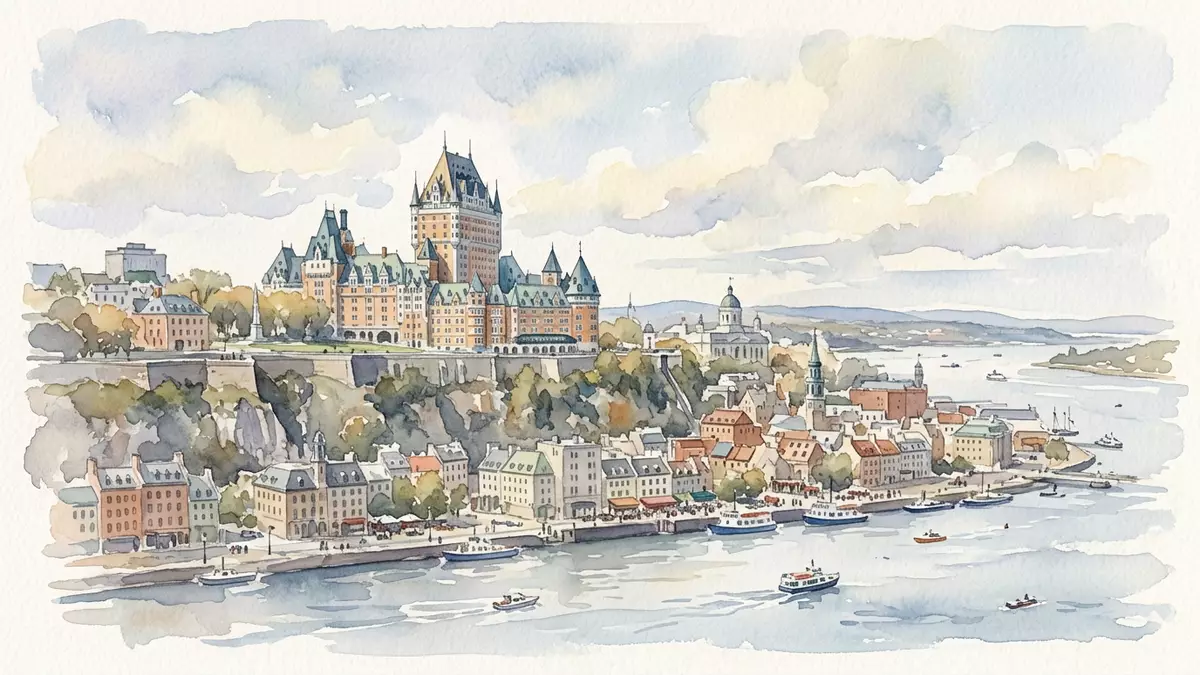
Vieux-Quebec rises above the St Lawrence River as a historic district divided between a cliff-top Upper Town and a Lower Town around Place Royale. Samuel de Champlain founded Quebec in 1608, and the district preserves the fortifications, churches, military works and stone streets associated with the French and British periods.
Vieux-Quebec above the river
The district is built across Cap Diamant, a headland whose upper level contains the ramparts, the Citadelle, Château Frontenac and the religious buildings of the Upper Town. Below it, the Lower Town gathers around Place Royale, the harbour and the streets of Petit-Champlain.
This division gives Vieux-Quebec a clear vertical character. Stairways connect the two levels, while the funicular links the Upper Town with the Lower Town near Dufferin Terrace. The change in elevation is part of the district’s physical form, alongside stone façades, narrow streets and public squares.
From New France to a World Heritage district
Champlain established the first permanent French settlement at Quebec in 1608. Place Royale marks that early colonial history, with Notre-Dame-des-Victoires Church facing the square and buildings arranged around a compact urban space.
Quebec became the capital of New France before British rule began in 1760. French and British architectural traditions remain visible in the district’s churches, convents, government buildings, military sites and domestic houses. The historic district’s UNESCO inscription dates from 1985.
Walls, gates and landmark buildings
The ramparts surrounding the Upper Town extend for more than four kilometres. They include gates, bastions and defensive works from different phases of the city’s military history. Vieux-Quebec remains the only walled city in North America north of Mexico.
The Citadelle occupies the highest ground within the fortified district. Its construction belongs to the British military period between 1820 and 1850, while Château Frontenac represents the railway-era architecture of the late nineteenth century. The hotel opened in 1893 and stands above Dufferin Terrace. The fortifications around Upper Town remain a defining feature of the district.
Notre-Dame de Québec Basilica-Cathedral, the Seminary of Quebec and the old convents add an ecclesiastical layer to the streetscape. Their presence reflects the administrative and religious role of Upper Town, while Place Royale and the Lower Town preserve the commercial character of the riverfront settlement. The two-part historic district brings these different urban settings together.
Visiting Vieux-Quebec: what travellers from Western Europe should know
- Vieux-Quebec lies within Quebec City beside the St Lawrence River. VIA Rail Canada serves Gare du Palais, while Quebec City Jean Lesage International Airport lies west of the historic district.
- The district includes steep streets, stairways and a substantial change in level between Upper Town and Lower Town. Comfortable walking footwear is useful on the stone and paved surfaces.
- The Upper Town ramparts, Citadelle, Château Frontenac, Dufferin Terrace and Place Royale are all named landmarks within the historic district.
- The official language is French and the currency is the Canadian dollar.
Searching for Vieux-Quebec on social platforms
These links open searches for Vieux-Quebec on each platform.
Frequently asked questions about Vieux-Quebec
Where is Vieux-Quebec?
Vieux-Quebec is the historic district of Quebec City in the province of Quebec, beside the St Lawrence River. It occupies Upper Town on Cap Diamant and Lower Town around Place Royale.
What can visitors expect in Vieux-Quebec?
Visitors find stone streets, stairways, churches, convents, military buildings, public squares and viewpoints near the river. The district combines urban walking with a visible change in elevation.
What makes Vieux-Quebec distinctive?
Its ramparts, gates, bastions and Citadelle form a continuous military landscape around Upper Town. French and British buildings, including Château Frontenac, Place Royale and Notre-Dame de Québec, occupy the same historic district.


