
Vieux-Quebec, the walled heart of Quebec City
Published on 09/19/2026 at 10:47 | Editorial responsibility: Rafael Müller, Editor-in-Chief AD HOC NEWS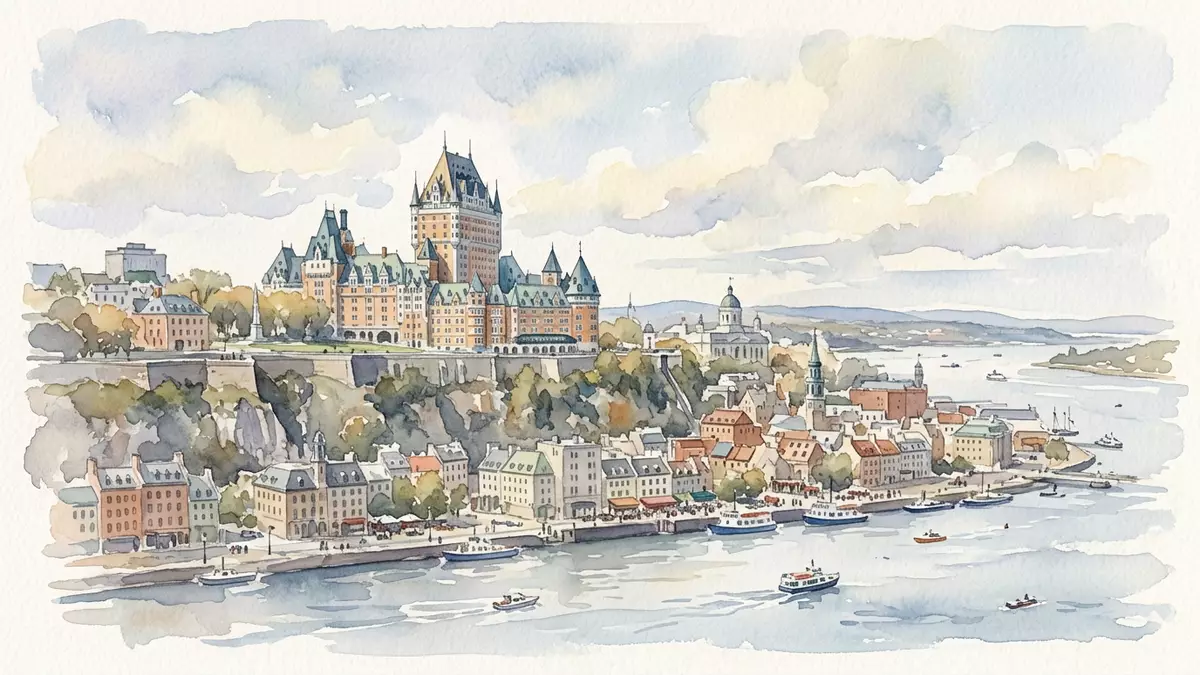
Vieux-Quebec, the historic district of Quebec City in Canada, is a compact walled quarter where an elevated Upper Town and a riverside Lower Town still read as parts of one city. Recognised as the Historic District of Old Québec and inscribed on the UNESCO World Heritage List as a cultural site in 1985, it condenses more than four centuries of urban, religious and military architecture into about 135 hectares of streets and squares.
City on a promontory and at the river’s edge
The defining experience of Vieux-Quebec is the way it occupies both the top of Cap Diamant and the narrow strip of land between the cliff and the water, giving the district a clear vertical structure that visitors can see in its streets. The Upper Town rises on the promontory and remains the religious and administrative centre, with churches, convents and civic buildings lining streets set above the river.
Below the cliff, the Lower Town gathers around historic squares and the harbour area where Quebec City first grew as a trading settlement on the Saint Lawrence River and near the mouth of the Saint-Charles River. The Historic District of Old Québec is formally recorded as an urban area of about 135 hectares made up of these two parts, with the Upper Town sitting atop Cap Diamant and the Lower Town built on the narrow band of riverside ground.about 135 hectares Within this territory, stone buildings, narrow streets and open squares shape a landscape that makes the division between plateau and waterfront legible at a glance.
Fortifications and a North American walled city
The walls and defensive works of Vieux-Quebec give Quebec City a character rare in North America, where few colonial cities retain a continuous system of fortifications. Ramparts, gates, bastions and the Citadel together form a defensive ensemble that encircles the Upper Town in a ring several kilometres long and defines the transition between the historic district and the surrounding modern city.fortifications surrounding Old Québec The first fortified wall was erected facing the Plains of Abraham in 1690, anchoring the city’s role as a stronghold on the Saint Lawrence.
Later ramparts and the star-shaped Citadel on the highest point of Cap Diamant completed a set of fortifications that remains largely intact and describes the historic boundaries of the district.citadel on the point culminant of Cap Diamant Gates pierce the walls and mark the change from newer streets into the old quarter, while caserns, redoubts and earthworks recall the city’s military function under French and British rule. Taken together with the urban fabric they enclose, these fortifications make Quebec a rare example of a walled colonial city whose defensive system still outlines the historic centre.
Layers of architecture and four centuries of urban life
Vieux-Quebec concentrates nearly 1,400 buildings constructed from the seventeenth century onwards, making it a district where different periods of architecture stand side by side in a relatively small area.nearly 1,400 buildings constructed from the seventeenth century The earliest stone houses and warehouses recall the era when New France was established and Quebec became its capital in 1663, with functions clustered around commerce, port activity and institutional life.
Later architecture inspired by French traditions, palladian and neoclassical styles adds civic buildings with more formal facades, while nineteenth-century and more eclectic constructions bring further layers to the streetscape. Churches, convents, military barracks, merchant houses and residences together reflect the district’s mix of commercial, cultural, financial, institutional, military, religious and residential uses. This concentration of built heritage, combined with the district’s continued urban role, led to its designation as the Historic District of Old Québec on the World Heritage List.Historic District of Old Québec
Visiting Vieux-Quebec: what travellers from Western Europe should know
- Vieux-Quebec lies within Quebec City in eastern Canada, on the north side of the Saint Lawrence River, with the historic streets reached from surrounding neighbourhoods by urban roads and bridges across the river.
- The district’s Upper Town occupies the top of Cap Diamant, and moving between Upper and Lower Town involves gradients and stairways that climb the cliff between plateau and riverside streets.
- Vieux-Quebec forms part of the Vieux-Québec–Cap-Blanc–Colline Parlementaire district in the borough of La Cité-Limoilou, a central area that also includes Parliament Hill and the slope at Cap Blanc.
- The official languages of Canada include French and English, and the national currency is the Canadian dollar.
- Entry requirements depend on your nationality; UK travellers can check the FCDO travel advice at gov.uk/foreign-travel-advice, Irish travellers the Department of Foreign Affairs at ireland.ie.
Searching for Vieux-Quebec on social platforms
These links open searches for Vieux-Quebec on each platform.
Frequently asked questions about Vieux-Quebec
Where is Vieux-Quebec and what does it include?
Vieux-Quebec is the historic district of Quebec City in Canada, encompassing both the Upper Town on Cap Diamant and the Lower Town along the Saint Lawrence River.
What can visitors expect when walking through Vieux-Quebec?
Visitors encounter stone streets and squares, fortifications, religious and civic buildings, and the noticeable change in level between the plateau of the Upper Town and the riverside Lower Town.
What makes Vieux-Quebec distinctive among historic districts in North America?
Its continuous system of fortifications, intact urban fabric and combination of Upper and Lower Towns together form one of the most complete examples of a fortified colonial city in the region.


