
Villa Cimbrone and the garden avenue above Ravello
Published on 09/23/2026 at 21:33 | Editorial responsibility: Rafael Müller, Editor-in-Chief AD HOC NEWS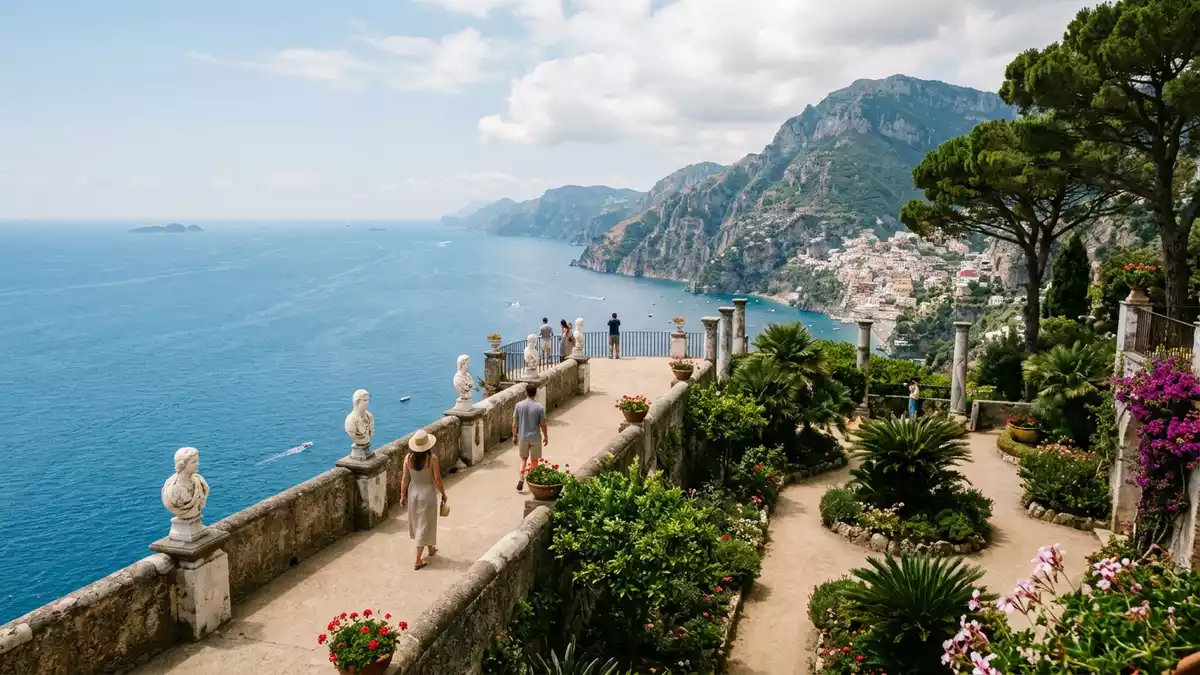
Villa Cimbrone occupies a rocky promontory above Ravello, where a long garden avenue leads towards the Terrace of Infinity. Medieval origins, imported architectural fragments and an English-influenced landscape meet within one historic estate.
Villa Cimbrone: a medieval estate reshaped in 1904
The first documentary references to Villa Cimbrone date from the eleventh century, when the property belonged to the Acconciagioco family of Ravello. Its name is connected with Cimbronium, the historic name associated with the promontory and estate.
Ownership passed to the Fusco family in the mid-fourteenth century, linking the property with noble networks connected to Florence and Naples. Villa Cimbrone’s early history belongs to the long medieval story of Ravello, a town shaped by aristocratic residences, agriculture and Mediterranean trade.
In 1904, Ernest William Beckett purchased the property. The British banker and politician, later known as Lord Grimthorpe, reshaped the villa and its grounds during the early twentieth century.
The resulting architecture combines Gothic, classical and Venetian references. Columns, arches, sculptures and other decorative elements appear alongside terraces, garden buildings and stonework, giving the estate an eclectic character.
From Viale dell’Immenso to the Terrace of Infinity
The principal garden route is Viale dell’Immenso, an avenue extending beneath planting and architectural features. It forms the clearest visual line through the grounds, connecting the entrance area with the panoramic terrace.
The gardens include fountains, statues, planted compartments, grottoes and small structures. Their arrangement reflects the landscape design of the early twentieth century, when English garden ideas were combined with Mediterranean vegetation and historic architectural references.
Vita Sackville-West contributed to the garden’s development. The writer and gardener brought an English horticultural perspective to a site already marked by Ravello’s climate, stone terraces and views across the Gulf of Salerno.
The six-hectare garden contains palms, pines, plane trees, citrus plants and flowering species. The planting changes from formal avenues to more enclosed garden rooms, with views appearing between foliage and masonry.
At the far end, the Terrace of Infinity projects above the coastline. Eighteenth-century marble busts line the balustrade, while the Gulf of Salerno and the Cilento coast form the open background.
Ravello’s villa above the Gulf of Salerno
Villa Cimbrone stands on Via Santa Chiara in Ravello, on the Amalfi Coast of southern Italy. The estate is reached through Ravello’s historic streets, where stone walls, stairways and narrow passages define the approach.
The villa itself functions as a hotel, while the historic gardens form the public-facing part of the estate. This division gives the property two identities: an accommodation house and a landscaped cultural site centred on the Terrace of Infinity.
The building and gardens are connected by views rather than by a single architectural style. Gothic details sit beside classical fragments, while Mediterranean planting frames features associated with English garden design.
Villa Cimbrone in Ravello therefore reads as an accumulated place. The eleventh-century estate, the 1904 transformation and the later hotel use remain visible through different layers of architecture and landscape.
The most distinctive sequence is the movement from enclosed garden paths towards the open terrace. Trees, pergolas, statues and stone structures gradually give way to the coastline, where the balustrade places the landscape below the garden’s architectural frame.
That sequence also explains the estate’s visual identity without reducing it to a single style. Villa Cimbrone is neither simply a medieval residence nor simply an English garden, but a Ravello villa assembled from both local history and international influences.
Visiting Villa Cimbrone: what travellers from Western Europe should know
- Villa Cimbrone is at Via Santa Chiara 26 in Ravello, above the Amalfi Coast. Buses from Amalfi and nearby coastal towns reach Ravello, followed by a walk through the town.
- The approach from Ravello’s centre uses narrow historic streets, steps and sloping lanes. Comfortable footwear suits the stone surfaces and garden paths.
- The gardens extend across a large hillside estate. The route includes avenues, terraces, planted areas and the elevated Terrace of Infinity.
- The official language is Italian and the currency is the euro.
Searching for Villa Cimbrone on social platforms
These links open searches for Villa Cimbrone on each platform.
Frequently asked questions about Villa Cimbrone
Where is Villa Cimbrone?
Villa Cimbrone is in Ravello, on Italy’s Amalfi Coast. Its address is Via Santa Chiara 26, above the Gulf of Salerno.
What can visitors see at Villa Cimbrone?
The estate includes historic buildings, a large landscaped garden, Viale dell’Immenso, fountains, statues and the Terrace of Infinity.
What makes Villa Cimbrone distinctive?
Its identity combines an eleventh-century estate, Ernest William Beckett’s 1904 transformation and an English-influenced garden above the Mediterranean coastline.


