
Vizcaya Museum and Gardens, a Gilded Age villa on Biscayne Bay
Published on 08/17/2026 at 14:11 | Editorial responsibility: Rafael Müller, Editor-in-Chief AD HOC NEWS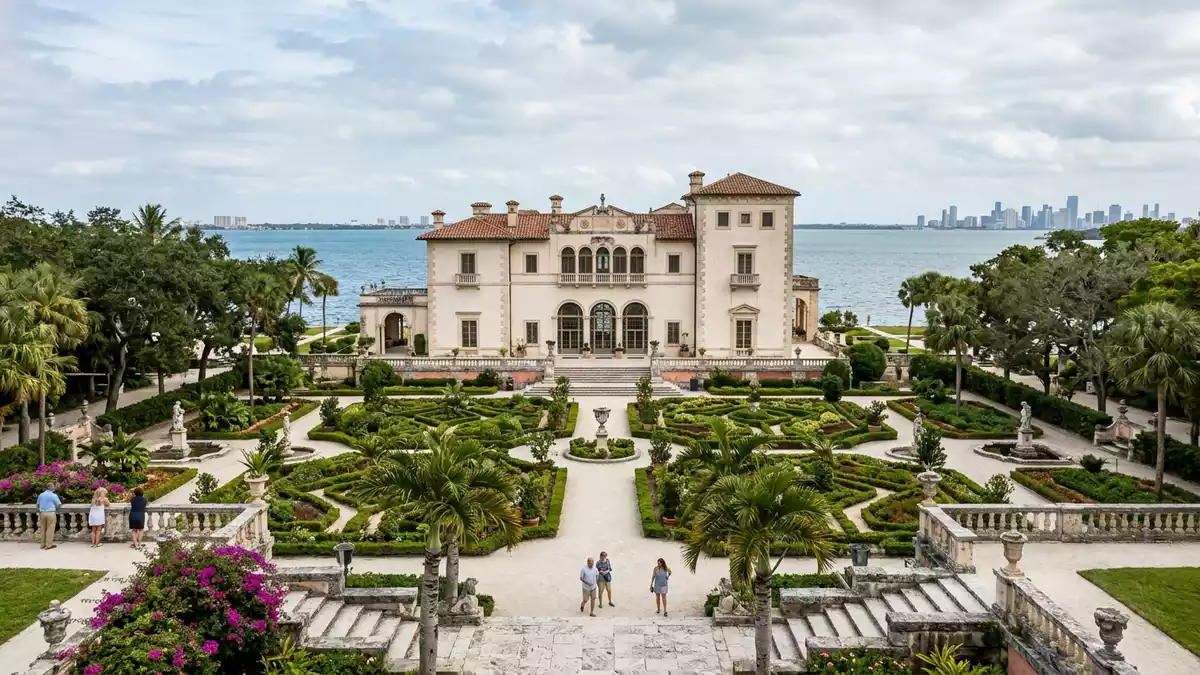
Vizcaya Museum and Gardens in Miami is an early twentieth?century estate where a Gilded Age mansion opens onto formal gardens and Biscayne Bay, combining an American industrial fortune with European models of country living. Built for International Harvester executive James Deering between 1914 and the early 1920s, the house and grounds present a deliberate evocation of an eighteenth?century Italian villa transplanted to subtropical Florida.
An Italian Renaissance vision in subtropical Miami
The main house at Vizcaya is a Mediterranean Revival villa conceived as a modern interpretation of an eighteenth?century Italian country residence, with clear influences from Veneto and Tuscan Renaissance architecture.Mediterranean Revival villa Architect F. Burrall Hoffman shaped the building, working with artistic director Paul Chalfin, while Colombian landscape designer Diego Suarez developed the formal garden plan around the house.F. Burrall Hoffman and Paul Chalfin The villa stands on South Miami Avenue in the Coconut Grove area, fronting Biscayne Bay and framed by native woodland on the landward side.location on Biscayne Bay
Construction of Vizcaya began in 1914 and the estate took much of the following decade to reach its present extent, with the house largely complete by the mid?1910s and the wider grounds and village buildings finished by around 1922.built between 1914 and 1922 Deering, who was vice?president of the International Harvester company, used Vizcaya as his winter residence from 1916 until his death in 1925.James Deering winter home The interiors, filled with European furnishings and art spanning several centuries, reinforce the impression of a long?established Old World estate, even though the fabric belongs firmly to the twentieth century.
Gardens that frame the bay and the villa
Extending from the south and east façades of the house, Vizcaya’s formal gardens lay out a carefully composed sequence of terraces, hedged compartments and ornamental features that mediate between the villa and Biscayne Bay. Diego Suarez drew on Italian Renaissance precedents, organising the grounds in a symmetrical plan with clipped greenery, classical statuary and water features aligned along axial paths.Italian Renaissance gardens Beyond the formal core of the garden, native woodland and tropical hammock vegetation are retained, creating a contrast between geometrical design and the natural growth of South Florida.
One of the estate’s most striking garden elements is the elaborate stone structure projecting into Biscayne Bay, often described as a barge or breakwater, which serves as a sculptural focal point for views from the terraces.ornamental stone barge Within the gardens, visitors encounter features such as grottos, fountains and stairs linking different levels, with the planting and masonry revealing European influences adapted to a subtropical climate. The relationship between the villa, its garden compartments and the open water is central to the character of Vizcaya, placing the house as an architectural object in a broader landscape composition.
From private estate to National Historic Landmark
After James Deering’s death in 1925, Vizcaya remained in family hands for several decades before a significant portion of the property was transferred to public ownership. In 1952, the Deering heirs donated the main house and formal gardens to Dade County, which opened the estate to the public as a museum the following year.donation in 1952 and museum opening Subsequent restoration campaigns stabilised the buildings and gardens and adapted parts of the estate for cultural use while maintaining its historic fabric.
The historic significance of Vizcaya has been recognised at federal level: the estate is listed on the National Register of Historic Places and was designated a National Historic Landmark in 1994.National Historic Landmark designation As Vizcaya Museum and Gardens, the site functions as a cultural institution operated by a non?profit organisation in partnership with Miami?Dade County, with the main house presenting furnished historic rooms and the gardens accessible as a designed landscape along Biscayne Bay.museum and county partnership
Visiting Vizcaya Museum and Gardens: what travellers from Western Europe should know
- Vizcaya Museum and Gardens stands at 3251 South Miami Avenue in the Coconut Grove area of Miami, beside Biscayne Bay and south of the city’s downtown districts.
- The estate includes the main villa, extensive formal gardens and a historic village of outbuildings, with paths and staircases linking different levels of the grounds.
- The official language is English and the currency is the United States dollar.
- Entry requirements depend on your nationality; UK travellers can check the FCDO travel advice at gov.uk/foreign-travel-advice, Irish travellers the Department of Foreign Affairs at ireland.ie.
Searching for Vizcaya Museum and Gardens on social platforms
These links open searches for Vizcaya Museum and Gardens on each platform.
Frequently asked questions about Vizcaya Museum and Gardens
Where is Vizcaya Museum and Gardens located in Miami?
Vizcaya Museum and Gardens stands at 3251 South Miami Avenue in the Coconut Grove area of Miami, directly on the shore of Biscayne Bay.
What can visitors expect during a visit to Vizcaya Museum and Gardens?
Visitors encounter a furnished Mediterranean Revival villa dating from the early twentieth century and extensive Italian?inspired formal gardens, together forming a preserved Gilded Age estate.
What makes Vizcaya Museum and Gardens distinctive among historic houses?
Vizcaya Museum and Gardens is distinctive for its combination of a Renaissance?inspired villa, formal European?style gardens and a bayside setting, all created as a single early twentieth?century composition.


