
Volcan de Santa Ana and its turquoise crater lake
Published on 09/24/2026 at 09:04 | Editorial responsibility: Rafael Müller, Editor-in-Chief AD HOC NEWS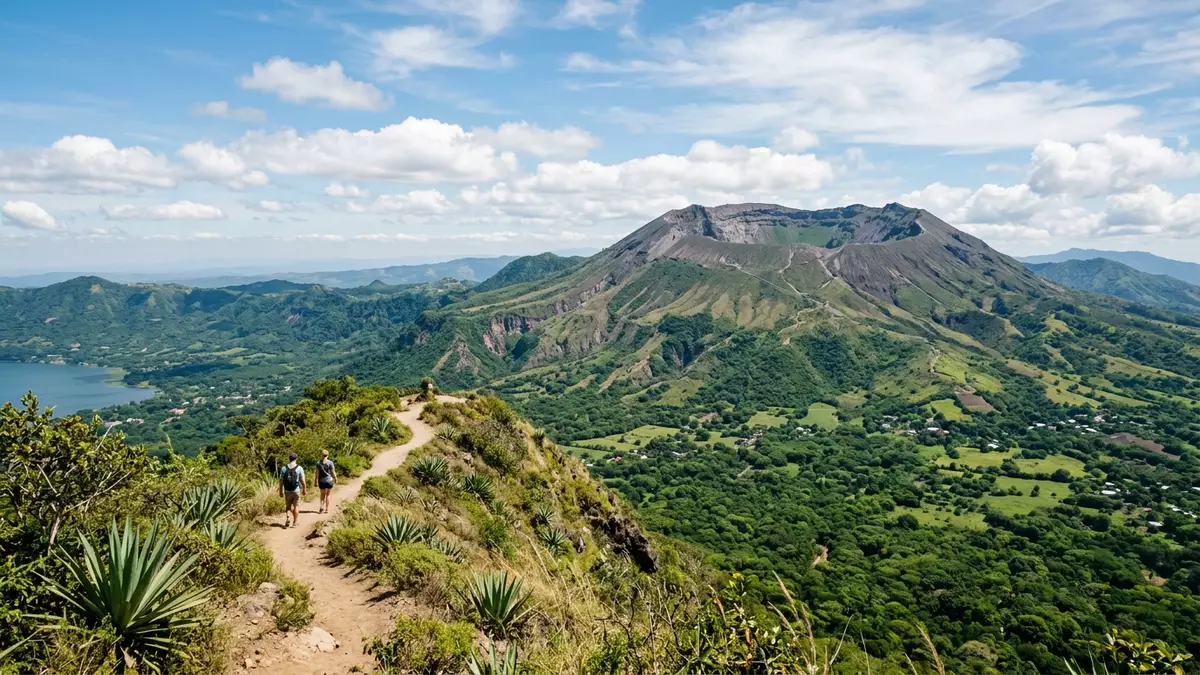
Volcan de Santa Ana rises above western El Salvador as a broad stratovolcano with a turquoise lake inside its summit crater. At 2,381 m (7,812 ft), it is the country’s highest volcano, standing west of Lake Coatepeque and near the city of Santa Ana.
Volcan de Santa Ana: a summit shaped by layers of fire
Volcan de Santa Ana is also known as Ilamatepec. The mountain belongs to the Apaneca-Ilamatepec range and forms part of Los Volcanes National Park, a protected landscape shared with Izalco volcano and Cerro Verde.
Its volcanic form comes from successive deposits of ash, lava and fragmented rock. The mountain is classified as an andesitic-to-basaltic stratovolcano, with broad lower slopes rising towards a summit crater. The Smithsonian volcano profile records its summit at 2,381 m and places it immediately west of the Coatepeque caldera.
The crater lake above Lake Coatepeque
The summit contains a crater with a small lake whose water can appear turquoise or green. The lake occupies the lowest part of the crater, surrounded by steep volcanic walls and exposed rock.
Lake Coatepeque lies at the eastern foot of the volcano, filling a separate caldera. From the upper mountain, the lake, forested ridges and cultivated slopes form a connected volcanic landscape. The relationship between the summit crater and the larger lake below gives Volcan de Santa Ana its distinctive vertical setting.
Ilamatepec in El Salvador’s volcanic landscape
The name Ilamatepec belongs to the mountain’s Indigenous cultural vocabulary, while Volcan de Santa Ana connects it with the department and nearby city. Activity at the volcano has been documented since the sixteenth century.
The mountain’s most recent eruption occurred in 2005. Its active character remains part of the site’s identity, alongside its summit lake, layered slopes and position within Los Volcanes National Park. The historical profile of Santa Ana Volcano identifies the mountain as the highest peak in El Salvador and places Santa Ana at its northeastern foot.
The protected landscape extends across forest and coffee-growing country in western El Salvador. The Los Volcanes National Park overview places Santa Ana alongside Izalco and Cerro Verde within the same volcanic complex.
Visiting Volcan de Santa Ana: what travellers from Western Europe should know
- Volcan de Santa Ana lies in the department of Santa Ana, west of Lake Coatepeque and near Santa Ana city. The mountain belongs to Los Volcanes National Park.
- The ascent reaches 2,381 m (7,812 ft), with volcanic ground and exposed summit terrain around the crater. The route is a mountain walk rather than an urban viewpoint.
- The surrounding landscape includes cloud-forest vegetation, coffee-growing slopes, Lake Coatepeque and the neighbouring volcanic peaks of Izalco and Cerro Verde.
- The official language is Spanish and the currency is the Salvadoran colón and the United States dollar.
- Entry requirements depend on your nationality; UK travellers can check the FCDO travel advice at gov.uk/foreign-travel-advice, Irish travellers the Department of Foreign Affairs at ireland.ie.
Searching for Volcan de Santa Ana on social platforms
These links open searches for Volcan de Santa Ana on each platform.Frequently asked questions about Volcan de Santa Ana
Where is Volcan de Santa Ana?
Volcan de Santa Ana is in western El Salvador, in the department of Santa Ana. It rises west of Lake Coatepeque and near Santa Ana city.
What can visitors expect on the mountain?
The route leads through volcanic terrain towards a summit crater containing a turquoise lake. The high point reaches 2,381 m (7,812 ft).
What makes Volcan de Santa Ana distinctive?
The mountain combines the country’s highest volcanic summit with a crater lake, layered volcanic slopes and a position beside Lake Coatepeque.


