
Volcan Irazu above Cartago’s high central valley
Published on 09/17/2026 at 21:01 | Editorial responsibility: Rafael Müller, Editor-in-Chief AD HOC NEWS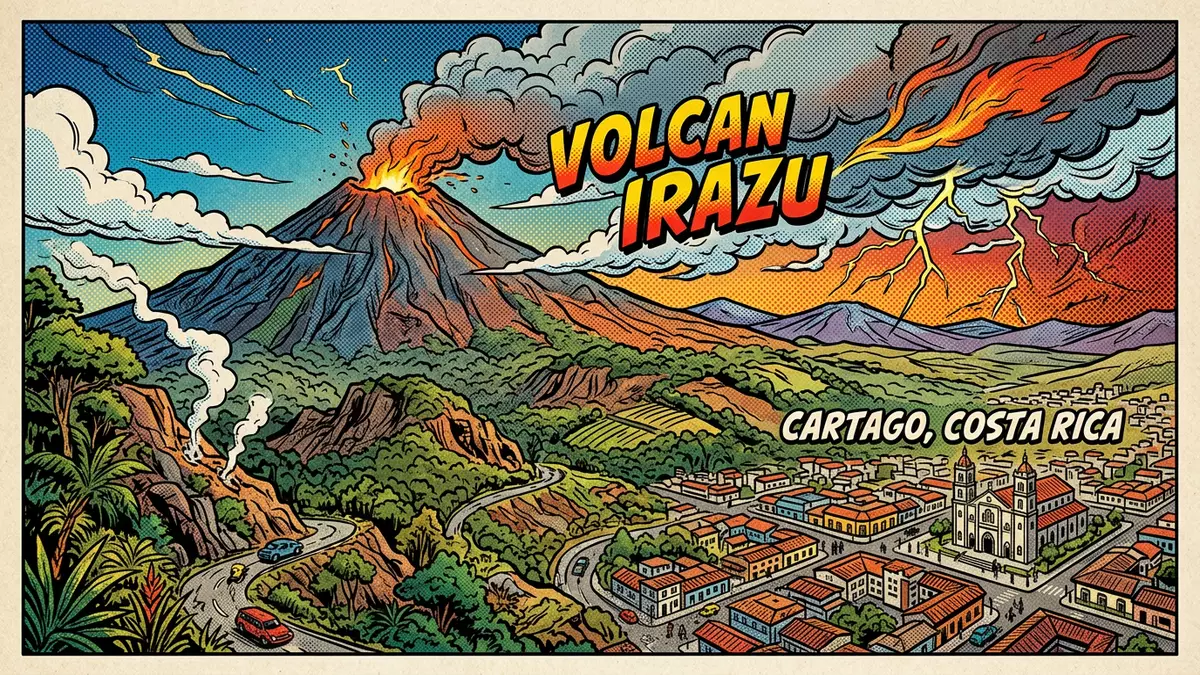
Volcan Irazu, or Volcán Irazú, is an active stratovolcano in Costa Rica’s Cordillera Central, rising above the city of Cartago with a broad summit crater complex and exposed ash plains that feel markedly different from the fertile valley below.Cordillera Central
The highest volcano in Costa Rica
The massif of Volcan Irazu is firmly established as Costa Rica’s tallest volcano, reaching about 3,432 m (11,260 ft) above sea level, and forming the highest peak of the Cordillera Central east of San José.3,432 m (11,260 ft) The volcano stands immediately above Cartago, a historic city in the central valley that developed at the foot of the mountain and still uses it as a geographic reference.foot of Irazú Volcano
The name “Irazú” derives from an indigenous word associated with thunder, reflecting the long record of eruptions documented since at least 1723 in colonial sources from Cartago.records of the eruptive activity The modern summit is reached by paved road and has become a classic ascent for visitors, because in clear weather the cone offers views across the spine of Costa Rica and, on rare days, glimpses of both the Caribbean and Pacific coasts from one vantage point.views of both coasts
Crater landscape and national park
Volcan Irazu’s summit area is protected as Irazú Volcano National Park, which encompasses the main crater and surrounding highland terrain as well as the Prusia Forest Reserve in the same conservation unit.Irazú Volcano National Park The park was created in the mid?twentieth century and later expanded, framing the volcano within a defined area of several thousand hectares where ash fields, eroded lava and patches of vegetation share space close to the crater rim.expanded by Executive Decree
The summit complex contains an active crater with steep walls and a substantial depth; measurements describe a depression roughly 300 m (980 ft) deep, with a small crater lake nestled against the inner slopes.active crater is 980 feet Around it, the plateau carries loose volcanic material shaped into terraces and hollows, and on clear days visitors can look from these stark surfaces down towards Cartago and across to other summits of the Cordillera Central.
Eruptions and the central valley
Volcan Irazu has a long eruptive history in Costa Rica, with explosive eruptions recorded in the eighteenth century and a major episode between March 1963 and February 1965 that projected ash towards Cartago and the capital, San José.1963 eruption of Irazú Volcano During that twentieth?century sequence, ashfall accumulated in local river valleys and contributed to damaging floods in Taras de Cartago, while fine material reached San José and affected everyday life across the central valley.avalanche that destroyed houses
Geological summaries describe the volcano as a large stratovolcano with at least ten satellite cones on its southern flank and a summit area that covers roughly 500 km², much of it vegetated up to near the crater complex.covers an area of 500 km2 The most recent eruptions in the twentieth century were explosive rather than effusive; lava flows such as the Cervantes flows on the southern side belong to much older phases, while later activity has centred on ash, blocks and smaller phreatic events.all known Holocene eruptions
Visiting Volcan Irazu: what travellers from Western Europe should know
- Volcan Irazu lies north of Cartago in Costa Rica’s central highlands, and a paved road runs from Cartago up the mountain to the national park entrance on the crater sector.
- The summit area stands at over 3,400 m (around 11,000 ft), and visitors move across exposed volcanic terrain with loose ash and some short walks between parking areas and viewpoints.
- Cartago is part of Costa Rica’s Central Valley east of San José, and the volcano’s national park is linked to Cartago by a named highway that passes through several small agricultural communities on the mountain slopes.
- The official language is Spanish and the currency is the Costa Rican colón.
- Entry requirements depend on your nationality; UK travellers can check the FCDO travel advice at gov.uk/foreign-travel-advice, Irish travellers the Department of Foreign Affairs at ireland.ie.
Searching for Volcan Irazu on social platforms
These links open searches for Volcan Irazu on each platform.
Frequently asked questions about Volcan Irazu
Where is Volcan Irazu located in Costa Rica?
Volcan Irazu stands in the Cordillera Central in east?central Costa Rica, directly above the city of Cartago and within easy reach of the broader Central Valley.
What can visitors expect at the summit of Volcan Irazu?
Visitors encounter a high volcanic plateau with a deep main crater, ash?covered ground, short paths to viewpoints and, in clear conditions, wide views towards distant coasts.
What makes Volcan Irazu distinctive among Costa Rican volcanoes?
It is Costa Rica’s tallest volcano, has a national park built around its crater complex, and carries a well?documented history of explosive eruptions that shaped life in Cartago and San José.


