
Wahat Siwa and the hilltop remains of an oasis town
Published on 09/17/2026 at 10:06 | Editorial responsibility: Rafael Müller, Editor-in-Chief AD HOC NEWS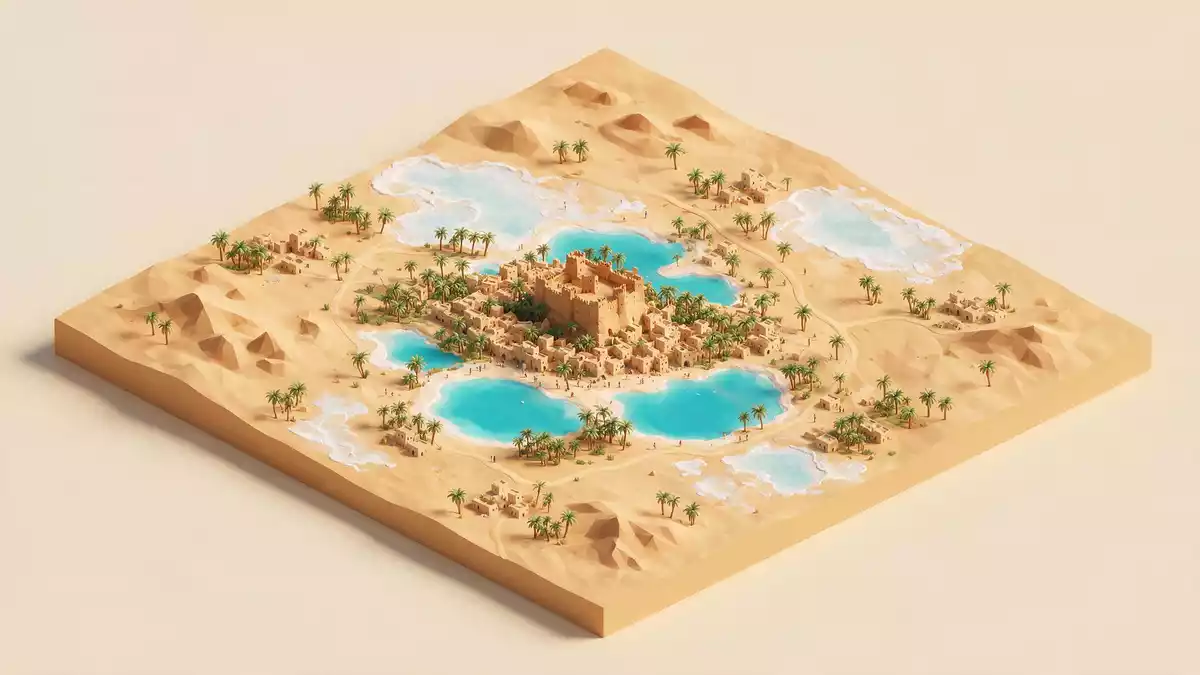
Wahat Siwa lies in Egypt’s Western Desert near the Libyan frontier, where springs, salt water and mud-brick settlements define the landscape. The oasis is known for Shali, the hilltop remains of Siwa’s former fortified town, and for the ancient oracle site at Agh?rm?.
Shali and the mud-brick hill above Siwa
Shali is the most visible landmark in Wahat Siwa: a compact hilltop ruin of mud-brick houses and defensive walls rising above the town. In 1926, heavy rain damaged the settlement severely, and the inhabited part of Siwa spread across the surrounding plain.
The surviving structures give the place a layered look, with fragments of walls, narrow passages and uneven surfaces set against the flatter town below. A mud-brick houses and salt-based building traditions remain central to the oasis’s identity.
The oracle site at Agh?rm?
Agh?rm? is tied to the oracle temple of Amon, one of the best-known names in Siwa’s long history. The temple ruins include inscriptions from the fourth century BCE, and the site was linked with Alexander the Great in the ancient world.
This side of Wahat Siwa adds an archaeological counterpoint to the hill settlement: ruins on rock, rather than the low, earth-coloured fabric of the town. the oracle temple remains one of the oasis’s defining historical reference points, and the name W??at S?wah is widely associated with that older sacred landscape.
Springs, salt lakes and the wider oasis
Wahat Siwa is not only a historic settlement but also a fertile desert basin with springs, date palms and olive trees. Britannica describes the oasis as about 10 km long and 6 to 8 km wide, with around 200 springs.
That mix of water, cultivation and open desert gives Siwa its broad character. The date palms and olive trees spread across the oasis, while the old core stays concentrated on the hill and around the spring-fed ground.
Visiting Wahat Siwa: what travellers from Western Europe should know
- Wahat Siwa lies in western Egypt near Libya, and travellers usually reach it from Cairo or Alexandria by road. Siwa town is the main base for the oasis.
- The old settlement of Shali is a hilltop ruin with uneven mud-brick surfaces and remnants of walls. Footwear with grip is useful on the broken ground.
- The oasis has springs, salt pools and cultivated land in the same basin. The landscape combines settlement, agriculture and desert in close sequence.
- English is not the official language. The official language is Arabic and the currency is the Egyptian pound.
- Entry requirements depend on your nationality; UK travellers can check the FCDO travel advice at gov.uk/foreign-travel-advice, Irish travellers the Department of Foreign Affairs at ireland.ie.
Searching for Wahat Siwa on social platforms
These links open searches for Wahat Siwa on each platform.
Frequently asked questions about Wahat Siwa
Where is Wahat Siwa?
Wahat Siwa is an oasis in western Egypt, near the Libyan border. It sits in Siwa, in the governorate of Matrouh.
What does a visit involve?
The main impressions come from Shali’s ruins, the spring-fed oasis landscape and the archaeological remains at Agh?rm?. The terrain mixes broken mud-brick structures, cultivated land and open desert.
What makes Wahat Siwa distinctive?
Its combination of a fortified hill settlement, oracle history and a fertile desert basin gives it a strong identity. The oasis also retains a landscape shaped by springs, palms and salt water.


