Waikiki and the curve of sand that shaped Honolulu
Published on 08/07/2026 at 15:08 | Editorial responsibility: Rafael Müller, Editor-in-Chief AD HOC NEWS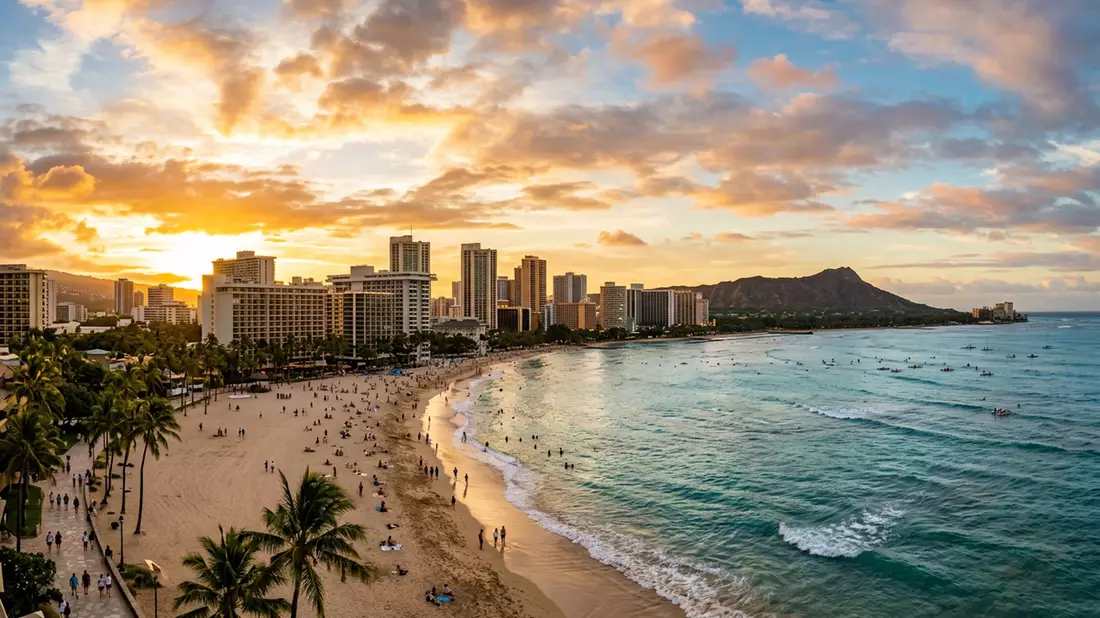
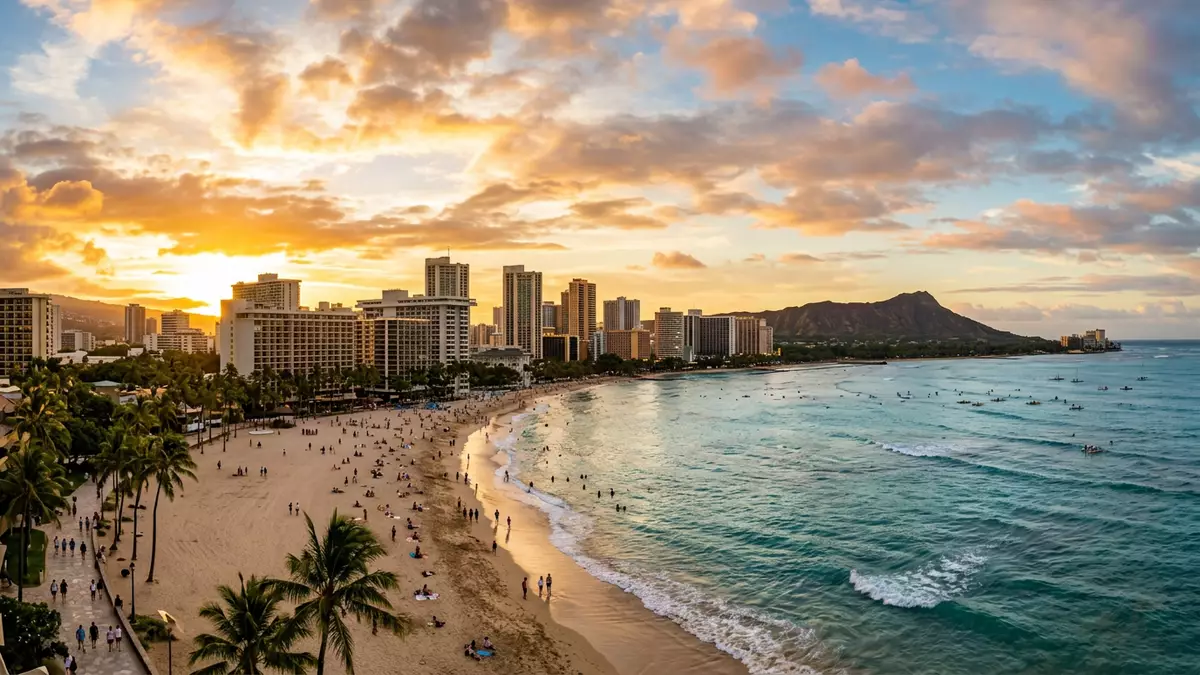
Waikiki in Honolulu is the stretch of coast where a broad arc of pale sand, the outlines of Diamond Head and a dense waterfront of hotels share the same frame. Once a retreat of Hawaiian royalty, it developed in the twentieth century into one of the best known resort districts in the Pacific, framed by the volcanic landscape of Oahu.
The sweep of Waikiki’s shoreline
The simplest way to understand Waikiki is to walk along its curve of sand between the surf and the city streets. The beach lies on the southern shore of Oahu, facing the Pacific Ocean and backed by palms, promenades and hotel terraces that step almost directly onto the sand. Low waves roll across the nearshore shallows, where beginners learn to balance on surfboards under the eye of local instructors.
Look east and the profile of Diamond Head, a volcanic tuff cone dating from the late stages of Oahu’s formation, closes the horizon. The crater rises above the district with a dry, rugged surface that contrasts sharply with the manicured lawns and pavements beside the water. Between the headland and the sea, the beach is divided into named sections that flow into one another, each with its own mix of sand, groynes and reef.
From royal playground to twentieth-century resort
Long before mass tourism, Waikiki was part of a wet, fertile coastal plain used by Native Hawaiians for taro patches and fishponds. In the nineteenth century members of the Hawaiian royal family maintained residences and retreats here, taking advantage of the sea breezes and easy access from Honolulu. After the overthrow of the Hawaiian Kingdom in 1893 and the islands’ annexation by the United States in 1898, the character of the area began to shift towards recreation and hospitality aimed at visitors from mainland North America and beyond.
In the early decades of the twentieth century, landmark hotels rose along the waterfront, using reinforced concrete and terraced facades to frame direct views of the ocean. These buildings, together with later high-rise additions from the post?Second World War decades, gave Waikiki its dense skyline. The contrast between the older low?rise structures in pastel shades and the glassier towers that followed them is visible from almost any point on the sand.
Surfboards, sunsets and street life
Waikiki is closely associated with modern surfing, above all through the figure of Duke Kahanamoku, born in 1890 and celebrated as both an Olympic swimmer and a champion of Hawaiian surf culture. Statues and plaques in the district commemorate him, and surfboard racks line the walkway behind the beach, bearing boards in bright colours and smooth wooden longboards that recall earlier designs. Out on the water, outrigger canoes share space with surfers and stand?up paddlers over the reef.
As daylight fades, the character of Waikiki shifts from sea?oriented activity to street life along Kalakaua Avenue and its parallel roads. Pavements fill with shoppers moving between international brand stores, local boutiques and open?fronted cafes where live music carries into the night air. Torches flicker beside hotel entrances and on beachside lawns, underlining how closely the district’s entertainment scene hugs the shoreline rather than retreating inland.
Visiting Waikiki: what travellers from Western Europe should know
- Waikiki lies on the island of Oahu in the state of Hawaii, with Honolulu’s main urban districts and Daniel K. Inouye International Airport providing the usual air and road access.
- Admission arrangements and opening hours are set by the site’s operator and change with the season; the official website is the only binding source.
- Sea conditions, daylight and cloud cover shape the experience; many visitors favour the gentler light of early morning or the low sun and colours before darkness.
- The main beachfront is largely level, but the sand, occasional rock outcrops and any piers or sea walls mean that those with limited mobility may face uneven ground and some steps; restrictions may apply on site.
- English is the main language of tourism in Waikiki, with Hawaiian also present in place names and greetings; payment by major card and in US dollars is widespread in hotels, shops and restaurants.
- Entry requirements depend on your nationality. UK travellers should check the FCDO travel advice at gov.uk/foreign-travel-advice; Irish travellers the Department of Foreign Affairs at ireland.ie; EU and EEA citizens their own national foreign ministry.
Searching for Waikiki on social platforms
These links open searches for Waikiki on each platform.
Frequently asked questions about Waikiki
Where exactly is Waikiki?
Waikiki is a coastal district of Honolulu on the southern shore of Oahu, one of the main islands of the state of Hawaii in the United States.
What should visitors expect on a first visit?
Expect a broad urban beach backed by high?rise hotels, busy streets and a steady rhythm of surf lessons, outrigger canoes and evening activity along the seafront.
What makes Waikiki distinctive compared with other Hawaiian beaches?
The combination of its sweeping arc of sand, the backdrop of Diamond Head, its association with Duke Kahanamoku and the dense city skyline create a setting strongly identified with Honolulu.