
Waikiki between Ala Wai Canal and Diamond Head
Published on 09/15/2026 at 14:23 | Editorial responsibility: Rafael Müller, Editor-in-Chief AD HOC NEWS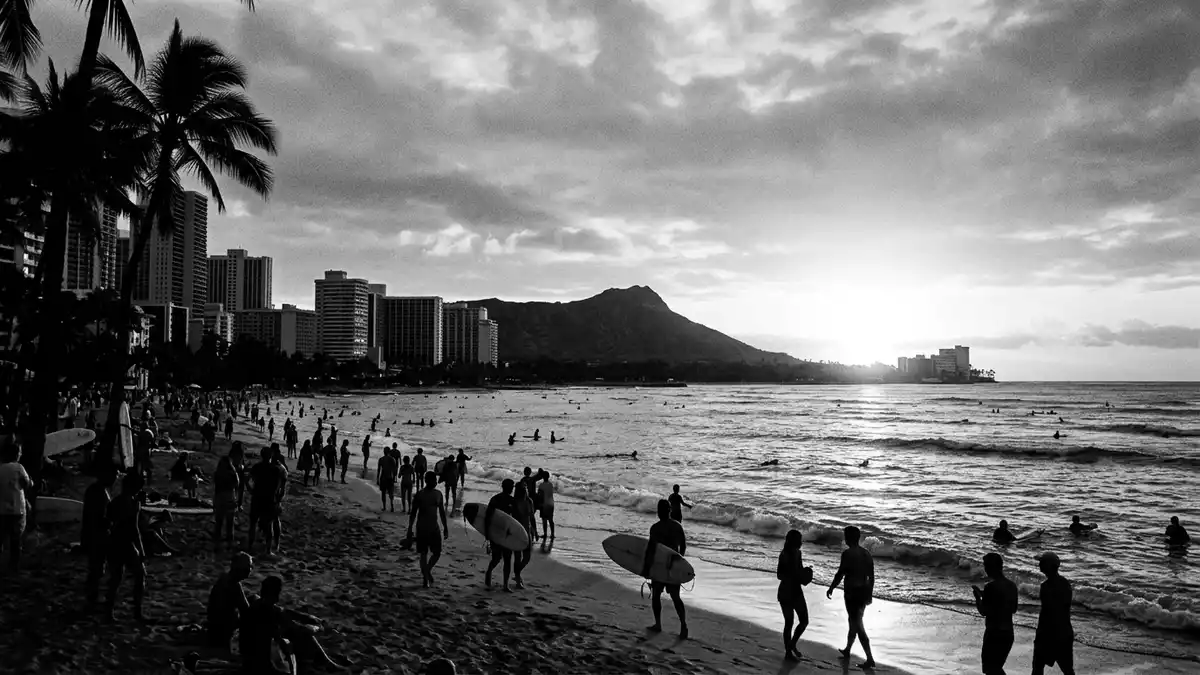
Waikiki is the beachfront neighbourhood of Honolulu where a long ribbon of sand meets high-rise hotels, parks and surf breaks in front of the Pacific. On the island of O?ahu in Hawaii, it lies between the Ala Wai Canal and the volcanic crater of Diamond Head, combining dense city blocks with an open shoreline that has shaped modern surf culture.
From royal retreat to resort district
Long before hotel towers lined the shore, Waikiki formed part of an ahupua?a, a Hawaiian land division running from the upland valleys to the sea and fed by springs and streams that earned it the name “spouting waters”. Centuries of cultivation turned its wetlands and ponds into a landscape of taro fields and fishponds, giving the area an agricultural character alongside its coastal setting.ahupua?a of Waikiki Hawaiian chiefs and members of the royal family spent time here, drawn to its accessible shore and gentle waves, and the district developed as a retreat within reach of Honolulu.
In the nineteenth century, the area took on new public spaces and roads that set the stage for its resort identity. King Kal?kaua established Kapi?olani Park in 1877 near the base of Diamond Head, laying out lawns and groves at the south-eastern end of Waikiki, and in 1888 the Park Beach Hotel opened nearby as one of the early seaside lodging houses.Kapi?olani Park in 1877 The extension of Waikiki Road, now Kal?kaua Avenue, during the mid-1800s created a through route along the shore, linking town and coast and making it easier for house builders and hotel operators to lay out properties beside the beach.
Sand, surf and the long curve of the shore
The physical setting of Waikiki is straightforward to trace on a map. The neighbourhood occupies the south shore of Honolulu on O?ahu, with the Ala Wai Canal forming its inland boundary to the north and west and the flank of Diamond Head closing its south-eastern end.between the Ala Wai Canal and Diamond Head Between canal and crater, streets run seaward from the urban grid to meet beaches that front Mamala Bay, and the narrow strip of land between water and canal contains hotels, shops, apartment blocks and public attractions.
Along the shoreline, Waikiki Beach is divided informally into sections that share the same strip of sand and shallow water. Several parks open directly onto the beach and provide shaded lawns and palms as a counterpoint to the built frontage. In places seawalls and groynes mark the transition from sand to deeper water, evidence of decades of efforts to manage erosion and maintain the bathing areas described in official documents.seawalls appeared in the late 1890s Offshore, the surf breaks that roll across the reef continue a tradition of he?e nalu, Hawaiian surfing that has been practised here for many generations.he?e nalu at Waikiki
Hotels, promenades and city attractions
Waikiki’s built character is defined by its resort district and public avenues. The first hotel credited with introducing Waikiki to a wider world, the Moana Surfrider, opened on the shore in 1901, establishing the model of a multi-storey beachfront property facing the ocean.Moana Surfrider was built in 1901 Later hotels followed along Kal?kaua Avenue and neighbouring streets, creating a skyline of high-rise accommodation that looks out over the water and frames the beach in concrete and glass.
Within this framework, Waikiki holds long promenades, retail centres and recreational sites. Kal?kaua Avenue runs parallel to the shore as the main street of the neighbourhood, lined with shops, restaurants and arcades that face both the city and the sea.Kal?kaua Avenue Inland from the beach sit attractions such as the Waikiki Aquarium and Honolulu Zoo, while Kapi?olani Park provides open green space and mature trees near Diamond Head. Together with garden areas and smaller parks, these places give Waikiki a sequence of outdoor rooms between tower blocks and shoreline, and they help explain why the neighbourhood is associated with both leisure and dense urban life.
Visiting Waikiki: what travellers from Western Europe should know
- Waikiki lies on the south shore of Honolulu on the island of O?ahu in Hawaii, framed by the Ala Wai Canal to the north and west and Diamond Head to the south-east.
- The terrain along the beachfront is mostly level, with paved promenades, park lawns and stretches of sand; streets between the canal and the shore carry regular kerbs and crossings.
- The neighbourhood sits within the wider city of Honolulu, with Daniel K. Inouye International Airport located inland to the north-west and city bus routes running towards the beachfront district.
- The official language is English and the currency is the United States dollar.
Searching for Waikiki on social platforms
These links open searches for Waikiki on each platform.
Frequently asked questions about Waikiki
Where is Waikiki within Honolulu?
Waikiki is a neighbourhood on the south shore of Honolulu on the island of O?ahu in Hawaii, bounded inland by the Ala Wai Canal and seaward by Mamala Bay.
What should visitors expect on a first visit to Waikiki?
Visitors encounter a narrow coastal district where high-rise hotels, shops and parks sit beside a long beach, with promenades, lawns and surf breaks shaping the experience of the shore.
What makes Waikiki distinctive compared with other parts of Honolulu?
Waikiki combines one of O?ahu’s main resort skylines with a historic beachfront, visible landmarks such as Diamond Head and Kapi?olani Park, and surfable waves that connect the urban district to longstanding Hawaiian surf traditions.


