
Waikiki between spouting waters and city shoreline
Published on 09/12/2026 at 12:17 | Editorial responsibility: Rafael Müller, Editor-in-Chief AD HOC NEWS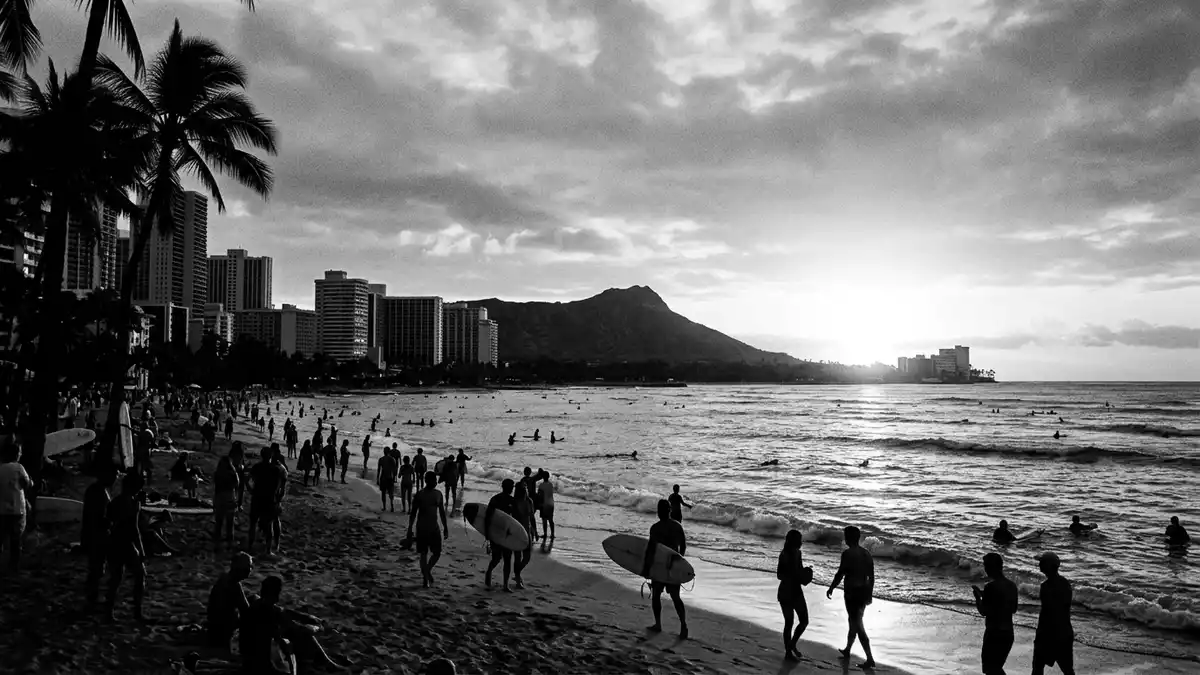
Waikiki in Honolulu is a shoreline neighbourhood on the south coast of O?ahu where the ocean, ancient waterways and dense city blocks meet in a compact strip of land. Its Hawaiian name refers to “spouting waters”, a reminder that before hotels and pavements this flat coastal plain was fed by streams and springs flowing down from the Ko?olau Range.
From royal retreat to urban shoreline
Waikiki lies between the Pacific and the Ala Wai Canal, on the south shore of O?ahu in the State of Hawaii in the United States. The district sits east of central Honolulu and looks towards L??ahi, better known in English as Diamond Head, whose volcanic cone anchors views along the main streets and beaches.between the Ala Wai Canal and Diamond Head For centuries the area formed part of an ahupua?a, a traditional Hawaiian land division stretching from mountain ridges down to the sea, with fertile soils irrigated by freshwater springs.an organised Hawaiian land division
In the fifteenth century Waikiki was established as a royal centre on O?ahu, and by the late eighteenth century it had become the first capital of the Kingdom of Hawaii under Kamehameha I.royal residence and centre of governance The shallow, consistent waves along the shoreline made it a natural setting for he?e nalu, Hawaiian surfing, practised by royalty and commoners on long wooden boards.shallow waves suited to surfing During the nineteenth century members of the Hawaiian royal family used Waikiki as a retreat, and small bathhouses and hotels began to appear beside the beach towards the end of that century.first smaller hotels from around 1880
Spouting waters, taro fields and the Ala Wai Canal
The meaning of Waikiki – “spouting waters” – reflects the way mountain-fed streams once spread across this low-lying shore, forming wetlands, taro patches and fishponds before reaching the sea.translates as fresh spouting waters Early Polynesian settlers developed an extensive network of irrigated kalo, or taro, and loko i?a, fishponds, making Waikiki one of the productive agricultural areas on O?ahu.kalo lo?i and fishponds supported agriculture Much of the land that visitors now cross on foot or by road once lay under standing water, with waterways reaching inland towards valleys such as M?noa and P?lolo.
In the early twentieth century territorial planners decided to drain the wetlands and redirect the streams into a straight channel, creating the Ala Wai Canal as a boundary along the inland side of Waikiki.construction of the Ala Wai Canal completed in 1928 Completed in 1928, the canal changed the landscape from taro fields and fishponds to firm ground suited to dense building plots and road layouts.reclamation project turning fields into house lots The present neighbourhood covers a smaller land area than the original marshes, which once extended over more than 2,000 acres, but its grid of streets and hotels rests on infilled ground shaped by that drainage scheme.marshland boundaries and present land area
Resort hotels, surf culture and city streets
The shoreline at Waikiki developed into a resort district during the early twentieth century, with the Moana Surfrider hotel opening directly onto the beach in 1901 and later resorts following along the sand.first hotel built on its shores in 1901 In the 1950s taller concrete and steel hotel buildings began to rise above the older shoreline structures, marking a shift towards high-rise accommodation in the district.first high-rise hotels built in 1955 Today the main commercial street, Kal?kaua Avenue, runs parallel to the beach, carrying shops, restaurants and hotel entrances behind rows of palms and paved promenades.Kal?kaua Avenue as the principal street
Surfing remains closely tied to Waikiki’s identity, with long, rolling waves breaking over reef in front of the hotels and surfboards stacked at rental points along the sand.gentle waves and surf culture Landmarks such as the Royal Hawaiian Hotel, with its distinctive historic architecture, and public spaces including Kapi?olani Park, the Waikiki Aquarium and the Honolulu Zoo sit within walking distance of the shoreline, making the area a compact mix of leisure, accommodation and green space.Royal Hawaiian Hotel and Kapi?olani Park Along Kal?kaua Avenue and neighbouring streets, pavements, planted verges and beach access points link the city fabric directly to the ocean, so that moving through Waikiki alternates between built-up blocks and open views onto the surf.
Visiting Waikiki: what travellers from Western Europe should know
- Waikiki forms part of Honolulu on the south shore of O?ahu in Hawaii, with the Pacific on one side and the Ala Wai Canal running along its inland edge.
- The coastal strip is largely level, but approaches to viewpoints on Diamond Head involve uphill walking and staircases cut into the volcanic slopes.
- Nearby sights include Kapi?olani Park towards the Diamond Head end of Waikiki, the Waikiki Aquarium on the shoreline and the Honolulu Zoo beside the main streets.
- The official language is English and the currency is the United States dollar.
- Entry requirements depend on your nationality; UK travellers can check the FCDO travel advice at gov.uk/foreign-travel-advice, Irish travellers the Department of Foreign Affairs at ireland.ie.
Searching for Waikiki on social platforms
These links open searches for Waikiki on each platform.
Frequently asked questions about Waikiki
Where is Waikiki and what kind of place is it?
Waikiki is a shoreline neighbourhood of Honolulu on the south coast of O?ahu in Hawaii, bordered by the Pacific Ocean and the Ala Wai Canal.
What can visitors expect on a visit to Waikiki?
Visitors encounter a mix of sandy beaches, surf breaks, resort hotels, parks and busy streets, with Diamond Head and the ocean forming constant reference points.
What makes Waikiki distinctive compared with other districts of Honolulu?
Waikiki combines historic surf culture, long sandy shoreline and a dense resort streetscape on land reshaped from former wetlands, giving it a character closely tied to water.


