
Waitan’s stone riverfront and Shanghai’s changing skyline
Published on 09/23/2026 at 09:58 | Editorial responsibility: Rafael Müller, Editor-in-Chief AD HOC NEWS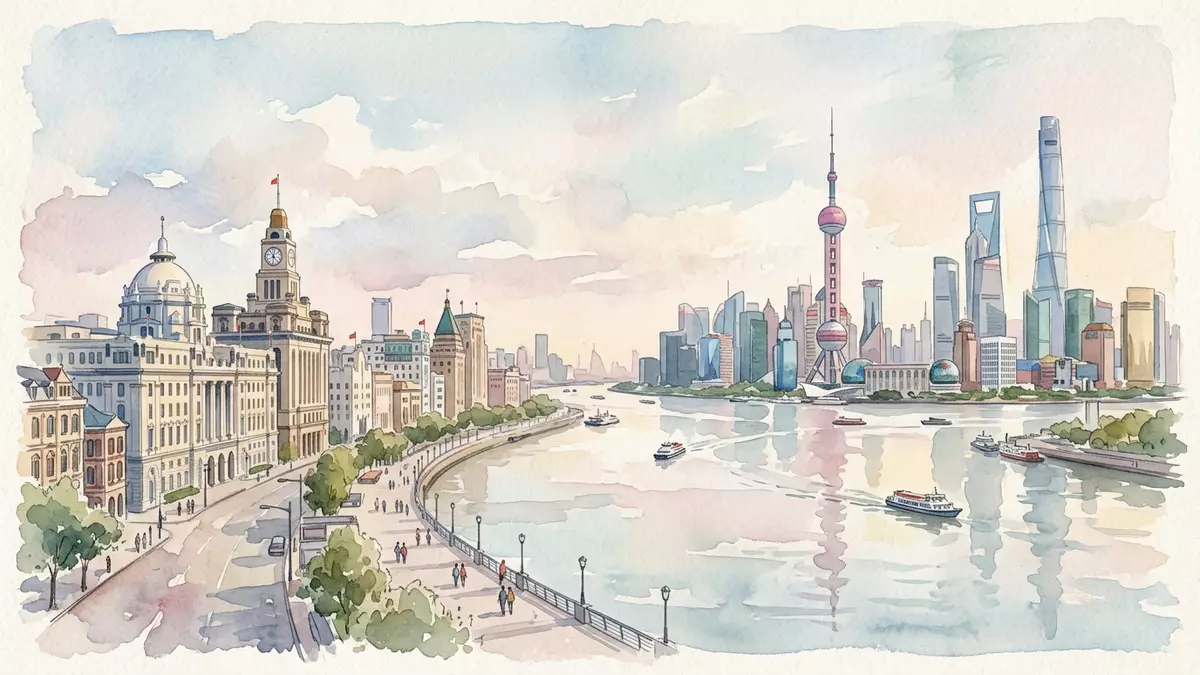
Waitan is Shanghai’s historic riverfront, where a long row of stone buildings faces the Huangpu River and the towers of Pudong. The visible contrast between nineteenth-century commercial architecture and a high-rise skyline gives the waterfront its defining character.
Waitan’s stone façades beside the Huangpu
Waitan runs along the western bank of the Huangpu River in central Shanghai. The promenade follows Zhongshan East 1st Road, with the river on one side and a continuous urban frontage on the other.
The riverfront buildings form a dense architectural ensemble. Their façades use stone, masonry and reinforced concrete, with colonnades, cornices, domes and vertical window bays. Neoclassical, Gothic, Renaissance Revival, Beaux-Arts and Art Deco elements appear within the same historic district. A guide to Waitan architecture identifies the Chinese name ?? and the district’s embankment meaning.
From treaty port to financial riverfront
Shanghai became a treaty port after the Treaty of Nanking in 1842. Waitan developed within the Shanghai International Settlement, where banks, trading houses, consulates, clubs and hotels occupied premises beside the river.
The main building row grew between the late nineteenth century and the 1930s. The former HSBC Building was completed in 1923, the Customs House dates from 1927, and Sassoon House, which contains the Peace Hotel, was completed in 1929. These dates place separate architectural phases along the same waterfront.
The area’s financial history remains legible in its building names and façades. Customs House has a prominent clock tower, while the former HSBC Building has a dome and a grand banking hall. The Peace Hotel occupies a building with a distinctive copper roof. A record of landmark buildings gives the completion dates of these structures.
Two cityscapes across the Huangpu River
The river separates two architectural readings of Shanghai. On the western bank, Waitan presents masonry façades, historic street walls and the formal line of the promenade. Across the water, Pudong presents towers and large-scale contemporary development.
Views from the riverfront include the Lujiazui skyline, with the Oriental Pearl Tower and the Shanghai World Financial Centre among its recognisable forms. The view changes with the direction of the river, while Waitan’s buildings remain the foreground’s fixed architectural sequence.
Waitan’s importance lies in this direct visual relationship. A late nineteenth-century trading district and a high-rise financial quarter occupy opposite banks of the same river. The waterfront therefore brings Shanghai’s treaty-port history and its later metropolitan form into a single view.
Visiting Waitan: what travellers from Western Europe should know
- Waitan lies on Shanghai’s western Huangpu riverbank along Zhongshan East 1st Road. Shanghai Metro stations near the riverfront include East Nanjing Road and Yuyuan Garden.
- The promenade is a paved urban waterfront beside a broad river. Walking involves stairs and level changes at some connections between the street, promenade and river edge.
- Pudong lies across the Huangpu River. The Oriental Pearl Tower and Shanghai World Financial Centre are visible from the riverfront.
- The official language is Mandarin Chinese and the currency is the Chinese yuan.
Searching for Waitan on social platforms
These links open searches for Waitan on each platform.
Frequently asked questions about Waitan
Where is Waitan?
Waitan is the historic riverfront along the western bank of the Huangpu River in central Shanghai. It faces Pudong across the water.
What can visitors see at Waitan?
The promenade faces historic banks, customs offices, hotels and commercial buildings. Their façades display neoclassical, Gothic, Renaissance Revival, Beaux-Arts and Art Deco features.
What makes Waitan distinctive?
Waitan places an early twentieth-century stone riverfront beside Pudong’s high-rise skyline. The contrast connects Shanghai’s treaty-port history with its later financial cityscape.


