
Waitan’s stone riverfront between Huangpu and Pudong
Published on 09/19/2026 at 14:44 | Editorial responsibility: Rafael Müller, Editor-in-Chief AD HOC NEWS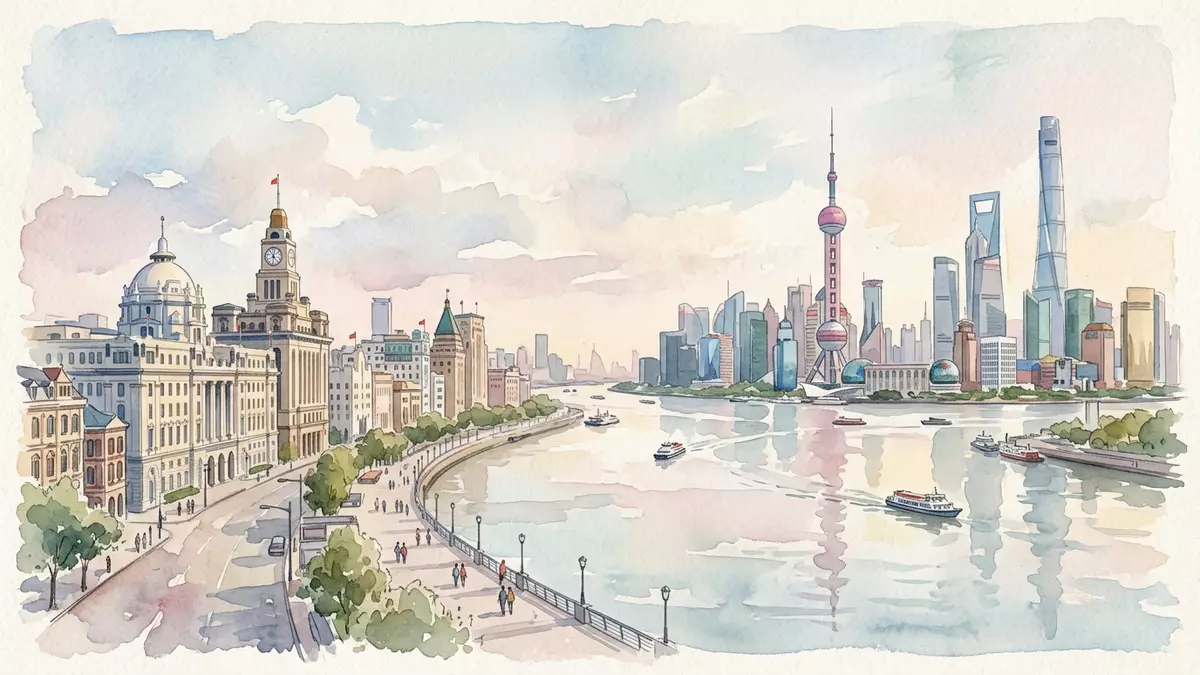
Waitan in Shanghai is the historic riverfront where a long band of early twentieth?century stone buildings faces the high?rise skyline of Pudong across the Huangpu River. Better known in English as the Bund, this stretch of waterfront along Zhongshan East 1st Road has become one of the clearest places to see how Shanghai’s older riverbank architecture and its newer towers share the same frame of water and sky.
Waitan between river, road and skyline
Waitan occupies a section of Zhongshan East 1st Road on the western bank of the Huangpu River in the Huangpu District of central Shanghai, forming a broad promenade directly beside the embankmentin the Huangpu District. Across the water, the towers of Lujiazui in Pudong stand almost opposite the riverfront row, so that many viewpoints along Waitan look straight out to clusters of glass and steel while stone façades line the bank behind. The waterfront section extends for roughly 1.5 km between the Waibaidu Bridge in the north and the area around Yan’an East Road in the south, following the curve of the river along a continuous raised promenade1.5 km elevated waterfront promenade. Along the inland edge, Zhongshan East 1st Road carries traffic past the façades, while the river side is given over to broad walkways and open viewing points.
The riverfront’s Chinese name, Waitan, is often translated as “outer beach” or “outer bank”, a term associated with Shanghai’s river edge as the city developed as a treaty?port centre in the nineteenth and early twentieth centuriesWaitan means the outer beach or outer bank. In English?language travel writing the name Bund Shanghai is widely used, but on the ground the characters for Waitan appear in local usage and on some address listings. The river itself, the Huangpu, is a working waterway, and vessels still pass between the historic embankment and the newer commercial districts upriver and downriver, keeping movement on the water as much a part of the scene as the buildings on either side.
Stone façades and early twentieth?century architecture
On the inland edge of Waitan stands a continuous row of substantial buildings whose façades largely date from the late nineteenth and early twentieth centuries, built in stone and masonry with colonnades, cornices and strong vertical linesstone façades with colonnades and cornices. Many of these structures were completed in the 1920s and 1930s, forming a sequence that reads as a catalogue of early twentieth?century commercial architecture along a single stretch of riverfront. Different styles appear side by side, including neoclassical and Beaux?Arts influences, as well as later Art Deco elements, particularly visible in some of the taller blocks within the ensemblevarious architectural styles including Art Deco. The buildings line the west side of the promenade in a relatively uninterrupted row, which gives the waterfront a strong architectural rhythm even where individual structures vary in height and detailing.
Several named buildings have become reference points for descriptions of Waitan’s architecture. The former HSBC Building, completed in 1923, stands out for its dome and its grand banking hall, and is often used as a marker for the central section of the riverfront rowformer HSBC Building completed in 1923. Nearby, the Customs House with its clock tower dates from 1927 and adds a prominent timepiece to the skyline over Zhongshan East 1st RoadCustoms House clock tower from 1927. The building now housing the Peace Hotel in the former Sassoon House was completed in 1929 with a copper roof that reads green against the stone façades, while the Bank of China Building, completed in 1937, brings more modern lines together with Chinese detailing, marking a later phase of the riverfront’s developmentPeace Hotel and Bank of China dates.
Historic district and riverside promenade
Beyond individual façades, Waitan functions as a recognised historical district within Shanghai’s urban core, with several waterfront structures designated as key cultural relics under state protectiondesignated as key cultural relics. This status highlights the riverfront as a record of the city’s early twentieth?century international architecture, from bank headquarters and trading houses to hotels and former consular buildings. Some accounts describe the Bund waterfront as featuring around 52 historic buildings along the roughly 1.5?kilometre riverfront, while other listings focus on smaller sets of particularly notable structures, but all treat the ensemble as a coherent stretch of heritage architectureguide to Bund architecture. The numbering of buildings along Zhongshan East 1st Road, running roughly south to north, reflects this sense of a continuous sequence rather than isolated monuments.
The riverfront promenade itself is as much a part of Waitan’s character as the façades. The walkway runs directly beside the water along the elevated embankment, with railings, terraces and open platforms that frame views of both the historic stone row and the Pudong skyline across the riverhistoric waterfront between East Yan'an Road and Waibaidu Bridge. Behind the riverfront, streets lead deeper into Huangpu District, but along the embankment the focus remains on the relationship between water, stone and skyline. Where side streets meet Zhongshan East 1st Road, there are sightlines back towards domes, clock towers and rooflines, so that the waterfront row forms a kind of edge to the older city fabric at this point along the river.
Visiting Waitan: what travellers from Western Europe should know
- Waitan sits on the western bank of the Huangpu River in the Huangpu District of central Shanghai, along Zhongshan East 1st Road between Waibaidu Bridge and the area around Yan’an East Road.
- The promenade runs along an elevated embankment directly beside the river, with broad paved walkways and terraces that involve level walking rather than steep climbs, though some access points use stairs.
- Nearby landmarks include Waibaidu Bridge at the northern end of the waterfront and the high?rise cluster of Lujiazui in Pudong across the river, which forms the main skyline facing Waitan.
- The official language is Chinese and the currency is the Chinese yuan.
- Entry requirements depend on your nationality; UK travellers can check the FCDO travel advice at gov.uk/foreign-travel-advice, Irish travellers the Department of Foreign Affairs at ireland.ie.
Searching for Waitan on social platforms
These links open searches for Waitan on each platform.
Frequently asked questions about Waitan
Where is Waitan within Shanghai?
Waitan runs along Zhongshan East 1st Road on the western bank of the Huangpu River in Huangpu District, between Waibaidu Bridge and the area around Yan’an East Road.
What can visitors expect on a walk along Waitan?
Visitors walk a broad riverside promenade beside the Huangpu, with continuous rows of early twentieth?century stone façades on one side and the towers of Pudong visible across the water.
What makes Waitan distinctive among Shanghai’s riverfronts?
Waitan combines a long sequence of protected early twentieth?century commercial buildings, including landmarks such as the former HSBC Building and Customs House, with uninterrupted views towards the modern skyline in Pudong.


