
Wanli Changcheng and the Ming wall near Peking
Published on 08/14/2026 at 14:37 | Editorial responsibility: Rafael Müller, Editor-in-Chief AD HOC NEWS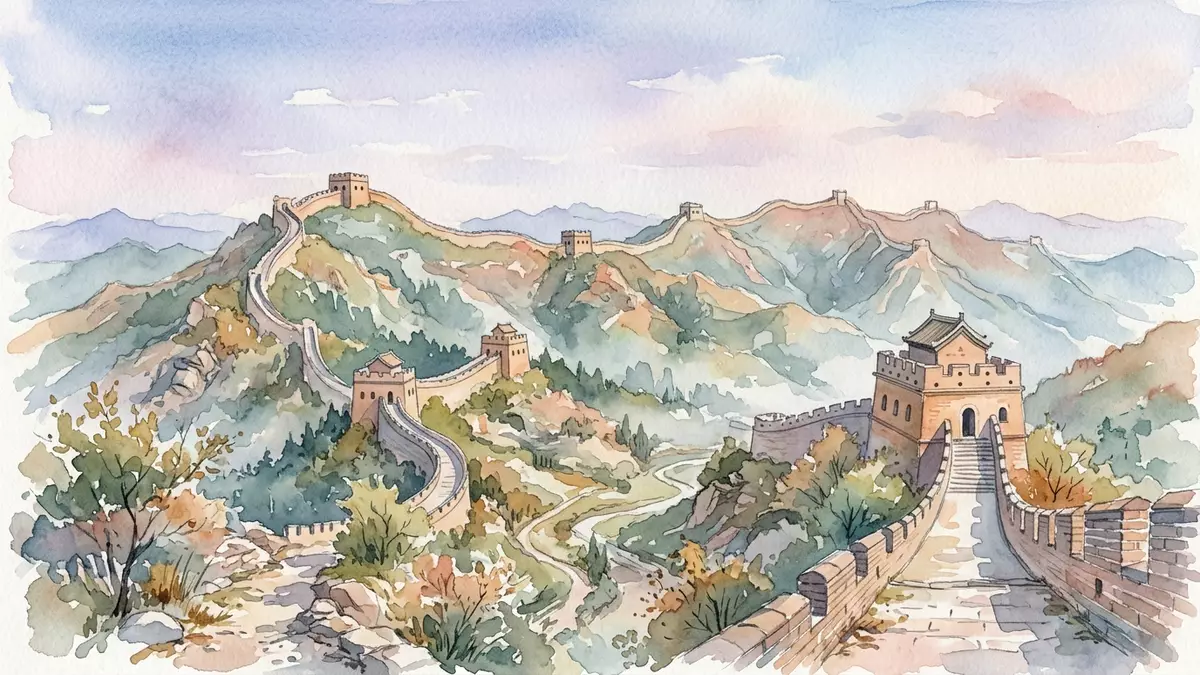
Wanli Changcheng is the familiar Chinese name for the Great Wall, and its best-known surviving stretches near Peking belong to the Ming dynasty. The wall runs through stone ramparts, watchtowers and passes rather than a single continuous line.
Wanli Changcheng in the Ming landscape
The wall as seen near Peking is closely tied to the Ming dynasty, which left the most recognisable brick and stone sections. UNESCO lists the Great Wall as a World Heritage Site, and the site entered the register in 1987.
One useful anchor is the word Wanli Changcheng itself, which appears in reference works as an alternative name for the Great Wall of China. Another is the period: the Ming dynasty, from 1368 to 1644, is the era most closely associated with the wall’s present form.
Stone, brick and long defensive lines
The surviving sections near Peking combine masonry with watchtowers, battlements and gate structures. In many places, the wall reads as a sequence of built elements set into hills rather than a single uniform barrier.
Badaling is the section most often linked with Peking in general travel writing, and it shows the Ming wall in a formal, built-up setting. That section is described as using granite and bricks, which gives the wall a harder, more regular appearance than earth-built fortifications.
A wall shaped by a long imperial border
The Great Wall grew across centuries, but the form most visitors recognise belongs to the Ming period. The Ming sections near Peking are part of a broader chain that UNESCO describes as extending across northern China.
Reference works also note that the present-day wall near Beijing is largely the reconstructed remnant of the Ming wall. That makes the place legible as both monument and defensive architecture, with the later restoration preserving the outline of an older military landscape.
Visiting Wanli Changcheng: what travellers from Western Europe should know
- The wall near Peking is reached by road into the northern districts of Beijing, with Badaling lying in Yanqing District. Rail and cable-car links exist at some sections, but the route depends on the chosen section.
- The terrain includes steep hills, stone surfaces and long flights of steps on the wall itself. In some sections, the walk moves across uneven masonry and watchtower platforms.
- The official language is Chinese and the currency is the renminbi.
- Entry requirements depend on your nationality; UK travellers can check the FCDO travel advice at gov.uk/foreign-travel-advice, Irish travellers the Department of Foreign Affairs at ireland.ie.
Searching for Wanli Changcheng on social platforms
These links open searches for Wanli Changcheng on each platform.
Frequently asked questions about Wanli Changcheng
Where is Wanli Changcheng?
Wanli Changcheng runs across northern China, and the sections most closely associated with Peking lie in the Beijing area. Badaling is in Yanqing District, north-west of the city centre.
What does a visit involve?
The wall is experienced as masonry, steps, watchtowers and long ridges rather than as a single level promenade. Some sections are more heavily developed than others, with Badaling presenting one of the most formal approaches.
What makes it distinctive?
Its scale and historical layering are central to its character, especially the Ming sections that survive near Peking. The combination of stone, brick and military structures gives it a clear identity as both architecture and landscape.


