
Wat Arun and its porcelain riverside skyline in Bangkok
Published on 08/19/2026 at 19:01 | Editorial responsibility: Rafael Müller, Editor-in-Chief AD HOC NEWS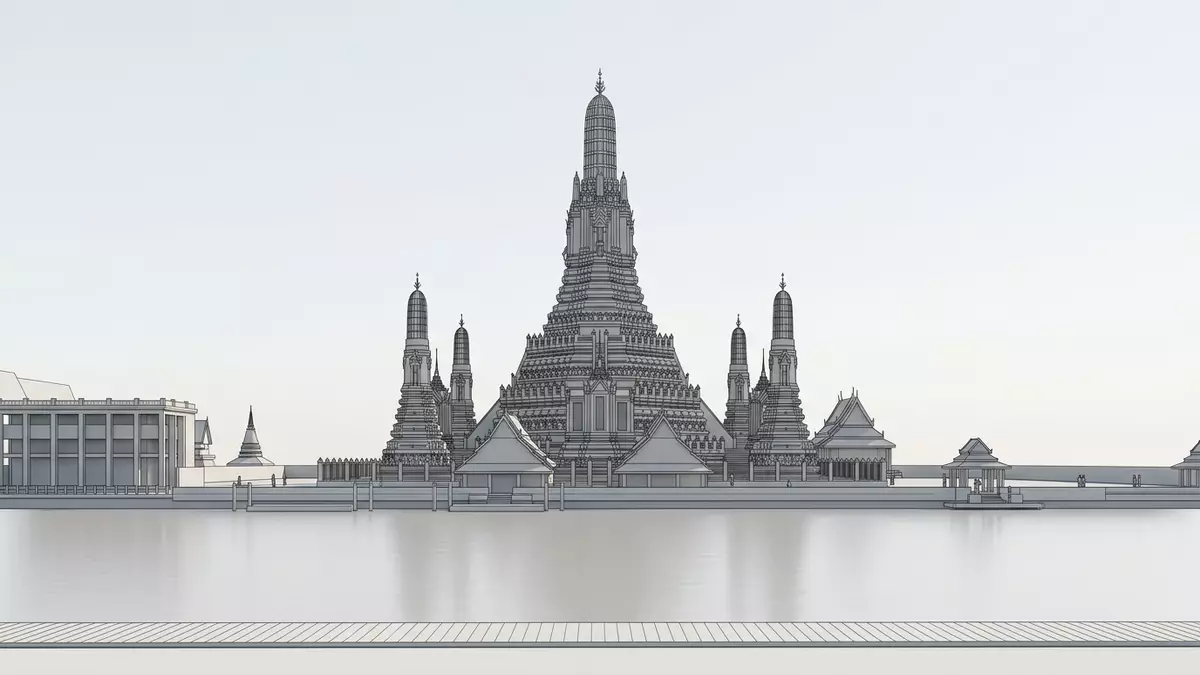
Wat Arun, the Temple of Dawn on the Thonburi bank of the Chao Phraya River in Bangkok, is a Buddhist temple whose riverfront towers define this stretch of the Thai capital. Its central prang, clad in coloured porcelain, gives the temple a distinctive vertical profile that catches the light above the low buildings of the old riverside districts.
Porcelain towers on the Chao Phraya
Wat Arun stands in the Bangkok Yai district on the western bank of the Chao Phraya River, facing Wat Pho and the old royal quarter on the opposite shore.The temple occupies a riverside site in Thonburi that was once the heart of an earlier capital. The river bends gently at this point, so the towers form a landmark for boats approaching from several directions.
The most striking feature is the main prang, a Khmer-style tower that rises high above the surrounding halls and cloisters.Its brick and stucco core is covered with mosaics of broken porcelain and coloured glass, arranged in floral and geometric patterns that glint in the sun. Smaller satellite prangs cluster around the base of the central tower, giving the complex a stepped, mountain-like silhouette that echoes the cosmic Mount Meru of Buddhist cosmology.
From Ayutthaya roots to a Bangkok landmark
Wat Arun traces its origins to the Ayutthaya period, when a modest riverside temple known as Wat Makok stood on this stretch of bank.The site gained prominence in the late eighteenth century under King Taksin, who established his capital in Thonburi after the fall of Ayutthaya and elevated the temple, then known as Wat Chaeng. The current name, Wat Arun, honours the Hindu deity Aruna and links the temple to the first light of day.
The characteristic prang dates to the early Rattanakosin period. The tower, in its present form, took shape during the reigns of King Rama II and King Rama III in the first decades of the nineteenth century, when the new Chakri dynasty was consolidating its rule on both banks of the river.Sources describe the prang as a nineteenth-century addition to an older riverside temple, so a visit today brings several layers of Thai history together in one compact complex.
Layout, decoration and everyday life at Wat Arun
The full ceremonial name of the temple, Wat Arun Ratchawararam Ratchawaramahawihan, reflects its status as a royal temple in Bangkok’s network of major wats.The complex includes ordination halls, cloistered courtyards and smaller shrines arranged around the central prang, with paved terraces stepping down towards the river piers. Whitewashed walls and red-and-green tiled roofs frame the porcelain-clad towers, so the colours shift sharply between rooflines, plaster and mosaic.
Within the grounds, statues and guardian figures stand at gateways and along walkways, while rows of Buddha images line the cloisters in the main courtyard. Monks live and work in the surrounding monastic quarters, and ritual life continues alongside the movements of visitors crossing the river by ferry. From the terraces around the base of the prang, there are outward views across the Chao Phraya towards the chedis and halls of Wat Pho and the Grand Palace, so the river feels like a broad ceremonial axis between two historic quarters of Bangkok.
Visiting Wat Arun: what travellers from Western Europe should know
- Wat Arun stands on the Thonburi side of the Chao Phraya River, opposite Rattanakosin Island in central Bangkok, and is reached by river boats that serve piers on both banks.
- The temple grounds include terraces, exterior stairways and uneven paving, and the climb towards the base of the central prang involves steep steps that can feel exposed.
- Wat Arun is part of a wider riverside district with other temples, small markets and ferry piers, so it combines easily with visits to Wat Pho and the historic royal area across the river.
- The official language is Thai and the currency is the baht.
- Entry requirements depend on your nationality; UK travellers can check the FCDO travel advice at gov.uk/foreign-travel-advice, Irish travellers the Department of Foreign Affairs at ireland.ie.
Searching for Wat Arun on social platforms
These links open searches for Wat Arun on each platform.
Frequently asked questions about Wat Arun
Where is Wat Arun located in Bangkok?
Wat Arun stands in the Bangkok Yai district on the Thonburi bank of the Chao Phraya River, facing Wat Pho and the historic royal area across the water.
What should visitors expect inside Wat Arun?
Visitors find a complex of porcelain-clad towers, ordination halls, cloistered courtyards and riverside terraces, with steep exterior steps and views across the river to central Bangkok.
What makes Wat Arun distinctive among Bangkok’s temples?
Wat Arun is distinguished by its central prang, a Khmer-style tower with a porcelain mosaic surface, which rises directly above the riverbank and forms a landmark in the city skyline.


