
Wat Phra That Doi Suthep and its golden mountain terrace
Published on 08/19/2026 at 22:38 | Editorial responsibility: Rafael Müller, Editor-in-Chief AD HOC NEWS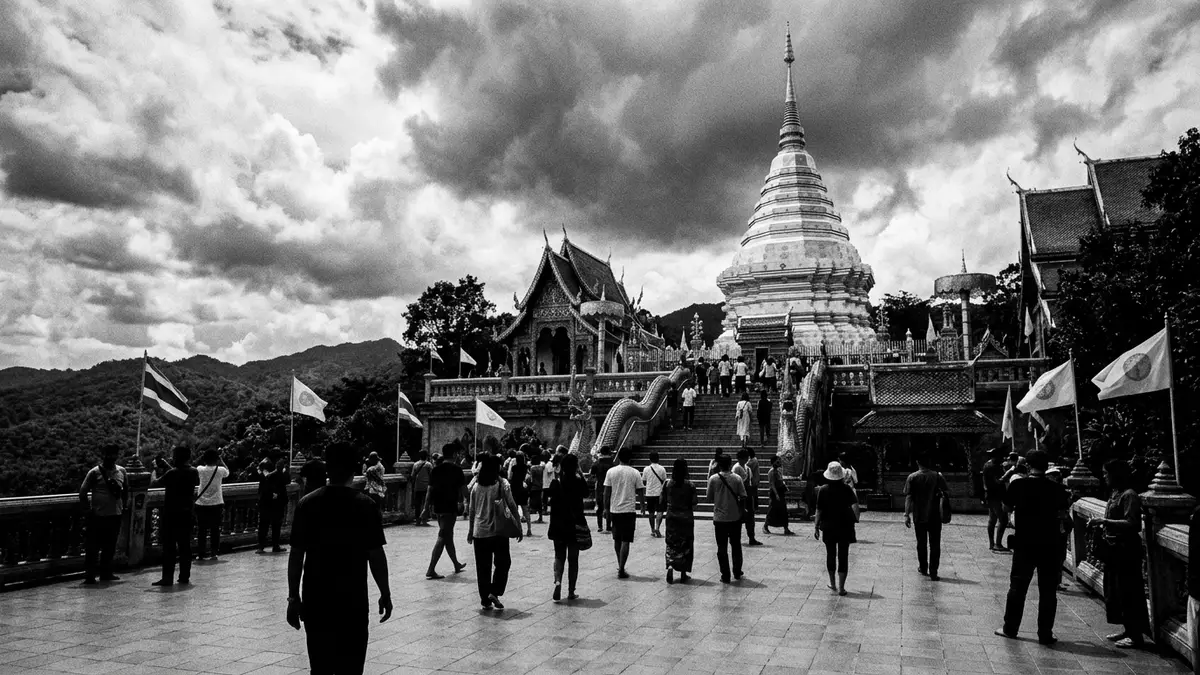
Wat Phra That Doi Suthep is a Buddhist mountain temple overlooking Chiang Mai, known above all for its golden chedi and the broad terrace that opens towards the valley below. Rising on Doi Suthep in northern Thailand, it is closely linked with the Lanna Kingdom and is associated with a foundation in 1383 under King Keu Naone. The combination of a gilded central stupa, surrounding cloisters and panoramic views makes the upper courtyard a distinct plateau in the hills west of the city.
A Lanna sanctuary on a northern Thai peak
Wat Phra That Doi Suthep stands on Doi Suthep, one of the peaks of the Doi Suthep–Pui range west of Chiang Mai, placing the temple high above the plain and giving it a clear relationship with the city below.Wat Phra That Doi Suthep From the upper terrace the view stretches across Chiang Mai and the surrounding countryside, and the temple’s position on a mountain forms part of its identity as a site of pilgrimage in northern Thailand.
The temple is associated with the Lanna Kingdom and is linked with King Keu Naone, who is recorded as ordering its construction in the fourteenth century to enshrine a Buddha relic.the monastery was established in 1383 Its architecture reflects northern Thai traditions that later came to be grouped under the Chiang Mai School of art, with the chedi serving as a prototype for later bell-shaped stupas in the region.Its art is classified as Chiang Mai School The founding legend links the site with a sacred white elephant carrying a bone relic, which is said to have chosen the spot where the chedi stands by stopping and dying near the summit of the mountain.
The golden chedi and inner courtyard
At the heart of Wat Phra That Doi Suthep lies a gilded chedi that dominates the inner courtyard and serves as the reliquary of the temple. Sources describe it as bell-shaped and link it with the late Lanna period, noting that its form influenced similar chedis built in Chiang Mai and Lamphun in the sixteenth century.Its chedi is also a prototype The structure rises from a square base and is covered in gold-coloured metal, catching the light and forming a strong visual focus within the enclosure.
The chedi stands within an inner terrace where cloister galleries frame the courtyard and visitors walk around the stupa along a paved path.a walkway circumnavigates the gleaming golden chedi Around the central stupa are smaller shrines containing Buddha images from different periods, votive offerings and candles, creating a dense arrangement of religious structures within a relatively compact space.the central gold chedi surrounded by smaller shrines The combination of the golden stupa, polished stone paving and surrounding galleries means the inner terrace feels like a self-contained sanctuary set apart from the forested slopes outside.
The naga staircase and mountain approach
Approach to Wat Phra That Doi Suthep is a significant part of the experience of the place, and it begins with the road up the mountain constructed in the 1930s under the guidance of the monk Kruba Srivichai.a road to the temple in 1935 The temple itself is reached by a long staircase guarded by naga balustrades, their scaled bodies running continuously along the sides of the steps and their heads forming a dramatic entrance at the base.a 306-step staircase flanked by naga The climb from the lower level to the upper terrace under the naga guardians marks a transition from the forested slope to the religious precinct at the summit.
The stairway has become one of the most recognisable features of the temple, described as a long naga balustrade leading directly to the entrance and forming an elaborate decorated ascent.The ‘Serpent Steps’ are a 309-step stairway At the top of the staircase, gateways and small terraces lead into the inner sanctuary, and the movement from the base to the summit underscores the distinction between the everyday world below and the religious space above. Together with the mountain road, the naga steps shape the way visitors arrive at the temple and encounter its main terrace.
Visiting Wat Phra That Doi Suthep: what travellers from Western Europe should know
- Wat Phra That Doi Suthep stands on Doi Suthep mountain to the west of Chiang Mai, reached by a road that climbs from the city towards the Doi Suthep–Pui National Park.
- The final approach to the temple involves a staircase of several hundred steps with naga balustrades; the ascent is on solid steps and gains noticeable height between the lower terrace and the upper courtyard.
- The temple complex lies at an elevation above 1,000 m (3,281 ft), so the terraces sit higher than the city and the air can feel cooler than the plain during some parts of the year.
- Wat Phra That Doi Suthep is in Thailand, where the official language is Thai and the currency is the baht.
- Entry requirements depend on your nationality; UK travellers can check the FCDO travel advice at gov.uk/foreign-travel-advice, Irish travellers the Department of Foreign Affairs at ireland.ie.
Searching for Wat Phra That Doi Suthep on social platforms
These links open searches for Wat Phra That Doi Suthep on each platform.
Frequently asked questions about Wat Phra That Doi Suthep
Where is Wat Phra That Doi Suthep located?
Wat Phra That Doi Suthep stands on Doi Suthep mountain in the Doi Suthep–Pui range west of Chiang Mai in northern Thailand, above the urban area.
What should visitors expect on a visit?
Visitors encounter a long naga staircase, mountain terraces, cloistered courtyards and a gilded chedi that enshrines a Buddha relic, together with broad views over Chiang Mai.
What makes Wat Phra That Doi Suthep distinctive?
Its combination of Lanna-era sanctuary, golden bell-shaped chedi, naga-guarded staircase and elevated terrace facing Chiang Mai gives the temple a distinctive character among northern Thai sites.


