
Wat Rong Suea Ten and its saturated blue vision in Chiang Rai
Published on 09/19/2026 at 07:16 | Editorial responsibility: Rafael Müller, Editor-in-Chief AD HOC NEWS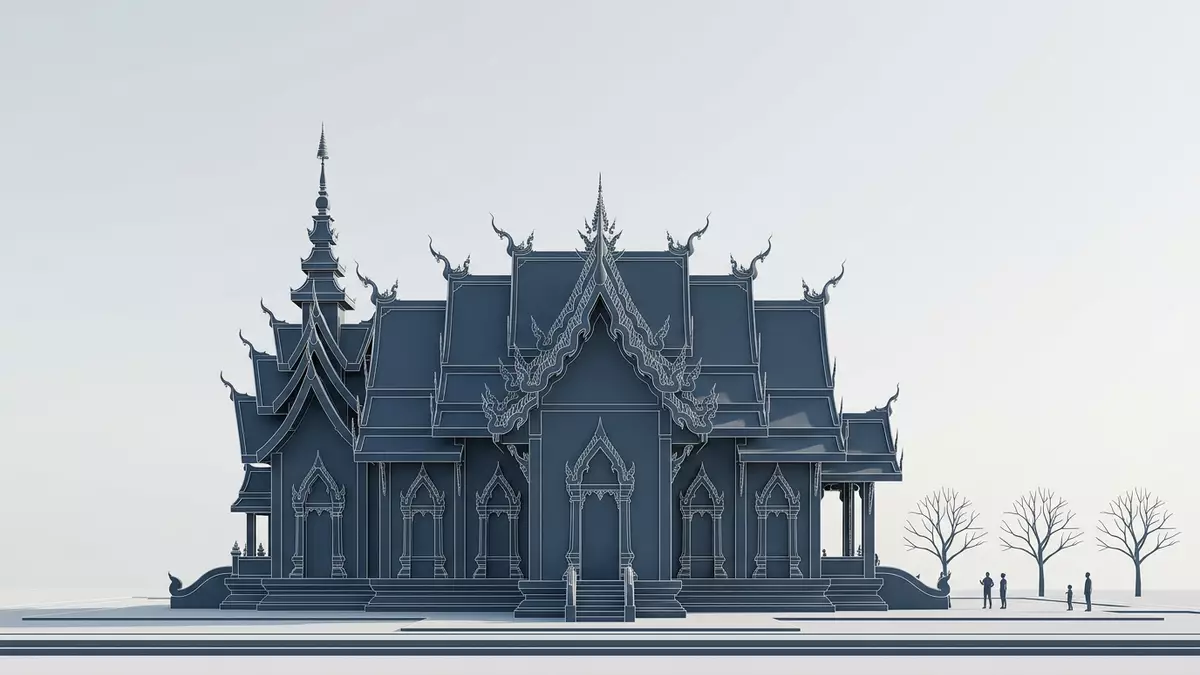
Wat Rong Suea Ten in Chiang Rai, widely known as the Blue Temple, is a contemporary Buddhist temple whose saturated blue surfaces wrap a familiar northern Thai hall and its luminous white Buddha in an arresting, modern vision. Completed in 2016, it stands in the Rim Kok area north of the city centre, close to the Mae Kok River in northern Thailand, and has become a clear landmark of Chiang Rai’s recent wave of art-inflected temples.
A blue reimagining of a northern Thai temple form
Wat Rong Suea Ten takes the outline of a traditional northern Thai temple hall and renders it almost entirely in vivid blue, picking out edges, ornaments and guardian figures in bright gold and other strong colours. The temple’s main hall stands in Rim Kok Subdistrict in Mueang Chiang Rai District and is recorded as about 13 m (43 ft) wide and 48 m (157 ft) long, giving the building a long, rectangular footprint that visitors approach from a forecourt lined with statues and ornamental structures.The temple’s main hall dimensions
The Thai name “Wat Rong Suea Ten” is commonly rendered in English as “Blue Temple”, but its literal meaning refers to a tiger and is linked to the history of the Rim Kok area on the north bank of the Mae Kok River. The temple stands in the village of Rong Suea Ten, and the name is connected with accounts of tigers leaping in the area, which gave the village its name long before the present complex was built.Rong Suea Ten village name This combination of a deep blue palette with tiger motifs and Buddhist imagery gives the place a distinct visual identity among Chiang Rai’s temples.
From abandoned village temple site to contemporary art temple
Wat Rong Suea Ten stands on the site of an earlier temple in Rong Suea Ten village that had fallen into disuse and become a ruin, and the present complex grew out of local efforts in the 1990s to establish a new ceremonial centre for the community. Construction on the modern temple began on 27 October 2005 and continued for more than a decade; the building in its present form was completed in January 2016, giving Wat Rong Suea Ten a clear dating within the early twenty-first-century development of Thai religious architecture.Construction start and completion dates
The design of the temple is linked to Phutta Kabkaew, a local artist who had previously worked with Chalermchai Kositpipat at Wat Rong Khun, the White Temple outside Chiang Rai. Phutta Kabkaew, also known locally as Sala Nok, led the construction of Wat Rong Suea Ten and applied a similar willingness to work with strong colour, intricate ornament and contemporary visual motifs within a conventional religious layout.Phutta Kabkaew’s role and connection to Wat Rong Khun The result is a temple that is recognisably part of the Chiang Rai art-temple tradition while remaining an active place of Buddhist worship for local residents.
Inside the hall: white Buddha and layered ornament
Passing through the decorated entrance into the main hall brings a marked shift from blue exterior walls to an interior organised around a large white seated Buddha. The figure sits on a raised platform at the far end of the hall, framed by patterned walls and ceiling surfaces that carry the blue colour scheme into the space alongside additional decorative motifs. Around the central Buddha stand further statues, smaller figures and structural columns, each treated with layered ornament and colour in keeping with the rest of the temple.
Outside the main hall, the temple grounds contain further structures and sculptural elements that extend the visual language of the complex. Guardian figures with elaborate bodies and expressive faces flank approaches and platforms, and water features and smaller shrines provide additional points of focus around the site.Descriptions of the blue and gold exterior and interior Buddha Together, these elements make Wat Rong Suea Ten a place where the visitor’s experience is shaped as much by colour and ornament as by the outline of the buildings themselves.
Visiting Wat Rong Suea Ten: what travellers from Western Europe should know
- Wat Rong Suea Ten stands in Rim Kok Subdistrict on the north side of Chiang Rai, near the Mae Kok River, and is reached most directly by road from the city centre. Local transport such as taxis or tuk-tuks commonly travel to the temple along Maekok Road and other routes in the urban area.
- The temple complex is largely level at ground level, with paved approaches and a forecourt leading to the main hall, but entry into the hall involves a short staircase and time spent standing or moving on foot inside the building.
- Chiang Rai lies in northern Thailand, and the official language is Thai and the currency is the baht.
- Entry requirements depend on your nationality; UK travellers can check the FCDO travel advice at gov.uk/foreign-travel-advice, Irish travellers the Department of Foreign Affairs at ireland.ie.
Searching for Wat Rong Suea Ten on social platforms
These links open searches for Wat Rong Suea Ten on each platform.
Frequently asked questions about Wat Rong Suea Ten
Where is Wat Rong Suea Ten located?
Wat Rong Suea Ten stands in Rim Kok Subdistrict in Mueang Chiang Rai District in northern Thailand, in the village of Rong Suea Ten near the Mae Kok River.
What can visitors expect during a visit?
Visitors encounter a contemporary Buddhist temple whose main hall is covered in deep blue ornament outside and centred on a large white seated Buddha inside, with further statues and decorative structures around the grounds.
What makes Wat Rong Suea Ten distinctive among Chiang Rai’s temples?
The temple’s saturated blue and gold exterior, its tiger-linked name, its luminous interior Buddha and its connection with artist Phutta Kabkaew place it within Chiang Rai’s art-temple movement while giving it a clear identity of its own.


