
Wat Si Saket in Vientiane and its ring of Buddhas
Published on 08/16/2026 at 14:45 | Editorial responsibility: Rafael Müller, Editor-in-Chief AD HOC NEWS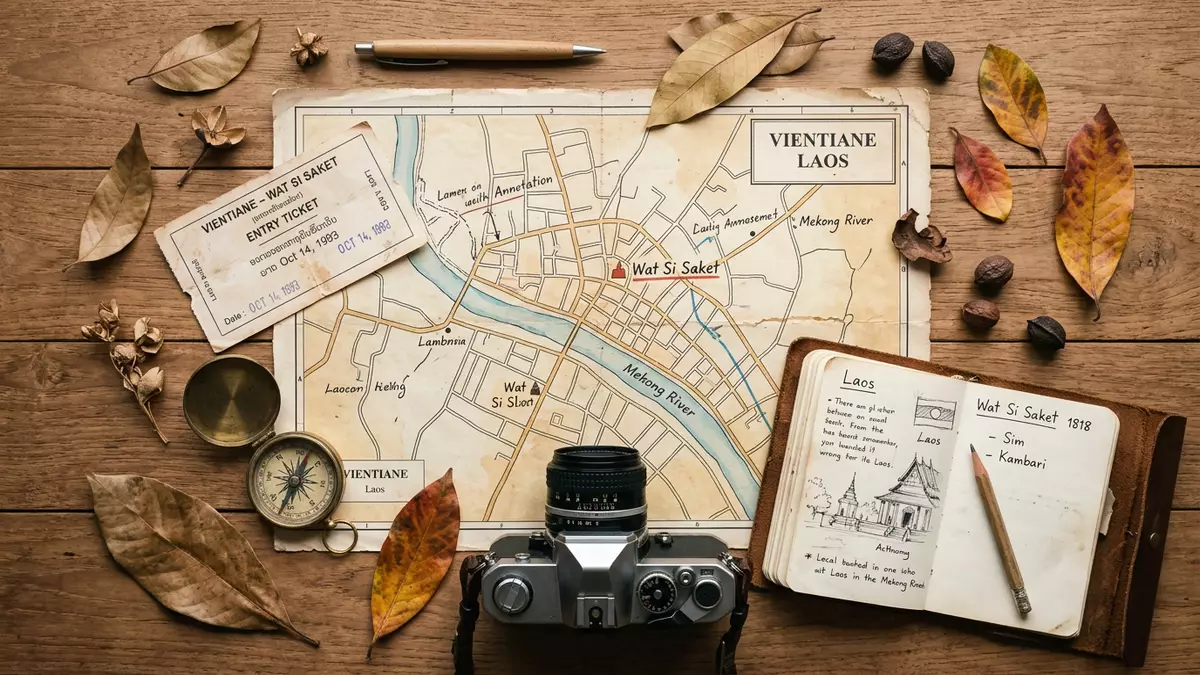
Wat Si Saket in Vientiane is a nineteenth?century Buddhist monastery where rows of Buddha images line the inner cloister, creating a ring of statues around the central hall. This Buddhist wat was commissioned by King Anouvong of the Lao kingdom of Vientiane and completed in 1818, giving the complex a clear place in the early nineteenth century history of Laos.completed in 1818
The oldest surviving monastery in the Lao capital
Wat Si Saket stands close to the Presidential Palace in the centre of Vientiane, on the intersection of Lan Xang Road and Setthathirat Road.cnr Rue Lan Xang & Rue Setthathirath The temple complex occupies a rectangular plot, enclosed by cloister walls that separate the inner religious space from the streets and offices nearby.intersection of Lane Xang road and Setthathirat road Inside the walls, visitors find shady grounds and a sequence of buildings and galleries that frame the central viharn.
Many reference works describe Wat Si Saket as the oldest surviving Buddhist temple in Vientiane, a rare survivor of nineteenth century conflict that destroyed much of the former royal city.oldest surviving Buddhist temple in Vientiane The wat remained standing when other monasteries were damaged or rebuilt, and its early nineteenth century form still shapes the experience of the courtyard and main hall.oldest temple of the town that is still in its original form
King Anouvong and early nineteenth century Laos
The monastery was founded under King Anouvong, also known as Chao Anou, the last monarch of the Lao kingdom of Vientiane.Gestiftet wurde Wat Si Saket im Jahr 1818 von König Anouvong He ruled from the early 1800s, in an era when the Lao court maintained close ties with neighbouring Siam, present?day Thailand.founded under King Anouvong The architectural style of Wat Si Saket reflects those connections, with the main hall and its roof often described as closer to Siamese forms than to later Lao designs.Siamese style of Buddhist architecture
The early nineteenth century was a period of political tension in the Mekong region, and conflict between Vientiane and Siam in the late 1820s led to the sack of the city.Vientiane in der Folge weitgehend zerstört While many temples were destroyed or heavily damaged, Wat Si Saket remained standing, and religious activity continued there throughout the nineteenth century.L'activité religieuse s'y est poursuivie tout au long du XIXe siècle In the twentieth century, the monastery and its structures were restored by specialists associated with the École française d’Extrême?Orient, adding a colonial?era layer to its conservation history.in den 1930er-Jahren wurde Wat Si Saket ... restauriert
Buddha galleries and museum spaces
Wat Si Saket is known for the Buddha images that line its cloister galleries, set into recesses and placed on shelves along the inner walls. Travel accounts describe thousands of images of different sizes and materials, forming a continuous sequence around the central courtyard.over 10,000 Buddha sculptures Many figures are made of wood, stone or metal, and the variety of postures and styles reflects different periods of Lao and regional Buddhist art.more than 2000 ceramic and silver Buddha images
The main viharn at the centre of the complex houses larger Buddha statues and sacred objects, while parts of the cloister function as a small museum with religious artefacts and historical items linked to the temple and to Vientiane.Heute beherbergt Wat Si Saket auch ein Museum Visitors walk beneath multi?tiered rooflines and pass shrines, small stupas and standing figures, each contributing to the layered impression of a monastery that has served both as an active religious site and as a repository of sculptures and manuscripts over generations.Buddhist wat in Vientiane, Laos
Visiting Wat Si Saket: what travellers from Western Europe should know
- Wat Si Saket stands in central Vientiane on Lan Xang Road, close to the Presidential Palace and opposite Haw Phra Kaew. It is reached on foot, by local bus or by road transport from other parts of the city.
- The monastery complex is enclosed by cloister walls and includes a courtyard, galleries and shrine buildings. Paths within the grounds involve short walks on level surfaces and steps into the main hall.
- The official language is Lao and the currency is the Lao kip.
- Entry requirements depend on your nationality; UK travellers can check the FCDO travel advice at gov.uk/foreign-travel-advice, Irish travellers the Department of Foreign Affairs at ireland.ie.
Searching for Wat Si Saket on social platforms
These links open searches for Wat Si Saket on each platform.Frequently asked questions about Wat Si Saket
Where is Wat Si Saket located in Vientiane?
Wat Si Saket stands on Lan Xang Road at its junction with Setthathirat Road, near the Presidential Palace in central Vientiane.
What should visitors expect when entering the monastery complex?
Visitors enter an enclosed courtyard with cloister galleries lined with Buddha images, a central hall, shrines and museum displays within the same set of buildings.
What makes Wat Si Saket distinctive among temples in Vientiane?
Wat Si Saket is recognised as the oldest surviving Buddhist temple in Vientiane and is marked by continuous galleries of Buddha images around its inner courtyard.


