
Waza National Park, a Sahelian savanna on Cameroon’s northern frontier
Published on 09/05/2026 at 11:56 | Editorial responsibility: Rafael Müller, Editor-in-Chief AD HOC NEWS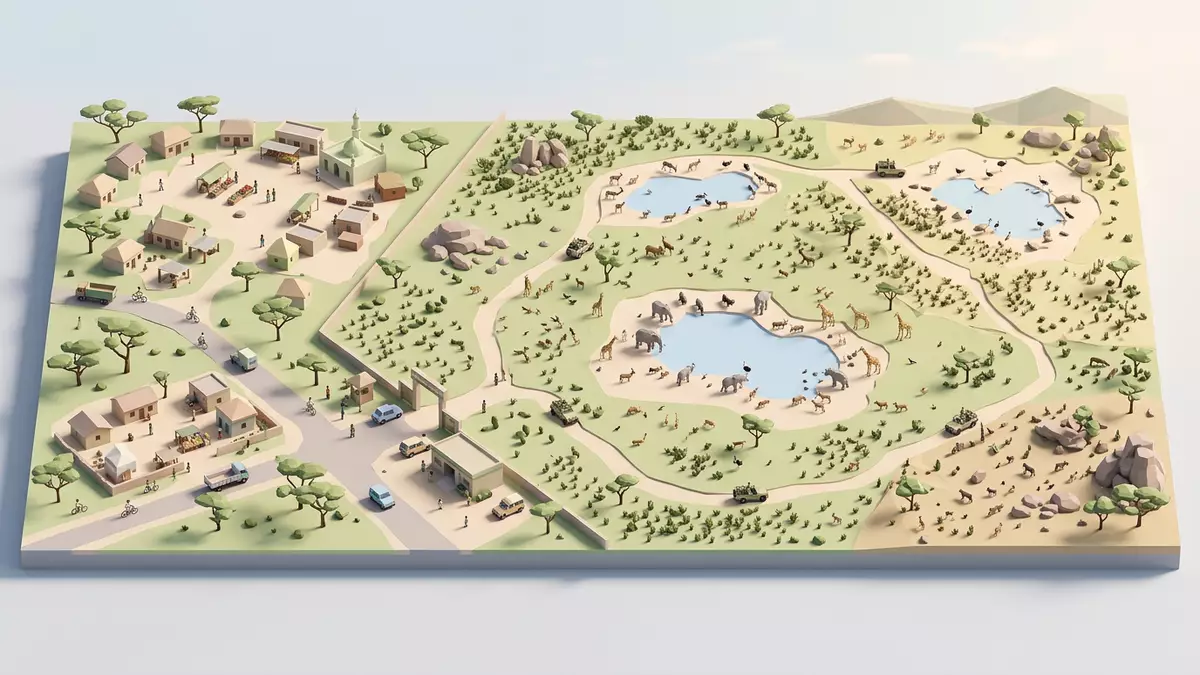
Waza National Park in Cameroon’s Far North Region is a broad expanse of Sahelian savanna and floodplain east of the town of Waza, close to the borders with Nigeria and Chad. Its protected status, its biosphere reserve designation and its location in the Chad depression give the park a defined role in safeguarding semi-arid landscapes and wildlife along Cameroon’s northern frontier.
Sahelian savanna, floodplains and the Chad depression
Waza National Park lies in the Chad depression, a vast lowland associated with the wider Lake Chad basin in northern Cameroon. The protected area covers about 1,700 km² (656 sq mi), giving space for open plains, acacia-dotted savanna and floodplain grasslands to stretch across the landscape between the Maroua–Kousséri road and the Logone flood-plain.covers about 1,700 km² The terrain sits at elevations around 300 m (984 ft), with broad, gently undulating ground rather than steep mountains, and the park lies only a short distance from the borders with Nigeria to the west and Chad to the east.only about 10 km from the border
The park sits within the transition zone between the Sahel and Sudan savanna, where semi-arid grassland meets slightly more wooded country.transition zone between the Sahel and Sudan savanna Seasonal floodplains linked to the Logone River form a key part of its setting, with depressions that can hold water and expansive flat areas that dry to short grass and bare soil. Within this environment, acacia trees and other drought-tolerant species mark the savanna, and the open horizons mean the sky and weather feel closely tied to the ground.
From hunting reserve to biosphere reserve
Waza National Park traces its protected status to the first half of the twentieth century, when a hunting reserve was established over a large tract of Sahelian plain in northern Cameroon.founded in 1934 as a hunting reserve It achieved national park status in 1968, on the basis of a formal decree that set out its boundaries and management objectives.créé par arrêté du 5 décembre 1968 This change placed conservation and ecological protection at the centre of its role, replacing earlier hunting-focused regulation with stricter controls on land use and wildlife protection.
In 1979 Waza became a biosphere reserve under UNESCO’s Man and the Biosphere Programme, with the Waza Biosphere Reserve recorded as part of the international network that links conservation of ecosystems with support for local communities.Waza Biosphere Reserve nomination recorded in 1979 Within the wider biosphere reserve, the national park forms a core zone of strict protection, surrounded by areas where grazing, agriculture and settlement are managed alongside ecological objectives. The combination of national park status, biosphere recognition and Ramsar wetland designation for the neighbouring Waza Logone floodplain places Waza within several overlapping conservation frameworks that shape how its savanna and floodplains are treated.
Wildlife, floodplain ecology and human presence
Waza National Park is known for Sahelian wildlife adapted to semi-arid conditions, including lions, elephants, giraffes, antelopes and numerous bird species.home to lions, elephants, giraffes and antelopes Open grassland and scattered trees offer habitat for large mammals, while floodplain pools, channels and seasonal wetlands support waterbirds and other species that rely on surface water. The mix of dry savanna and inundated areas creates a mosaic of environments across the park, and the large protected area lets wildlife range between them without crossing into intensive cultivation.
The Waza Logone floodplain east of the park provides a hydrological context for its ecology, with seasonal flooding and drying patterns influencing vegetation and wildlife movements.Plaine d’Inondation de Waza Logone Human presence is concentrated in the surrounding buffer zones and towns such as Waza and Maroua, with pastoralism and agriculture forming part of the wider landscape outside the core protected area.located in the Far North Region near the border with Chad and Nigeria Within the park itself, tracks link observation points and management posts, and the absence of permanent settlements preserves the open character of the savanna.
Visiting Waza National Park: what travellers from Western Europe should know
- Waza National Park lies immediately east of the town of Waza in Cameroon’s Far North Region, close to the Maroua–Kousséri road that links regional centres.
- The terrain consists mainly of flat to gently undulating Sahelian savanna and floodplains, so vehicle tracks cross open ground and viewpoints often stand on low rises above wide plains.
- The park sits near the borders with Nigeria and Chad, and the wider Waza Biosphere Reserve extends across semi-arid plains linked to the Chad depression.
- The official language is French and the currency is the Central African CFA franc.
- Entry requirements depend on your nationality; UK travellers can check the FCDO travel advice at gov.uk/foreign-travel-advice, Irish travellers the Department of Foreign Affairs at ireland.ie.
Searching for Waza National Park on social platforms
These links open searches for Waza National Park on each platform.
Frequently asked questions about Waza National Park
Where is Waza National Park?
Waza National Park is in Cameroon’s Far North Region, immediately east of the town of Waza and close to the borders with Nigeria and Chad.
What can visitors expect in terms of landscape and wildlife?
The park consists of Sahelian savanna, acacia-dotted plains and floodplains in the Chad depression, with lions, elephants, giraffes, antelopes and diverse birdlife.
What makes Waza National Park distinctive among African parks?
Waza combines national park status with UNESCO biosphere recognition in a semi-arid Sahelian setting near Lake Chad, linking open savanna, floodplain ecology and cross-border conservation.


