
Waza National Park, a Sahelian wildlife reserve in Cameroon’s Far North
Published on 09/18/2026 at 14:35 | Editorial responsibility: Rafael Müller, Editor-in-Chief AD HOC NEWS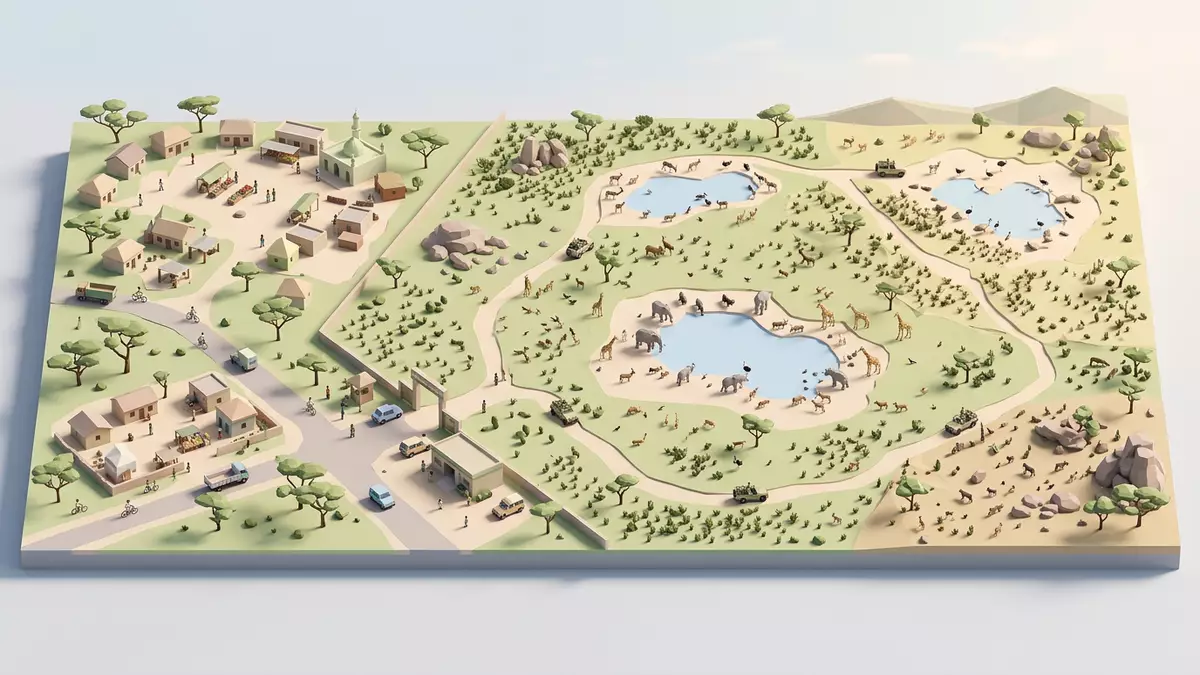
Waza National Park in northern Cameroon is a broad sweep of Sahelian savanna east of the town of Waza, where grasslands and floodplains stretch towards the borders with Chad and Nigeria. In this protected landscape the national park forms the core of the Waza Biosphere Reserve, recognised under UNESCO’s Man and the Biosphere Programme since 1979, with wildlife ranging across semi-arid plains in the Chad depression.Waza National Park
Sahelian savanna, floodplains and the Chad depression
Waza National Park lies in Cameroon’s Far North Region, in the Department of Logone-et-Chari, immediately east of Waza and less than 10 km from the borders with Nigeria and Chad.immediately east of the town of Waza The landscape sits in the Chad depression, part of the wider Lake Chad basin, at elevations around 300 m (984 ft), where semi-arid Sahelian conditions meet Sudan-type savanna.Waza Biosphere Reserve in the Chad depression
The protected area covers around 1,700 km² (656 sq mi), giving space to open grasslands, scattered acacia woodland and seasonally inundated floodplains associated with the Logone River system.around 1,700 km² During the short rainy period the Yaéré floodplain fills and channels water across former lakebed soils, while much of the year the ground dries to firm, dusty surfaces broken by low shrubs and hardy grasses adapted to the Sahelian climate.soudano sahélien, semi-arid and tropical climate
From hunting reserve to biosphere reserve
Waza was first set aside as a hunting reserve in 1934 under French colonial administration, reflecting concern for elephant, giraffe and antelope populations in Cameroon’s northern plains.founded in 1934 as a hunting reserve On 5 December 1968 the area was formally designated Waza National Park, with legal protection over roughly 170,000 ha of savanna and floodplain habitats in the Far North Region.created by decree on 5 December 1968
In 1979 the wider Waza Biosphere Reserve was accepted into UNESCO’s Man and the Biosphere Programme, recognising the national park as a strictly protected core area within a larger mosaic of land where local communities use grazing and fields under agreed management frameworks.UNESCO biosphere reserve since 1979 This status links Waza with global networks of biosphere reserves that aim to reconcile conservation with sustainable use in regions where people, wildlife and marginal climates meet.
Elephants, lions and Kordofan giraffes on the savanna
Waza National Park is known for its substantial African bush elephant herds that gather at the Mare aux Éléphants, a watering area which concentrates wildlife on the plains in the dry season.Mare aux Éléphants watering hole The park also shelters one of the remaining populations of Kordofan giraffe, a subspecies with a limited range in Central and West Africa, alongside kob antelope, red-fronted gazelle, korrigum and other large ungulates adapted to Sahelian conditions.refuge for Kordofan giraffe
Predators include lion, leopard and cheetah, with Waza’s lion population described as small but still functioning, and hyenas moving across the open plains.protection of lions and other carnivores Primates such as olive baboon, patas monkey and vervet monkey use wooded patches and gallery vegetation, while the Yaéré floodplain and associated wetlands support thousands of waterfowl, from marbled duck and greater spotted eagle to black crowned crane and various stork species.critical habitat for waterfowl and diverse birds
Visiting Waza National Park: what travellers from Western Europe should know
- Waza National Park lies in Cameroon’s Far North Region, immediately east of Waza and near the borders with Nigeria and Chad, reached overland on the Maroua–Kousséri road.bounded to the west by the Maroua–Kousséri road
- The terrain consists of mostly flat savanna and floodplain, with vehicle tracks over firm soils and occasional access paths that cross low vegetation and seasonally damp ground.
- In the soudano-sahelian climate the region experiences a marked dry period and a shorter rainy spell, so visitors encounter dusty surfaces for part of the year and standing water on the Yaéré floodplain during the wet months.short rainy season and long dry season
- The official language is French and the currency is the Central African CFA franc.
- Entry requirements depend on your nationality; UK travellers can check the FCDO travel advice at gov.uk/foreign-travel-advice, Irish travellers the Department of Foreign Affairs at ireland.ie.
Searching for Waza National Park on social platforms
These links open searches for Waza National Park on each platform.
Frequently asked questions about Waza National Park
Where is Waza National Park located?
Waza National Park lies in Cameroon’s Far North Region in the Department of Logone-et-Chari, immediately east of Waza and close to the borders with Chad and Nigeria.northern Cameroon near Chad and Nigeria
What should visitors expect on a visit to Waza National Park?
Visitors travel across open Sahelian savanna and floodplain terrain, with the possibility of seeing elephants, giraffes, antelopes, monkeys and varied birdlife concentrated around water sources.wildlife-viewing experience with large mammals and birds
What makes Waza National Park distinctive among African parks?
Waza combines a Sahelian savanna setting in the Chad depression with its role as a UNESCO biosphere reserve, protecting elephants, Kordofan giraffes and floodplain birds in a semi-arid corner of Cameroon.biosphere reserve with diverse wildlife


