
Waza National Park, a Sahelian wildlife reserve on Cameroon’s northern frontier
Published on 08/16/2026 at 14:14 | Editorial responsibility: Rafael Müller, Editor-in-Chief AD HOC NEWS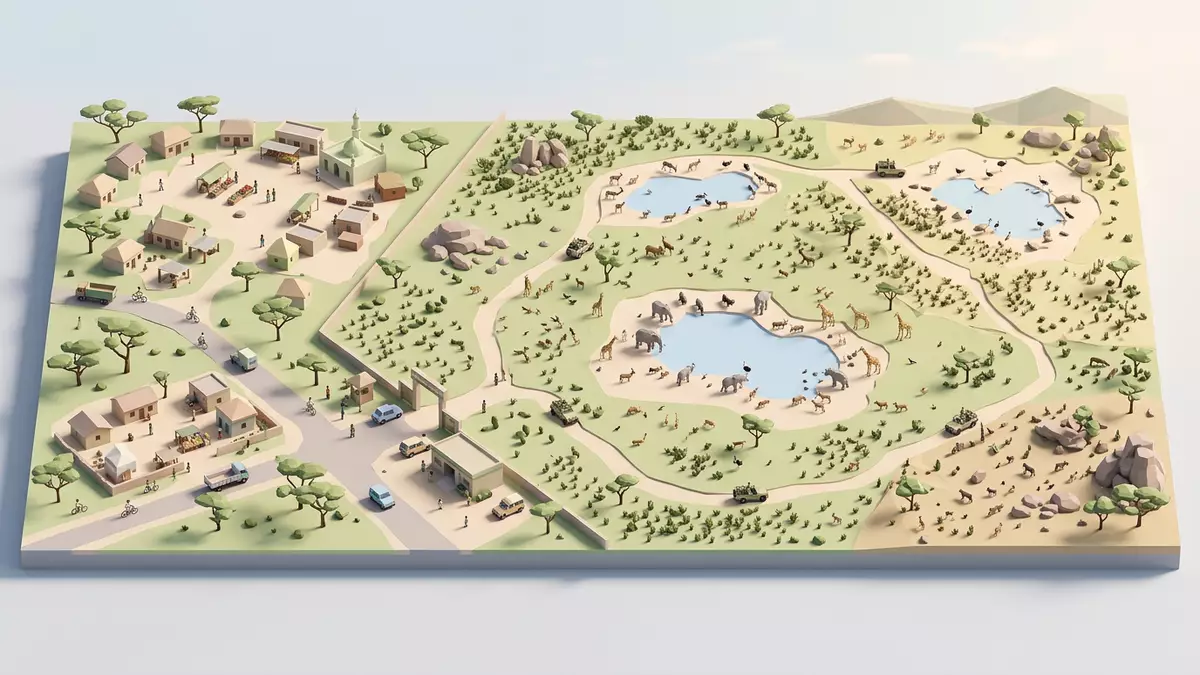
Waza National Park is a broad sweep of Sahelian savanna in Cameroon’s Far North Region, where grasslands, acacia woodland and floodplains stretch east of the town of Waza towards the borders with Nigeria and Chad. Across this semi-arid landscape, seasonal watercourses and low plains create a mosaic of habitats that support elephants, lions, giraffes and a wide array of antelope and birds.
A biosphere reserve in the Chad depression
The park lies in the Chad depression, a vast lowland once associated with the greater Lake Chad basin, in the Department of Logone-et-Chari in Cameroon’s Far North Region.Logone-et-Chari in the Far North Region The terrain sits at elevations around 300 m (984 ft), with broad, open plains broken by sparse trees and shallow depressions that hold water during the short rainy season.elevation around 300 m Much of Waza National Park is described as yaéré savanna, a type of floodplain grassland that becomes saturated during the rains and dries to firm ground for the rest of the year.yaéré savanna floodplain
The protected area covers about 1,700 km² (656 sq mi), giving wide-ranging species space to roam between acacia stands, open grassland and former lakebed soils.around 1,700 km² It is recognised as a UNESCO biosphere reserve, with the Waza Biosphere Reserve nomination recorded in 1979.Waza Biosphere Reserve in 1979 Within the wider biosphere, the national park forms a core zone of strict protection, surrounded by areas where local communities use the land for grazing and agriculture under defined management frameworks.
From hunting reserve to national park
Waza was founded in 1934 as a hunting reserve under colonial administration, reflecting an early attempt to keep a portion of the Sahelian wildlife landscape under formal control.founded in 1934 as a hunting reserve In 1968 it was redesignated as a national park, giving higher legal protection to its elephants, giraffes and antelopes and limiting extraction and settlement within its boundaries.redesignated as a national park in 1968 This shift from reserve to fully protected park marked a change in emphasis from controlled hunting to conservation of entire ecosystems.
The climate is described as Sudano-Sahelian, semi-arid and tropical, with a short rainy season lasting a few months and a longer dry season that dominates much of the year.Sudano-Sahelian, semi-arid climate During the rains, floodplains and shallow pans hold water and support lush grass growth, while in the dry months animals move towards remaining water sources and shade. Over the decades since its creation, Waza National Park has become one of Cameroon’s recognised wildlife reserves, mentioned frequently alongside other northern protected areas as a key site for large mammals.
Wildlife on the Sahelian savanna
Waza National Park is known for its assemblage of large mammals, including African elephants, lions, giraffes and several antelope species such as kob and waterbuck.elephants, lions, giraffes and antelopes Reports also list hyenas, roan antelope, reedbuck and gazelles among the park’s notable residents, illustrating the breadth of Sahelian and Sudanian fauna present within its boundaries.hyenas and roan antelope The park has significance for West African giraffe populations and is referenced in regional conservation discussions for its role in maintaining viable groups of these and other species.
Birdlife is rich, with pelicans, waders and various waterbirds recorded on the wetlands and floodplains.pelicans and spotted waders The combination of seasonal water and open grassland attracts both resident and migratory birds, and international inventories list Waza National Park as a key biodiversity area for freshwater and terrestrial systems.key biodiversity area Visitors travelling through the park encounter wide horizons punctuated by wildlife silhouettes and occasional clusters of trees, with wildlife concentrating more visibly near water during drier periods of the year.
Landscape and access around Waza
The park lies immediately east of the town of Waza, close to Cameroon’s frontiers with Nigeria and Chad; the protected area is described as less than 10 km from both borders.less than 10 km from both borders A paved road runs north from Maroua towards Kousséri, with the park entrance situated near this route on the south-western edge of the Waza plain.park entrance near the Maroua–Kousséri road This makes Waza accessible as part of overland journeys through northern Cameroon, even though the landscapes beyond the main road quickly become remote.
Inside Waza National Park, travel is largely by vehicle along established tracks across flat terrain, with occasional gentle rises. The ground ranges from firm, dry earth during much of the dry season to softer, waterlogged areas during the rains, especially on the yaéré floodplains where water lingers. Dense woodland is relatively limited; instead, scattered acacias and other trees dot the horizon, while open spaces provide broad views across the savanna and wetlands.
Visiting Waza National Park: what travellers from Western Europe should know
- Waza National Park is located in Cameroon’s Far North Region, east of the town of Waza and close to the borders with Nigeria and Chad; access commonly uses the main road between Maroua and Kousséri.
- Travel inside the park generally takes place in vehicles along rough tracks over flat savanna and floodplain terrain; sections of ground can become soft or muddy in the rainy season.
- The official language is French and the currency is the Central African CFA franc.
- Entry requirements depend on your nationality; UK travellers can check the FCDO travel advice at gov.uk/foreign-travel-advice, Irish travellers the Department of Foreign Affairs at ireland.ie.
Searching for Waza National Park on social platforms
These links open searches for Waza National Park on each platform.
Frequently asked questions about Waza National Park
Where is Waza National Park located?
Waza National Park is in Cameroon’s Far North Region, in the Department of Logone-et-Chari, east of the town of Waza and near the borders with Nigeria and Chad.
What can visitors expect during a visit to Waza National Park?
Visitors encounter broad Sahelian savanna with acacia trees, seasonal floodplains and the possibility of seeing large mammals such as elephants, lions, giraffes and antelopes alongside diverse birdlife.
What makes Waza National Park distinctive among Cameroon’s protected areas?
Waza combines its status as a national park and UNESCO biosphere reserve with a location in the Chad depression, offering a large area of yaéré savanna and floodplain habitats for Sahelian wildlife near an international frontier.


