
Westminster Abbey’s layered Gothic history in London
Published on 09/21/2026 at 06:54 | Editorial responsibility: Rafael Müller, Editor-in-Chief AD HOC NEWS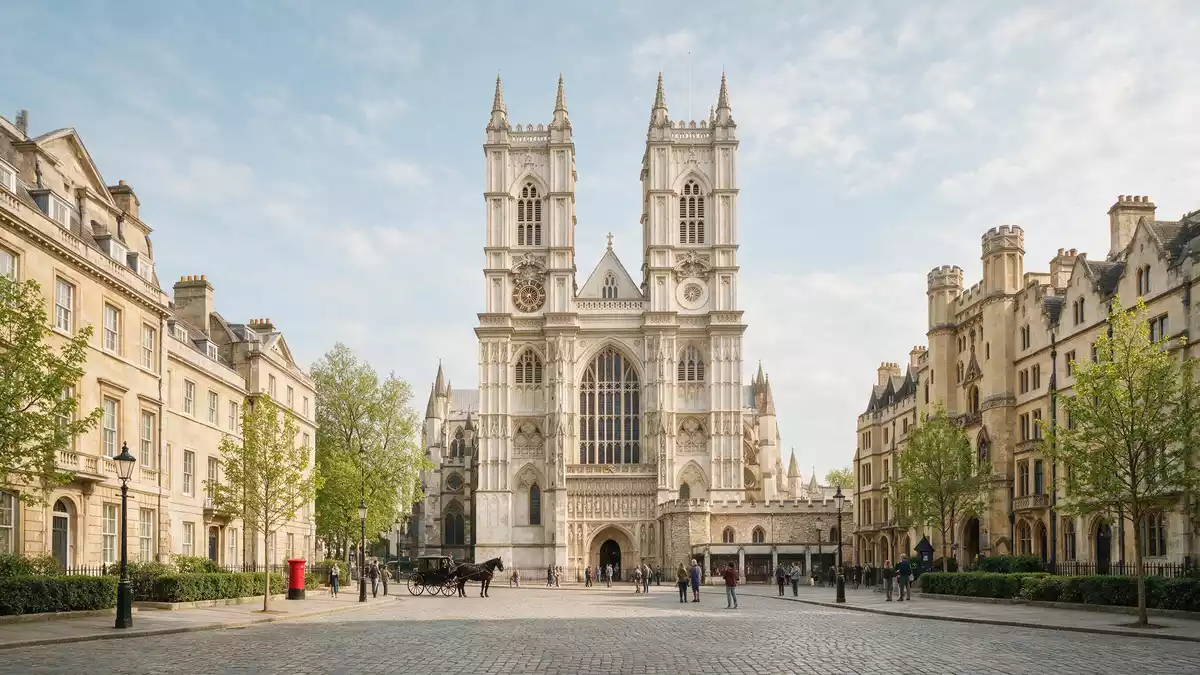
Westminster Abbey in London is a great Gothic church whose stone fabric records centuries of English and British history in one dense cluster of spaces. Rising beside the Palace of Westminster, the Collegiate Church of St Peter has served as a coronation church and royal burial place since the eleventh century, while its architecture reflects a long sequence of rebuilding from Norman foundations to Tudor vaults.
A Gothic church rooted in medieval monarchy
The origins of Westminster Abbey lie in a Benedictine monastery established on Thorney Island beside the River Thames during the early medieval period, when a small community of monks settled here under the influence of figures such as Dunstan of Canterbury.Benedictine monastery on Thorney Island In the eleventh century King Edward the Confessor ordered a new stone church in the Norman style on the site; this building, consecrated in 1065, gave the abbey its first major cruciform layout and became the king’s burial place.Edward the Confessor’s Norman church
In 1245 King Henry III began to replace Edward’s church with the present Gothic structure, pulling down much of the earlier abbey and creating a taller and more luminous interior in the French-influenced style of the period.Gothic rebuilding under Henry III The thirteenth-century work established the apse, choir and transepts, and introduced the pointed arches, slender clustered piers and stone rib vaults that still define the main body of Westminster Abbey.Thirteenth-century Gothic structure Later campaigns extended and completed the nave in the later medieval period and added further chapels, so that the church’s architecture now spans the whole Gothic era from the thirteenth to the early sixteenth century.
Architecture from choir to western towers
Stepping inside Westminster Abbey, the most striking feature is the great height and slender proportions of the Gothic interior achieved under Henry III, with stone vaults rising far above the nave arcades and clerestory windows flooding the church with vertical rhythm.High Gothic nave and interior The main structural fabric is built in finely worked stone, including Reigate stone used for facings, and rests on a traditional cruciform plan where nave, transepts and choir intersect to frame the central crossing.Cruciform plan and Reigate stone
At the east end, Henry VII’s Lady Chapel from the early sixteenth century pushes Gothic ornament to an intricate extreme, with Perpendicular-style architecture and an elaborate vaulted ceiling that has been described as a tour de force of fan vaulting.Henry VII Lady Chapel Moving outside, the western front is framed by two stone towers completed in the eighteenth century to designs associated with Nicholas Hawksmoor, adding an early Gothic Revival note to the medieval church and giving Westminster Abbey its recognisable western silhouette against the London sky.Nicholas Hawksmoor western towers
Coronations, burials and memorials in stone
Westminster Abbey has served as the coronation church for English and later British monarchs since the eleventh century, making it the setting for every coronation from William the Conqueror onwards.Coronation church for monarchs The Coronation Chair, used during these ceremonies, stands within the church near the shrine of Edward the Confessor, underlining the continuity between the medieval king who rebuilt the abbey and the later rulers crowned here.Coronation tradition and royal burials
The abbey is also a major royal burial site, containing the tombs of numerous kings and queens alongside the shrine of Edward the Confessor, and chapels filled with monuments to members of the nobility and leading figures in British public life.Royal tombs and shrine Over time, Westminster Abbey has become a national place of memorial, with areas such as Poets’ Corner commemorating writers and artists and the tomb of the Unknown Warrior honouring the fallen of war, all set within the same Gothic stone fabric that once framed medieval monastic life.
Visiting Westminster Abbey: what travellers from Western Europe should know
- Westminster Abbey stands in the Westminster district of central London, near the River Thames and Parliament Square, with its main entrance on the side facing the Palace of Westminster.
- The interior includes long stone-flagged floors and chapels linked by steps and narrow passages, while the climb to some viewing areas and galleries uses staircases that can feel steep and confined.
- London is in the United Kingdom, where the official language is English and the currency is the pound sterling.
Searching for Westminster Abbey on social platforms
These links open searches for Westminster Abbey on each platform.
Frequently asked questions about Westminster Abbey
Where is Westminster Abbey located in London?
Westminster Abbey is in the Westminster district of central London, close to the River Thames and directly beside the Palace of Westminster and Parliament Square.
What can a visitor expect inside Westminster Abbey?
A visitor encounters a tall Gothic nave, side chapels filled with tombs and memorials, the shrine of Edward the Confessor, and richly carved stonework culminating in Henry VII’s Lady Chapel.
What makes Westminster Abbey distinctive among churches in Britain?
Its long role as the coronation church, its concentration of royal burials and national memorials, and its layered Gothic architecture from the thirteenth to the sixteenth century make it distinctive.


