
White House, a neoclassical landmark on Pennsylvania Avenue
Published on 09/19/2026 at 21:52 | Editorial responsibility: Rafael Müller, Editor-in-Chief AD HOC NEWS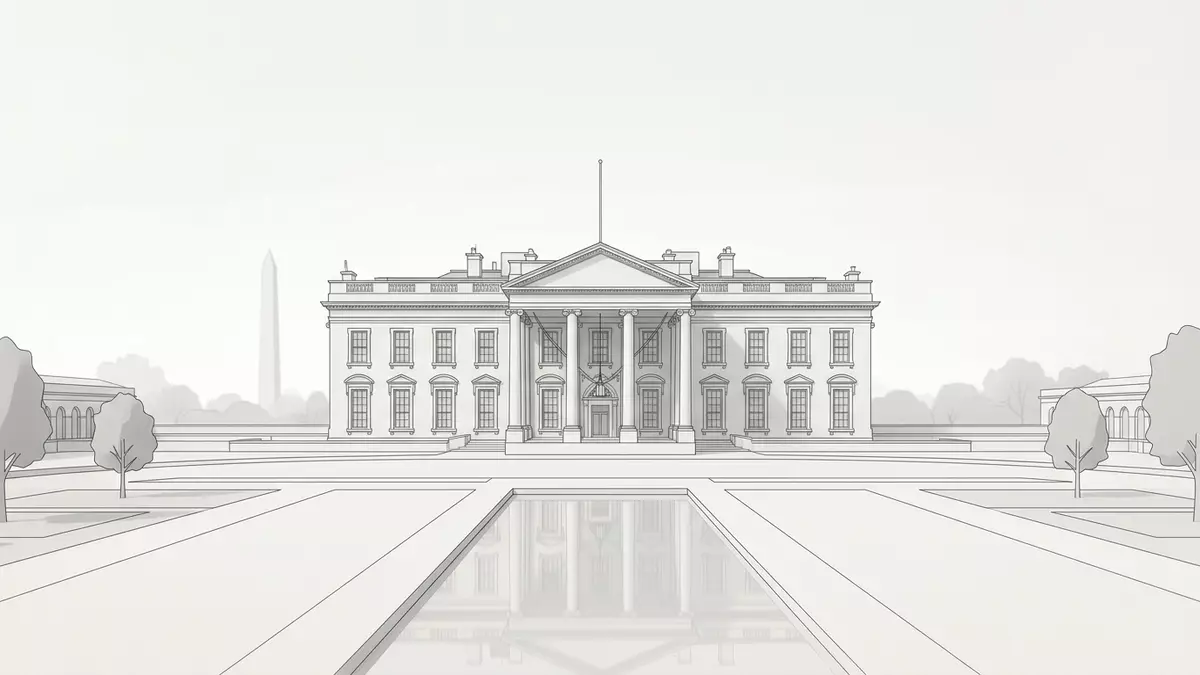
White House in Washington, D.C. is both the official residence and workplace of the President of the United States and a carefully composed neoclassical mansion aligned with Pennsylvania Avenue. Constructed in the 1790s and early 1800s under Irish?born architect James Hoban, it anchors the north?western end of the National Mall as a formal, pale stone façade facing an expanse of lawn and trees.
A sandstone mansion shaped by the early republic
The White House occupies a site chosen in 1791 by George Washington on the north side of what is now President’s Park, fronting Pennsylvania Avenue NW and backing onto gardens that extend towards the National Mall.George Washington selected the site in 1791 From the street, the building reads as a three?storey rectangular mansion in a restrained neoclassical style, its elevations organised by evenly spaced windows and a central portico.
Construction began in 1792 with the laying of a cornerstone, and the main phase of building ran through to 1800, when President John Adams and Abigail Adams moved into a residence that was still being completed.Construction started in 1792 and was completed in 1800 Hoban’s design drew on contemporary Georgian and Palladian models, with Aquia Creek sandstone masonry that was later painted white, giving the house the colour that became its enduring name.Aquia Creek sandstone coated with whitewash
Porticos, wings and the evolving presidential complex
Although the original mansion formed a compact block, the White House complex expanded in the nineteenth and twentieth centuries into the familiar composition of residence, porticos and detached wings. The semicircular South Portico, looking out across a broad lawn and beyond towards the National Mall, dates from the 1820s, while the North Portico facing Pennsylvania Avenue followed later that decade.South and North Porticos were added in the 1820s These columned porches give each main elevation a ceremonially framed entrance that visitors recognise from televised arrivals and departures.
In the early twentieth century the complex changed again with the addition of the West Wing and East Wing, extending the working parts of the presidency beyond the original house.West Wing and East Wing additions in the early twentieth century The Oval Office sits within the West Wing, while the East Wing links to facilities such as the visitors’ entrance and social rooms. Between the wings and the central residence, landscaped walkways and service courts connect formal spaces with offices, creating a layered sequence from ceremonial rooms to working corridors.
Fire, reconstruction and structural renewal
The White House has not remained unchanged since Hoban’s first design. During the War of 1812, British forces set fire to the building, damaging the interior and charring much of the exterior stonework, after which rebuilding began under Hoban’s supervision and the house was reoccupied in 1817.The British set fire to the White House in 1814 Later administrations oversaw further interventions, including the addition of colonnades concealing service structures and internal refurbishments that matched prevailing tastes.
By the mid?twentieth century, structural faults led to a thorough reconstruction of the interior fabric under President Harry S. Truman, retaining the outer walls while rebuilding floors, ceilings and service systems.Truman oversaw a major structural reconstruction in the mid twentieth century The result is a layered building in which eighteenth? and nineteenth?century exteriors wrap twentieth?century structural and mechanical engineering, all still organised around the state rooms and corridors that visitors see in official photographs.
Visiting White House: what travellers from Western Europe should know
- White House stands at 1600 Pennsylvania Avenue NW in central Washington, D.C., west of the United States Capitol and close to the northern edge of the National Mall.
- The building fronts President’s Park, with broad lawns and tree?lined paths around the mansion; public viewpoints across the railings and along the surrounding streets involve level walking on paved surfaces.
- To the south, the grounds descend towards the National Mall and the Washington Monument, while nearby streets carry frequent traffic and security barriers that shape pedestrian routes through the area.
- The official language is English and the currency is the U.S. dollar.
- Entry requirements depend on your nationality; UK travellers can check the FCDO travel advice at gov.uk/foreign-travel-advice, Irish travellers the Department of Foreign Affairs at ireland.ie.
Searching for White House on social platforms
These links open searches for White House on each platform.
Frequently asked questions about White House
Where is White House located in Washington, D.C.?
White House stands at 1600 Pennsylvania Avenue NW, at the edge of President’s Park in central Washington, D.C., near the north?western end of the National Mall.
What can visitors expect around the White House?
Visitors encounter formal lawns, tree?lined paths and views of the neoclassical mansion across security railings, with surrounding streets forming part of a wider ensemble of monuments and government buildings.
What makes White House distinctive as a building?
The combination of James Hoban’s late eighteenth?century sandstone mansion, its columned North and South Porticos, and the later West and East Wings creates a layered presidential complex that is both residence and workplace.


